


Contents: Removal ⬇ Installation ⬇
Note: When removing the cylinder head, the engine must be cold. Do not remove the head from a hot engine. When installing, use new mounting bolts and a new cylinder head gasket, and sealant will be required when installing the camshaft housing. The tightening torques specified apply only to the latest bolts available from Opel. Earlier types of bolts must be tightened to a different torque. Consult your supplier.
Removal
1. Disconnect the negative cable from the battery.
2. Drain the cooling system as described in Section 3.
3. Disconnect the exhaust outlet pipe from the manifold, following the Section 4C.
4. The cylinder head can be removed together with the manifolds or the manifolds can be separated from the cylinder head before removing it, refer to the relevant Chapters of Sections for this 4A, 4B or 4C. If no work is to be done on the intake manifold, it can be unscrewed from the head and secured, thus eliminating the need to disconnect the corresponding hoses, pipes and electrical wiring.
5. If the cylinder head must be removed together with the manifolds, disconnect all hoses, pipes and wiring from the intake manifold and associated components, referring to Sections 4A or 4B. On carbureted models, disconnect the warm air hose from the shroud on the exhaust manifold. Loosen the alternator fasteners as described in Section 5, then unbolt the upper alternator fastener from the intake manifold.
6. If the intake manifold is to be left in the engine compartment, proceed as described below, otherwise proceed to step 15.
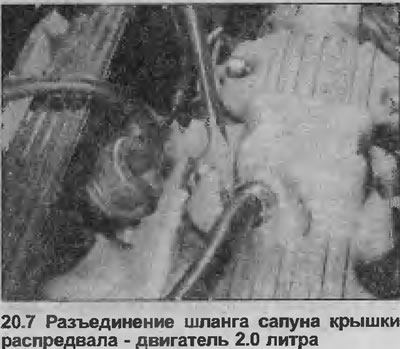
7. Disconnect the air cleaner line from the heater block on the carburetor or throttle body, or directly from the throttle body (depending on the model), disconnect the breather hose on the camshaft cover that goes to the carburetor or throttle body (depending on the model) (see illustration).
8. On C16NZ2, 1.8 and 2.0 liter models, disconnect the smaller coolant hose from the top of the thermostat housing.
9. On 1.6 liter models (except C16NZ2), disconnect the breather hose (which goes from the camshaft cover to the intake manifold) from the camshaft cover.
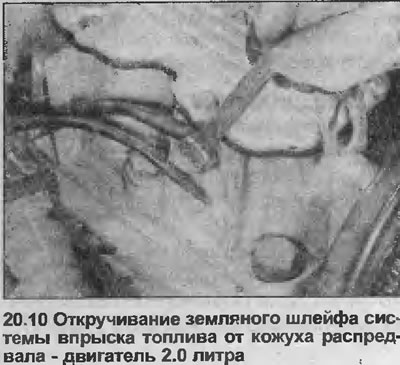
10. On fuel injected models, unscrew the two ground cables from the camshaft housing (see illustration).
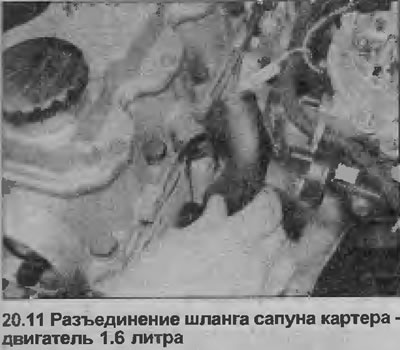
11. On 1.4 and 1.6 liter models (except C16NZ2), disconnect the hose that connects the crankcase breather pipe to the rear of the camshaft housing (see illustration).
12. Loosen the generator fasteners, following the Section 5, then unscrew the upper generator mount from the intake manifold.
13. Finally, check that all hoses, pipes and wires are disconnected, then unscrew the mounting nuts, marking the location of the engine lifting bracket, lift the intake manifold off the cylinder head. Make sure the manifold is properly supported, also take care not to deform the hoses, pipes, wires, etc. that remain connected.
14. Remove the manifold gasket from the cylinder head.
15. If necessary, remove the exhaust manifold as described in Section 4C.
16. Remove the timing belt and camshaft sprocket as described in Chapter 11.
17. Remove the two bolts securing the upper rear drive belt cover to the camshaft housing.
18. Disconnect the high tension wires from the spark plugs and ignition coil, marking their location to facilitate installation, and remove the distributor cover, using the Section 5. Where applicable, disconnect the distributor wiring.
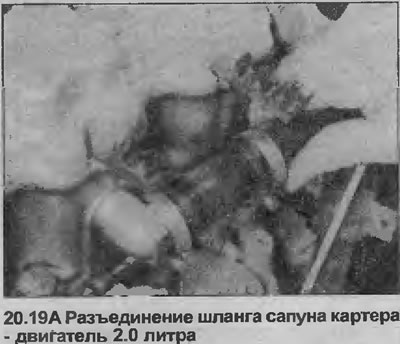
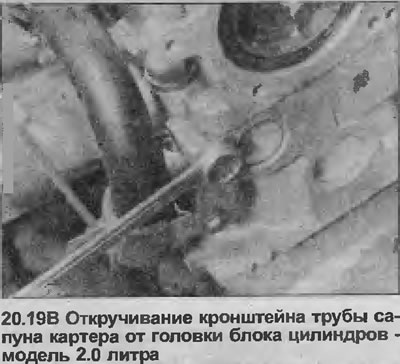
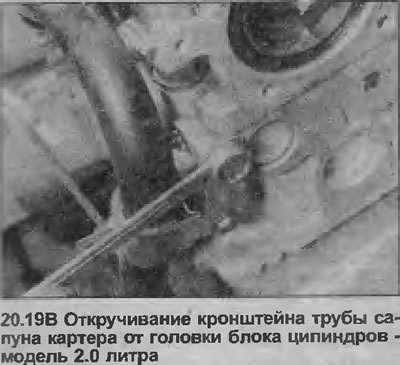
19. Disconnect the hose from the fitting that connects the crankcase breather pipe to the camshaft housing. Remove the bolt that secures the crankcase breather pipe bracket to the end of the cylinder head (see illustrations).
20. Disconnect the coolant hoses from the thermostat housing.
21. On carbureted models, disconnect the fuel supply hoses from the fuel lift pump. Plug the open ends of the hoses to prevent fuel leakage and dirt ingress
22. Finally, check that all relevant hoses, pipes, wires, etc. are disconnected.
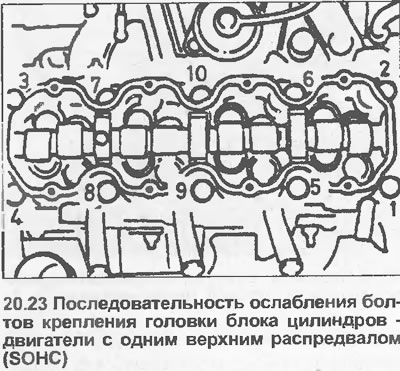
23. Working from the outside in a spiral as shown (see illustration), loosen all cylinder head mounting bolts by a quarter turn. Then loosen all bolts by half a turn, and finally loosen and remove the bolts completely. Remove the washers.
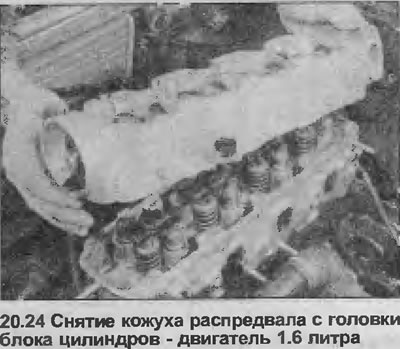
24. Lift the camshaft housing from the cylinder head (see illustration). If necessary, tap the housing lightly with a mallet to free it from the cylinder head. Note that the camshaft housing is located on pins.
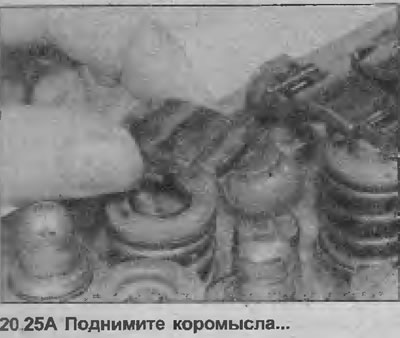
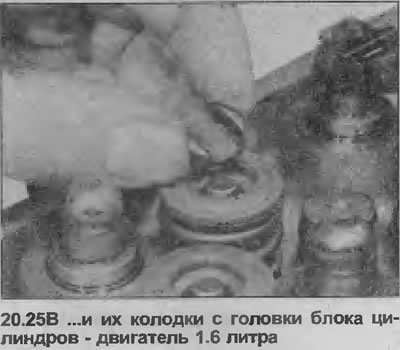
25. Lift the rocker arms and their pads from the head, store them in the order of removal so as not to mix them up during installation (see illustrations).
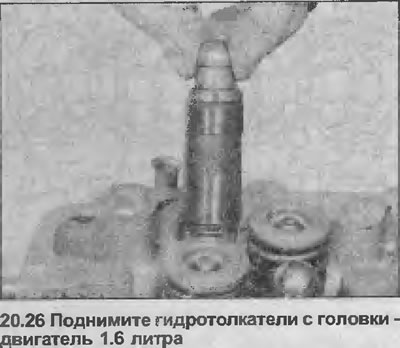
26. Lift the hydraulic valve lifters from the cylinder head and fold them standing in an oil bath (see illustration). Make sure the oil depth is sufficient to completely cover the valve lifters, and hold the lifters so that they can be installed in their places.
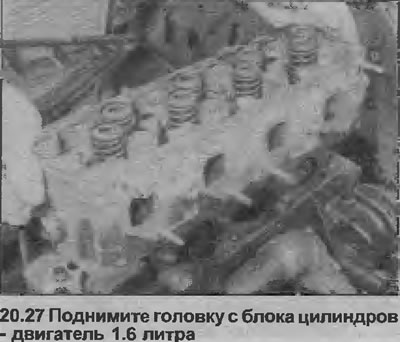
27. Lift the head from the cylinder block (see illustration). If necessary, tap the cylinder head lightly with a mallet to loosen it from the block. Note that the cylinder head is supported by pins.
28. Remove and discard the head gasket.
Installation
29. Clean the mating surfaces of the cylinder head and block, the mating surfaces of the camshaft housing and the cylinder head. Do not damage the machined surfaces of the head and camshaft housing. Cover the cooling passages and other openings with tape or rags to prevent the entry of dirt and carbon deposits. Remove oil from all bolt holes; if oil remains in the holes, the hydraulic pressure may cause the block to crack when the bolts are tightened.
30. If required, the cylinder head can be disassembled and inspected as described in Chapters 22 and 23, and the camshaft housing can be disassembled as described in Chapter 18.
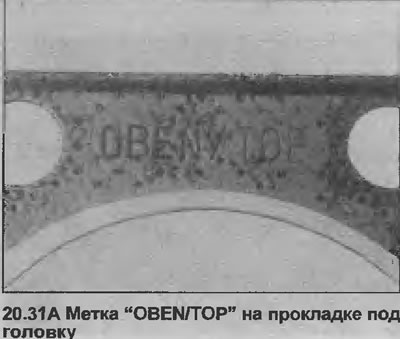
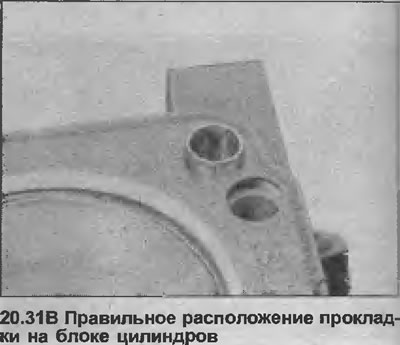
31. Start the installation as follows: place the new gasket on the block so that the word "OBEN" or "TOP" can be read from the top (see illustrations).
32. After thoroughly cleaning the mating surfaces, position the head on the cylinder block so that the pins enter the corresponding holes.
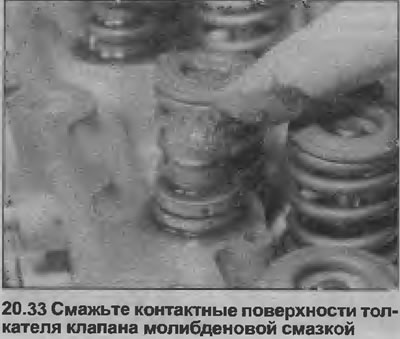
33. Install the hydraulic valve lifters, axial pressure pads and rocker arms on the cylinder head (to the places where they stood before removal). Generously lubricate the valve lifter seats with oil, and if new lifters are being installed, dip each one in a container of engine oil and squeeze it by hand several times to fill it with oil. Lubricate the contact surfaces of the lifters, thrust pads and rocker arms with molybdenum grease (see illustration).
34. Temporarily install the crankshaft sprocket, check that the timing marks remain in the same positions they were in before removing the drive belt (see Chapter 11).
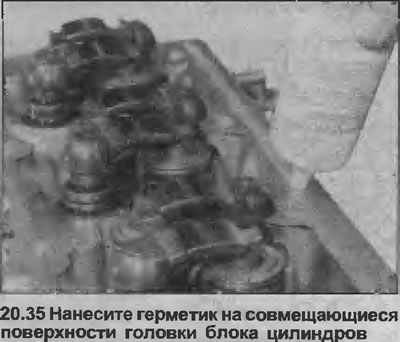
35. Apply sealant (Opel part number 90094714 or equivalent) to the mating surfaces of the cylinder head (see illustration), then install the camshaft housing onto the head.
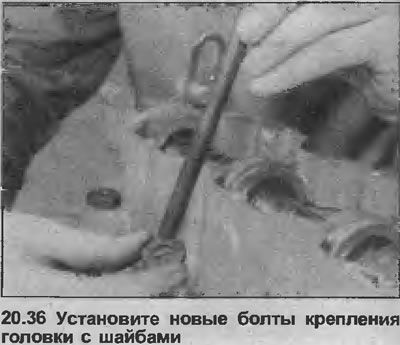
36. Install new head bolts, be sure to install washers under the head, tighten the bolts as much as possible by hand (see illustration).
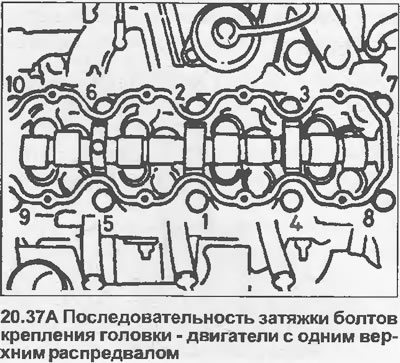
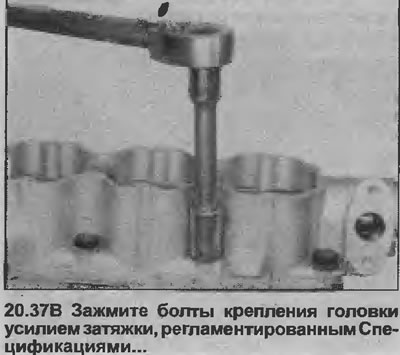
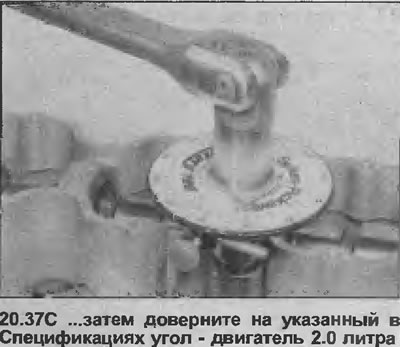
37. Tighten the bolts in a spiral pattern, starting from the inside out, as shown (see illustration). Tighten the bolts in four stages - that is, tighten all the bolts to Stage 1 torque, then tighten all the bolts to Stage 2 torque, and so on (see illustrations).
(Material copied from this portal: www.opelbook.ru)
38. Further installation is carried out in the reverse order of removal. Please note the following.
39. Make sure that the high tension wires are installed on their corresponding cylinders.
40. Install the camshaft sprocket and toothed drive belt, tension the belt as described in Chapter 11.
41. Where necessary, install the manifolds to the cylinder head as described in Section 4A, 4B or 4C, use new gaskets.
42. Reconnect the exhaust outlet pipe to the manifold using a new gasket. To do this, follow the Section 4C, if necessary.
43. Install the upper generator mount, then adjust the generator drive belt tension as described in Section 5.
44. Fill the cooling system as described in Section 3.
45. Finally, check that all relevant hoses, pipes, wires, etc. are connected.
46. Once the engine is started, check for signs of leaks
47. Once the engine has warmed up to normal operating temperature, check and, if necessary, adjust the idle speed (if possible) and a mixture (if possible), as described in Sections 4A or 4B.
Visitor comments