
OpelBook.ru
Cars AvtoVAZ Cars Mitsubishi Cars BMW Cars Mercedes Cars Nissan Cars Toyota Cars Chevrolet
English Русский
Български
Беларускі
Український
Српски
Hrvatski
Română
Polski
Slovenský
Magyar
 |  Sitemap  |  Contacts  |    


Main Astra Corsa Insignia Kadett Omega Vectra Zafira Others Articles
Vectra A (1988-1995, petrol) Vectra A (1988-1995) Vectra B (1995-2002, petrol) Vectra B (1995-2002) Vectra C (2002-2008)
  • Main
  • Vectra
  • Vectra A
  • Power unit
  • SOHC engine
  • Cylinder head — inspection and restoration

Cylinder head — inspection and restoration (Opel Vectra A)

            0

Contents: Inspection ⬇ Recovery ⬇
Note: Consult your dealer for advice before resurfacing valves or lapping valve seats. This is to strengthen the valve seats for use with unleaded gasoline.


Warning: Exhaust valves installed on models with 20 XEJ and C20XE engines (with two overhead camshafts), contain sodium to improve their heat transfer. Sodium is a highly reactive metal that can ignite or explode when in contact with water (or with water vapor in the air).


Inspection


1. Remember that the cylinder head is cast from a soft alloy and can be easily damaged by a scraper or wire brush when cleaning off carbon deposits. The valve stems and guides also need to be cleaned of carbon deposits. Flush the combustion chambers and passages with kerosene and clean the surface of the cylinder head.

2. If the engine is installed in the car, clean the top of the pistons and cylinder walls. If the pistons have not been removed from the block, care must be taken to ensure that carbon particles do not fall on the cylinder walls. They can scratch them or cause damage to the pistons and rings. To ensure that this does not happen, first turn the crankshaft so that two of the pistons are on top, they are annoying. Cover the two cylinder bores with a cloth or paper and duct tape. The cooling passages should also be covered with small pieces of duct tape, otherwise carbon particles that fall into the cooling system can damage the water pump.

3. Apply grease to the gap between the cylinder walls and the pistons. Using a blunt scraper, carefully scrape off any carbon deposits from the piston crown, being careful not to scratch the aluminum walls. Also scrape off any carbon deposits from the cylinder wall lip. Once all carbon deposits have been removed, carefully scrape off the grease, which will be contaminated with carbon particles. The piston crown can be polished to prevent carbon deposits from forming. Remove the cloth or tape from the other two cylinders, and rotate the crankshaft so that these two pistons are now positioned at the top. Place the cloth or tape on the open cylinders, which are now free of carbon deposits, and continue as described earlier.


4. Check the condition of the valve heads, paying special attention to the exhaust valves. Also inspect the valve seat surfaces. If there is slight pitting on the valve and seat, it can be removed by grinding the seat and valve with a special paste.

5. In case of severe pitting on the valve seats, it is necessary to grind them down and install new valves. It is best to contact your local dealer or machine shop to do this job. In practice, it is very rare for the seats to wear out significantly. Most often, it is the valves that are subject to wear, so it is easier to buy a new set of valves and grind them to the seats.

Recovery


6. To grind the valves, apply a coarse paste to the contact surface of the valve seat, install a grinding tool with a suction cup on the valve head. Using semi-rotary movements, grind the valve head, lapping it to the seat, occasionally lifting the valve to redistribute the grinding paste. When a matte, smooth surface appears on the seat and on the valve itself, wipe off the paste and repeat the same process with fine paste. If you place a weak spring under the valve head, this will greatly facilitate the work. When the surfaces become an even light gray color, grinding can be completed. Carefully clean the seats and valves from grinding paste, do not leave paste in the channels or in the guide bushings. Wipe the valves and seats with a cloth soaked in kerosene, then with a clean cloth and finally blow them with compressed air.

7. Check that the valve springs are not damaged. If any of them are broken, all springs should be replaced. Check the height of the springs in a free uncompressed state compared to new ones. If the length of some springs is less than new ones, replace all springs. The metal of the springs will fatigue over time and it is recommended to replace them even if they look serviceable.


8. The cylinder head must be checked for deformation by placing it on a piece of glass or using the edge of a ruler and a feeler gauge. If you are in doubt about the condition or if the surface of the block has traces of corrosion, it must be re-ground.

9. On models with 1.8 and 2.0 liter engines, always replace the O-ring between the cylinder head and the thermostat housing (see illustration). From Chapters 21 it can be seen that replacing the O-ring with the head installed requires a significant amount of work.
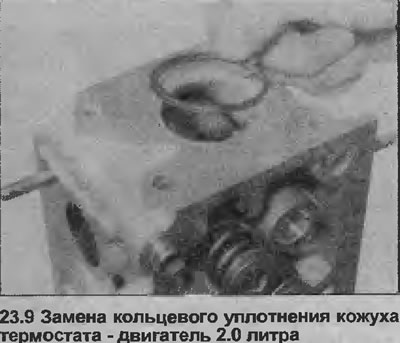
9. On models with 1.8 and 2.0 liter engines, always replace the O-ring between the cylinder head…


Original posted on the website Opelbook.ru

10. If the cylinder head oil pressure regulating valve needs to be replaced, it can be accessed through the round plug that covers the end of the valve (see illustration). After removing the old valve, install the new one and screw the plug back in. Due to the complexity of this operation, it is probably best to have the valve replaced by an Opel dealer.
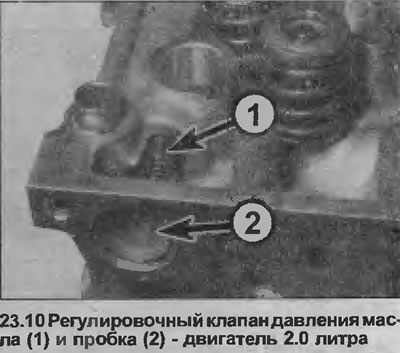
10. If the cylinder head oil pressure regulating valve needs to be replaced, it can be accessed…


This article is available at russian, bulgarian, belarusian, ukrainian, serbian, croatian, romanian, polish, slovak, hungarian
Checking the article: Chernov Alexander

Share information:

Previous articles
Opel Vectra A: SOHC engine
Next articles

Cylinder head — disassembly and assembly
Cylinder head — removal and installation (engine removed)
Cylinder head — removal and installation (engine in a car)
Camshafts, repair dimensions for models C16NZ2, 1.8 and 2.0 liters — general description
Camshaft housing and camshaft — disassembly, inspection and assembly
Camshaft housing and camshaft — general description
Hydraulic valve lifters — inspection
Flywheel — removal, inspection and installation
Drive Disc (Automatic Transmission) — Removal and Installation
Front Crankshaft Oil Seal — Replacement
Rear Crankshaft Oil Seal — Replacement
Pallet — removal and installation


See similar ones from other Opel car manuals:
▶ Cylinder head — removal and installation Opel Astra F (1991-1998, petrol)
▶ Removal and installation the cylinder head Opel Corsa B (1993-2000)
▶ Cylinder head cover Opel Insignia A (2008-2017)
▶ Cylinder head specifications Opel Kadett E (1984-1995)
▶ Cylinder head — removal and installation with engine in car Opel Omega A (1986-1993)
Link to this page in different formats

Visitor comments


No comments yet


How much will 21 + 17 =


Vectra C (2002-2008) 
  • General information
  • User manual
  • Vehicle device
  • Maintenance
  • Troubleshooting
  • Power unit
  • Engine repair
  • Cooling system
  • Power and control system
  • Engine electrics
  • Transmission
  • Clutch
  • Car gearbox
  • Drive shafts
  • Chassis
  • Car suspension
  • Steering
  • Brake system
  • Body
  • Exterior
  • Interior
  • Doors, locks and windows
  • Heating and ventilation
  • Electrical equipment
  • Equipment and devices
  • Headlights and lighting
  • Electrical circuits
Vectra B (1995-2002) 
  • General information
  • User manual
  • Weekly checks
  • Maintenance (gasoline)
  • Maintenance (diesel)
  • Troubleshooting
  • Power unit
  • SOHC gasoline engine
  • DOHC petrol engine
  • Diesel engine 1.7 liter
  • Diesel engine 2.0 liters
  • Engine repair
  • Cooling system
  • Fuel system (gasoline)
  • Fuel system (diesel)
  • Charging system
  • Launch system
  • Ignition and preheat
  • Transmission
  • Clutch
  • Mechanical gearbox
  • Automatic gearbox
  • Drive shafts
  • Chassis
  • Brake system
  • Wheel suspension
  • Steering
  • Body
  • Exterior
  • Interior
  • Doors and windows
  • Heating and ventilation
  • Electrical equipment
  • Equipment and devices
  • Electrical circuits
Vectra B (1995-2002, petrol) 
  • General information
  • Maintenance
  • Help with malfunctions
  • Power unit
  • Engine repair
  • Exhaust system
  • Cooling system
  • Fuel system
  • Multec injection system
  • Four point injection
  • Transmission
  • Clutch
  • Gearbox and drive
  • Chassis
  • Wheel suspension
  • Steering
  • Brake system
  • Wheels and tires
  • Body
  • Exterior
  • Interior
  • Electrical equipment
  • Fuses and electronics
  • Power devices
  • Ignition system
  • Lighting and signaling
  • Equipment and devices
  • Heating and ventilation
  • Electrical circuits
Vectra A (1988-1995) 
  • Power unit
  • Engine repair
  • Ignition system
  • Lubrication system
  • Cooling system
  • Injection system
  • Fuel system (carburetor)
  • Fuel system (diesel)
  • Exhaust system
  • Transmission
  • Clutch
  • Car gearbox
  • Chassis
  • Front suspension
  • Rear suspension
  • Steering
  • Brake system
  • Wheels and tires
  • Body
  • Exterior
  • Interior
  • Electrical equipment
  • Electrical circuits
Vectra A (1988-1995, petrol) 
  • General information
  • User manual
  • Maintenance
  • Power unit
  • SOHC engine
  • DOHC engine
  • Cooling and ventilation
  • Fuel system (carburetor)
  • Fuel system (injector)
  • Exhaust converter
  • Transmission
  • Clutch
  • Mechanical gearbox
  • Automatic gearbox
  • Drive shafts
  • Chassis
  • Brake system
  • Car suspension
  • Steering
  • Body
  • Body elements
  • Electrical equipment
  • Power devices
  • Equipment and devices
  • Electrical circuits
OpelBook.ru © 2017–2026 · Mobile version · · Sitemap: EN BG BY UA RS HR RO PL SK HU · Feedback · Site search
Astra F, petrol · Astra G, petrol · Astra G · Astra H · Astra J, petrol · Corsa B · Corsa C, petrol · Corsa C · Insignia A · Kadett D · Kadett E · Omega A · Omega B · Omega B2 · Vectra A, petrol · Vectra A · Vectra B, petrol · Vectra B · Vectra C · Zafira A, petrol · Frontera A, petrol · Frontera B · Ascona C · Vivaro A ·
We want your visit to be comfortable 🤝! We use cookies 🍪 to make that happen.