
OpelBook.ru
Cars AvtoVAZ Cars Mitsubishi Cars BMW Cars Mercedes Cars Nissan Cars Toyota Cars Chevrolet
English Русский
Български
Беларускі
Український
Српски
Hrvatski
Română
Polski
Slovenský
Magyar
 |  Sitemap  |  Contacts  |    


Main Astra Corsa Insignia Kadett Omega Vectra Zafira Others Articles
Vectra A (1988-1995, petrol) Vectra A (1988-1995) Vectra B (1995-2002, petrol) Vectra B (1995-2002) Vectra C (2002-2008)
  • Main
  • Vectra
  • Vectra A
  • Power unit
  • SOHC engine
  • Pistons and connecting rods — removal and installation

Pistons and connecting rods — removal and installation (Opel Vectra A)

            0

Contents: Removal ⬇ Installation ⬇
Note: Use new connecting rod cap bolts when installing.


Removal


1. Remove the cylinder head as described above in Chapter 20.

2. Remove the oil pan, oil pump inlet pipe and oil pan deflector (where it is applied), as described in Chapter 29.

3. If the connecting rods and caps do not have marks indicating their position in the cylinder block (that is, the cylinder number), make marks yourself with a punch. Note the orientation of the marks relative to the engine (see illustration).
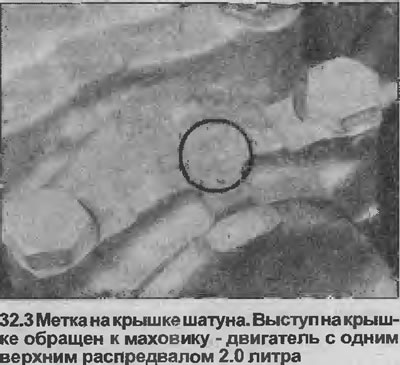
3. If the connecting rods and caps do not have marks indicating their position in the cylinder…


4. Unscrew the bolts of the first connecting rod cap, remove the cap. If the bearings are to be reused, tape the cap and the bearing together.

5. Check if there is a protrusion formed by wear on the top of the hole. If there is a protrusion, carefully remove it with a special tool, otherwise, after installing the piston, the piston rings may hit this wear ridge.

6. Using a wooden hammer handle, push the piston/connecting rod assembly up out of the cylinder bore. Remove the bearing shell and tape it to the connecting rod if reusing.

(Material was taken from a resource: OPELBOOK.ru)


7. Remove the remaining three assemblies in the same manner. Rotate the crankshaft as necessary to access the connecting rod small end mounting bolts.

8. The piston can be separated from the connecting rod by removing the retaining rings that secure the floating piston pin. Note the orientation of the piston and connecting rod before separating, making marks if necessary. Reassembly is in the reverse order, but ensure that the piston and connecting rod are correctly oriented.

9. Pistons and connecting rods can be checked for signs of wear and damage as described in Chapter 33, and the bearings can be checked as described in Chapter 35.

Installation


10. Lay out the piston/connecting rod assemblies in their correct order, along with the bearing shells, so everything is ready for installation in the cylinder block.

11. Check that the bearing seating areas are absolutely clean, then install the bearings in their places.

12. Wipe and lubricate the cylinder bores. Generously lubricate the piston rings, check that the ring cut gaps are located as described in Chapter 33.

13. Install the piston ring crimping tool into the piston grooves on the first assembly to be installed.

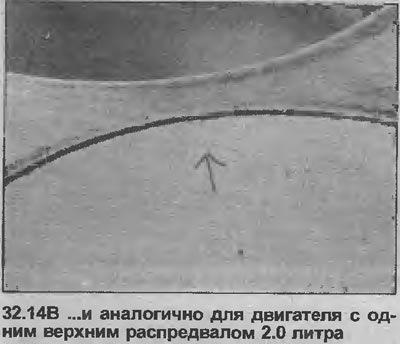
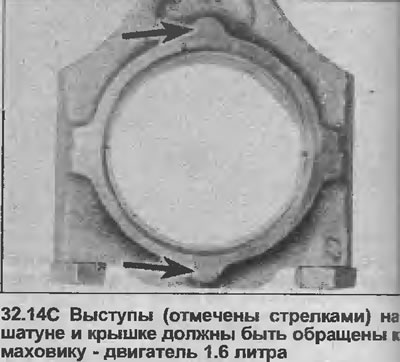
14. Insert the connecting rod with the piston through the top of the block into the cylinder bore so that the base of the crimping tool is on the block. Check that the marks on the connecting rod are oriented as noted before removal. Note that the arrow or notch, depending on the model, on the piston head should face the toothed drive belt, and the projections on the connecting rods should be turned towards the flywheel (see illustrations).
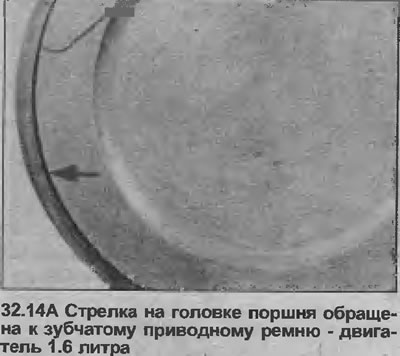
14. Insert the connecting rod with the piston through the top of the block into the cylinder bore…


14. Insert the connecting rod with the piston through the top of the block into the cylinder bore…


14. Insert the connecting rod with the piston through the top of the block into the cylinder bore…


15. Using a wooden hammer handle, tap the piston head to drive the assembly into the cylinder bore, simultaneously releasing the compressor (see illustration).
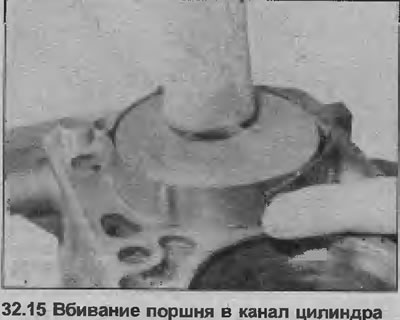
15. Using a wooden hammer handle, tap the piston head to drive the assembly into the cylinder bore,…


16. Lubricate the appropriate crankshaft journal, then position the connecting rod small end on the journal. Make sure that the bearing does not fall out of the connecting rod.


17. Install the connecting rod cap, orienting it as noted before removal (see illustration). Note that the protrusion should face the flywheel.
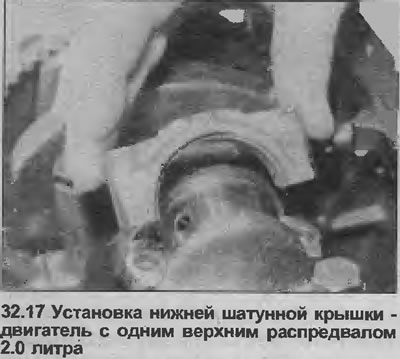
17. Install the connecting rod cap, orienting it as noted before removal (see illustration). Note…


18. Install and tighten the new connecting rod cap bolts in two stages to the specified tightening torque Specifications (see illustrations).
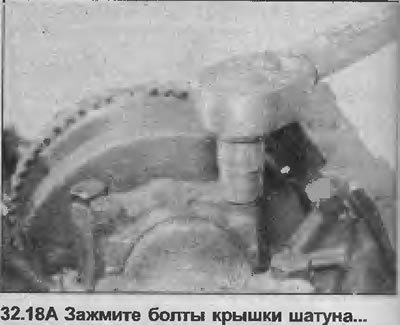
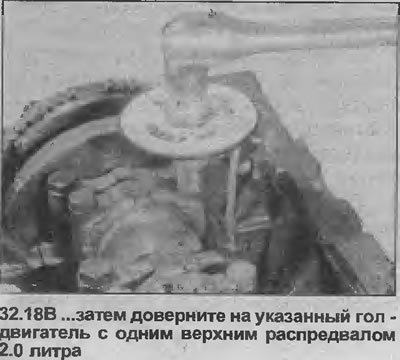
18. Install and tighten the new connecting rod cap bolts in two stages to the specified tightening…


18. Install and tighten the new connecting rod cap bolts in two stages to the specified tightening…


19. Repeat the procedure with the remaining three assemblies.


20. Install the sump deflector (where it is applied), the oil pump inlet pipe and the sump as described in Chapter 29.

21. Install the cylinder head as described earlier in this Chapter 20.


This article is available at russian, bulgarian, belarusian, ukrainian, serbian, croatian, romanian, polish, slovak, hungarian
Checking the article: Chernov Alexander

Share information:

Previous articles
Opel Vectra A: SOHC engine
Next articles

Oil pump — disassembly, inspection and assembly
Oil pump — removal and installation
Pallet — removal and installation
Rear Crankshaft Oil Seal — Replacement
Front Crankshaft Oil Seal — Replacement
Drive Disc (Automatic Transmission) — Removal and Installation
Pistons and connecting rods — inspection and maintenance
Crankshaft and bearings — removal and installation
Crankshaft and bearings — inspection
Cylinder Block and Channels — Inspection and Maintenance
Inspection and Maintenance — General Description
Preparing for launch after major repairs


See similar ones from other Opel car manuals:
▶ Pistons and connecting rods — removal Opel Astra G (1998-2004, petrol)
▶ Replacing pistons with connecting rods Opel Insignia A (2008-2017)
▶ Installing pistons with connecting rods into cylinders Opel Kadett E (1984-1995)
▶ Pistons and connecting rods Opel Omega B (1993-1999)
▶ Pistons and connecting rods — removal, inspection and… Opel Frontera A (1991-1998, petrol)
Link to this page in different formats

Visitor comments


No comments yet


How much will 25 + 20 =


Vectra C (2002-2008) 
  • General information
  • User manual
  • Vehicle device
  • Maintenance
  • Troubleshooting
  • Power unit
  • Engine repair
  • Cooling system
  • Power and control system
  • Engine electrics
  • Transmission
  • Clutch
  • Car gearbox
  • Drive shafts
  • Chassis
  • Car suspension
  • Steering
  • Brake system
  • Body
  • Exterior
  • Interior
  • Doors, locks and windows
  • Heating and ventilation
  • Electrical equipment
  • Equipment and devices
  • Headlights and lighting
  • Electrical circuits
Vectra B (1995-2002) 
  • General information
  • User manual
  • Weekly checks
  • Maintenance (gasoline)
  • Maintenance (diesel)
  • Troubleshooting
  • Power unit
  • SOHC gasoline engine
  • DOHC petrol engine
  • Diesel engine 1.7 liter
  • Diesel engine 2.0 liters
  • Engine repair
  • Cooling system
  • Fuel system (gasoline)
  • Fuel system (diesel)
  • Charging system
  • Launch system
  • Ignition and preheat
  • Transmission
  • Clutch
  • Mechanical gearbox
  • Automatic gearbox
  • Drive shafts
  • Chassis
  • Brake system
  • Wheel suspension
  • Steering
  • Body
  • Exterior
  • Interior
  • Doors and windows
  • Heating and ventilation
  • Electrical equipment
  • Equipment and devices
  • Electrical circuits
Vectra B (1995-2002, petrol) 
  • General information
  • Maintenance
  • Help with malfunctions
  • Power unit
  • Engine repair
  • Exhaust system
  • Cooling system
  • Fuel system
  • Multec injection system
  • Four point injection
  • Transmission
  • Clutch
  • Gearbox and drive
  • Chassis
  • Wheel suspension
  • Steering
  • Brake system
  • Wheels and tires
  • Body
  • Exterior
  • Interior
  • Electrical equipment
  • Fuses and electronics
  • Power devices
  • Ignition system
  • Lighting and signaling
  • Equipment and devices
  • Heating and ventilation
  • Electrical circuits
Vectra A (1988-1995) 
  • Power unit
  • Engine repair
  • Ignition system
  • Lubrication system
  • Cooling system
  • Injection system
  • Fuel system (carburetor)
  • Fuel system (diesel)
  • Exhaust system
  • Transmission
  • Clutch
  • Car gearbox
  • Chassis
  • Front suspension
  • Rear suspension
  • Steering
  • Brake system
  • Wheels and tires
  • Body
  • Exterior
  • Interior
  • Electrical equipment
  • Electrical circuits
Vectra A (1988-1995, petrol) 
  • General information
  • User manual
  • Maintenance
  • Power unit
  • SOHC engine
  • DOHC engine
  • Cooling and ventilation
  • Fuel system (carburetor)
  • Fuel system (injector)
  • Exhaust converter
  • Transmission
  • Clutch
  • Mechanical gearbox
  • Automatic gearbox
  • Drive shafts
  • Chassis
  • Brake system
  • Car suspension
  • Steering
  • Body
  • Body elements
  • Electrical equipment
  • Power devices
  • Equipment and devices
  • Electrical circuits
OpelBook.ru © 2017–2026 · Mobile version · · Sitemap: EN BG BY UA RS HR RO PL SK HU · Feedback · Site search
Astra F, petrol · Astra G, petrol · Astra G · Astra H · Astra J, petrol · Corsa B · Corsa C, petrol · Corsa C · Insignia A · Kadett D · Kadett E · Omega A · Omega B · Omega B2 · Vectra A, petrol · Vectra A · Vectra B, petrol · Vectra B · Vectra C · Zafira A, petrol · Frontera A, petrol · Frontera B · Ascona C · Vivaro A ·
We want your visit to be comfortable 🤝! We use cookies 🍪 to make that happen.