


Inspection
1. Check the condition of the crankshaft journals and main journals for wear or scratches, and check them for out-of-roundness and taper. If the running surface dimensions are not within the tolerances given in the Specifications at the beginning of this Section, the crankshaft journals and/or main journals will need to be reground.
2. When the lower head of the connecting rod and the crankpin are worn, metallic detonation is felt, especially noticeable under load on the engine at low speeds, all this is accompanied by a slight drop in oil pressure.
3. When the main bearing and main journal are worn out, strong vibration of the engine is felt - increasing with increasing speed, and again accompanied by a drop in oil pressure.
4. If the crankshaft needs to be re-ground, contact an engine repair specialist, who will also tell you the correct repair sizes of the bearings.
5. Inspect the connecting rod lower head and main bearings for signs of general wear, wear, pitting and scratches. The bearings should be matte grey. Bearings with indium in the substrate, and if copper-coloured inclusions are noticeably protruding on the working surface, the bearings are considered to be heavily worn. Replace the bearings if they are in this condition, or if there are other signs of wear or pitting. We strongly recommend that you replace the bearings regardless of their condition during a major overhaul of the engine. Installing used bearings is false economy.
6. Oversized repair liners are designed for installation in a reground crankshaft. In fact, the liners are slightly larger than stated, as there are working tolerances in their manufacture.
[Article posted on a web portal: www.OPELBOOK.ru]
7. Main and connecting rod bearings can be identified by the markings on the end. Standard size bearings are marked STD or.00, oversized bearings are marked with the said outside dimension - 0.020 u/s. This marking method applies only to replacement bearings, not to those used in engine production.
8. A special Plastigage tool is used to accurately determine bearing wear. The crankshaft is located in the main bearings (and, if necessary, connecting rods), and place a piece of Plastigage across the journal. Opel recommends generously lubricating the crankshaft journals and liners to prevent sticking and tearing of the Plastigage when removing the bearing cap. The cap is installed and the bolts are tightened to the tightening torque specified in the Specifications. The cap is then removed and the width of the crushed Plastigage is measured using a special table, which shows the working clearance of the bearing. The clearance must be compared with the data in the Specifications.
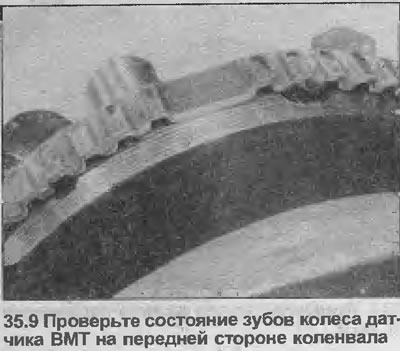
9. Where applicable, check that the teeth on the crankshaft TDC sensor wheel are not damaged (see illustration). If such damage is detected, the crankshaft must be replaced.
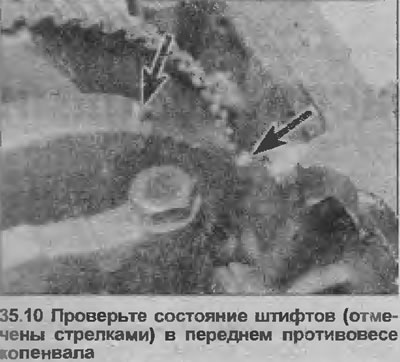
10. Similarly, check the condition of the pins in the front crankshaft counterweights, which are used to mount the diagnostic sensor unit used by Opel dealers (see illustration).
Visitor comments