


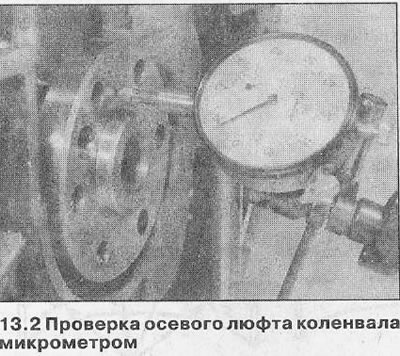
2. Check the crankshaft axial clearance with a micrometer (see illustration). Push the crankshaft all the way to one side, then set the micrometer to zero. Pull the crankshaft all the way to the other side and check the end play. The result can be compared with that specified in Specifications and determine if new thrust washers are required.
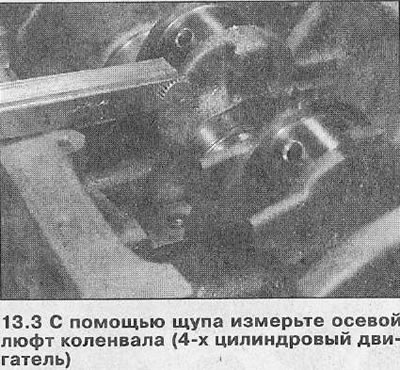
3. If you don't have a micrometer, you can use feeler gauges (see illustration). First push the crankshaft towards the flywheel/drive plate, then insert a feeler gauge between the crankshaft journal counterweight and the thrust washer, which on 4-cylinder engines is included in the main bearing shell No.3, and on 6-cylinder engines - in the main bearing shell No.4.
Inspection
4. Clean the crankshaft using kerosene or a suitable solvent and dry it with compressed air if possible.
5. Check the main and connecting rod bearing journals for uneven wear, scratches, corrosion and cracks.
6. When the connecting rod bearing is worn out, a metallic knocking sound can be clearly heard during engine operation (especially noticeable at low revs), and this is accompanied by some loss of oil pressure.
7. When the main bearing is worn out, strong vibration and engine noise are felt, gradually increasing with increasing engine speed, this is also accompanied by a loss of oil pressure.
8. Check the smoothness of the bearing journal surface by running your finger over it. If you feel any roughness, (the liner will be worn out), the crankshaft needs to be reground (if possible) or replace.
9. If the crankshaft has been reground, check that there are no burrs left around the crankshaft oil holes (the holes are usually beveled). Remove them with a fine file or scraper, and thoroughly clean the oil holes as described above.
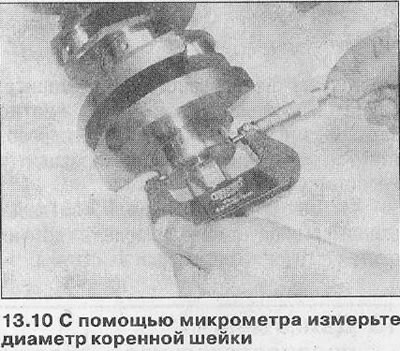
10. Using a micrometer, measure the diameter of the main and connecting rod bearing journals and compare the results with the Specifications (see illustration). By measuring the diameter at several points around the circumference of each journal, its ovality can be determined. By measuring the journal diameter at each edge near the counterweights, its taper can be determined. Compare the results with the data given in the Specifications. If there are still color marks on the crankshaft, the bearing journal size can be determined from them.
11. Inspect the seal contact surfaces at each end of the crankshaft for damage or signs of wear. If the crankshaft surface has a deep groove, consult an engine rebuilder about the possibility of rebuilding the crankshaft; if repair is not possible, a new crankshaft will be required.
12. Install the crankshaft in the V-blocks, place the micrometer on top of the No.1 crankshaft main journal. Set the micrometer to zero, then slowly rotate the crankshaft two full revolutions, noting the journal runout. Repeat the procedure on the remaining main journals. If the difference in runout between any two journals exceeds the Specifications limit, the crankshaft must be replaced.
13. For all engines Opel produces main and connecting rod bearings of repair sizes. If the crankshaft journals have not yet been reground, it is possible to restore it, and use bearings of repair sizes during installation. Main repair bearings of sizes 0.25 and 0.50 mm, and connecting rod repair bearings of sizes 0.25 and 0.50 mm are available for sale (for 6-cylinder engines) and sizes 0.25 mm (for 4-cylinder engines).
Text copied from an internet website (OPELBOOK.ru)
Visitor comments