
OpelBook.ru
Cars AvtoVAZ Cars Mitsubishi Cars BMW Cars Mercedes Cars Nissan Cars Toyota Cars Chevrolet
English Русский
Български
Беларускі
Український
Српски
Hrvatski
Română
Polski
Slovenský
Magyar
 |  Sitemap  |  Contacts  |    


Main Astra Corsa Insignia Kadett Omega Vectra Zafira Others Articles
Omega A (1986-1993) Omega B (1993-1999) Omega B2 (1999-2003)
  • Main
  • Omega
  • Omega B2
  • Power unit
  • Engine overhaul
  • Main and connecting rod bearings — inspection

Main and connecting rod bearings — inspection (Opel Omega B2)

            0

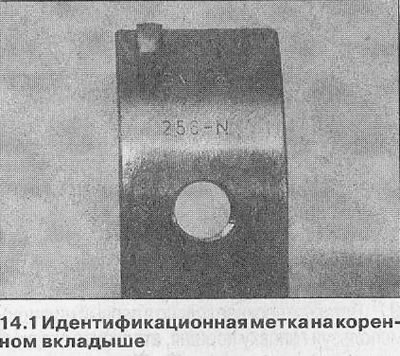
1. Although the main and connecting rod bearing shells should be replaced during an engine overhaul, keep the old shells for detailed inspection as they can provide valuable information regarding the condition of the engine. The shell size is printed on the back and this information should be given to the supplier to identify the size group (see illustration).

1. Although the main and connecting rod bearing shells should be replaced during an engine…


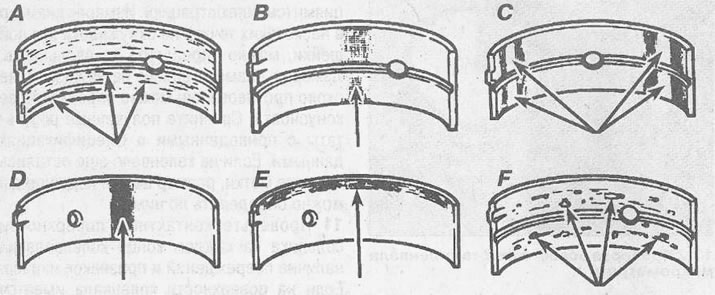
2. Damage to the bearings may be caused by insufficient lubrication, foreign particles getting on them, engine overload or corrosion (see illustration). Regardless of the cause, it must be eliminated before reassembling the engine.
14.2 Typical damage to bearings

14.2 Typical damage to bearings
A Scratched by foreign particles - grains are visible, immersed in the working layer of the liner
B Lack of oil - the top layer is worn off
C The inserts are incorrectly positioned during installation - there are shiny spots (polished) areas
D The neck is tapered - the top layer is removed from the entire surface
E Wear of the liner edge
F Fatigue fault - craters or pockets formed


3. To inspect the bearing shells, remove them from the cylinder block/caps/connecting rods. Lay them out on a clean work surface in the same order as they are in the engine. This will help you determine which bearing is causing the problem.


4. Dirt and foreign particles enter the engine in various ways. They can be left in the engine after overhaul or pass through filters or the crankcase ventilation system. Often there are metal grains left after regrinding or formed during normal engine wear. Foreign particles that get into the bearings are embedded in the soft working layer of the liners, where they are easy to detect. Large particles do not sink into the material of the liners, but scratch the liners and journals. The best way to prevent bearing failure for this reason is to thoroughly clean all components and maintain impeccable cleanliness during engine assembly. In addition, it is recommended to change the engine oil and filter frequently and regularly

5. Lack of lubrication has many interrelated causes. These may include: overheating (makes the oil less viscous, which causes its layer on the bearings to become thinner), overload (squeezes oil from the bearing surface) or leaks (bearing clearances are excessive, oil pump is worn out or engine speed is high). Blockage of the lubrication passages, which is usually the result of misalignment of the bearing lubrication holes, also leads to a lack of lubrication and causes bearing failure. When a bearing fails due to lack of lubrication, the bearing layer is worn or peeled off from its steel base. The temperature can rise to such a level that the steel base turns blue from overheating.

6. Driving style also affects bearing life. Full throttle and long hours at low revs (engine overload) put a very high load on the bearings, which causes the oil film to be pushed away from the liners. As a result, the liners bend and a network of small cracks forms on them (a "fatigue" failure). Ultimately, the working layer of the bearing liner will disintegrate into pieces and break away from the steel base.


7. Short trips cause corrosion of the bearings because the engine does not heat up enough to repel compressed water vapor and corrosive gases. The vapors are adsorbed by the engine oil, forming acid and sludge. When this oil gets into the engine bearings, the working layer of the bearing shells oxidizes.

8. Incorrect selection of the bearing shell will also cause bearing failure. Shells that are too large and fit tightly into the bearing will leave insufficient operating clearance, which will result in insufficient lubrication.

9. As mentioned at the beginning of this Chapter, the bearings should be replaced after each removal during an engine overhaul.


This article is available at russian, bulgarian, belarusian, ukrainian, serbian, croatian, romanian, polish, slovak, hungarian
Checking the article: Shapovalov Yaroslav

Share information:

Previous articles
Opel Omega B2: Engine overhaul
Next articles

Crankshaft — inspection
Piston/Connecting Rod Assembly — Inspection
Cylinder block — cleaning and inspection
Crankshaft — removal
Piston/Connecting Rod Assembly — Removal
Cylinder head — assembly
Engine — Assembly Sequence
Piston rings — installation
Crankshaft — installation and checking of main bearing clearance
Piston/Connecting Rod Assemblies — Installing and Checking Connecting Rod Bearing Clearance
Engine — preparation for starting after overhaul


See similar ones from other Opel car manuals:
▶ Main and connecting rod bearings — inspection Opel Astra F (1991-1998, petrol)
▶ Checking the condition of the main and connecting rod… Opel Corsa B (1993-2000)
▶ Inspection of main and connecting rod bearings Opel Vectra B (1995-2002)
▶ Checking the clearance in the crankshaft main bearings Opel Insignia A (2008-2017)
▶ Measuring clearances in crankshaft connecting rod bearings Opel Frontera B (1998-2004)
Link to this page in different formats

Visitor comments


No comments yet


How much will 39 + 27 =


Omega B2 (1999-2003) 
  • General information
  • User manual
  • Maintenance
  • Troubleshooting
  • Power unit
  • Petrol 4-cylinder
  • Petrol 6-cylinder
  • Engine overhaul
  • Diesel engines 2.0 l
  • Diesel engines 2.5 l
  • Cooling and heating
  • Injection system (gasoline)
  • Fuel system (diesel)
  • Fuel system
  • Exhaust system
  • Ignition system
  • Transmission
  • Clutch
  • Mechanical gearbox
  • Automatic gearbox
  • Main gear and shafts
  • Chassis
  • Brake system
  • Car suspension
  • Steering
  • Body
  • Body elements
  • Electrical equipment
  • Equipment and devices
  • Electrical circuits
Omega B (1993-1999) 
  • General information
  • User manual
  • Tips for the car owner
  • Maintenance (gasoline)
  • Maintenance (diesel)
  • Power unit
  • Petrol engine SOHC 2.0 l
  • Petrol engine DOHC 2.0 l
  • Petrol engines 2.5 and 3.0 l
  • Repair of gasoline engines
  • Diesel engine 2.0 l
  • Diesel engine repair 2.0 l
  • Diesel engine 2.5 l
  • Cooling and heating
  • Power system (petrol)
  • Emission reduction
  • Fuel system (diesel 2.0 l)
  • Fuel system (diesel 2.5 l)
  • Launch system
  • Ignition system
  • Transmission
  • Clutch
  • Mechanical gearbox
  • Automatic gearbox
  • Drive shafts
  • Chassis
  • Brake system
  • Wheel suspension
  • Steering
  • Body
  • Exterior
  • Interior
  • Doors and windows
  • Electrical equipment
  • Equipment and devices
  • Wiring diagrams (early)
  • Wiring diagrams (late)
Omega A (1986-1993) 
  • General information
  • User manual
  • Maintenance
  • Changes and additions
  • Troubleshooting
  • Power unit
  • Gasoline engines
  • Diesel engines
  • Cooling system
  • Fuel system (gasoline)
  • Fuel system (diesel)
  • Ignition system
  • Transmission
  • Clutch
  • Mechanical gearbox
  • Automatic gearbox
  • Cardan shaft
  • Drive shafts
  • Chassis
  • Brake system
  • Car suspension
  • Steering
  • Body
  • Exterior
  • Interior
  • Electrical equipment
  • Power devices
  • Lighting and appliances
  • Electrical circuits
OpelBook.ru © 2017–2026 · Mobile version · · Sitemap: EN BG BY UA RS HR RO PL SK HU · Feedback · Site search
Astra F, petrol · Astra G, petrol · Astra G · Astra H · Astra J, petrol · Corsa B · Corsa C, petrol · Corsa C · Insignia A · Kadett D · Kadett E · Omega A · Omega B · Omega B2 · Vectra A, petrol · Vectra A · Vectra B, petrol · Vectra B · Vectra C · Zafira A, petrol · Frontera A, petrol · Frontera B · Ascona C · Vivaro A ·
We want your visit to be comfortable 🤝! We use cookies 🍪 to make that happen.