


Caution: New connecting rod cap bolts will be required for installation.
1. On 4-cylinder engines, guided by Part A this Section, remove the cylinder head, oil pan, and oil pump pickup tube/oil strainer. Remove the crankshaft balancer assembly.
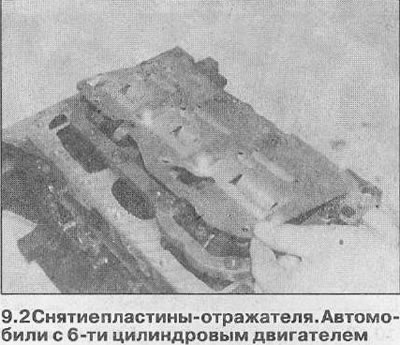
2. On 6-cylinder engines, remove the cylinder heads and oil pan as described in Parts B of this Section. Unscrew the reflector plate and remove it from the base of the main bearing bridge (see illustration).
3. On all models, if there is a step caused by wear at the top of any cylinder bore, it may be necessary to remove it with a reamer to avoid damaging the piston during removal. The presence of a step indicates excessive wear of the cylinder walls.
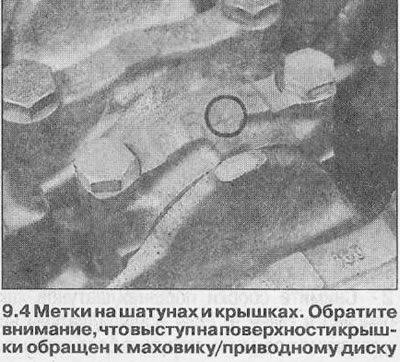
4. Using a hammer and punch, or paint, make marks on each connecting rod and bearing cap according to the cylinder number; if the engine has been disassembled before, carefully mark all the marks (see illustration). On 4-cylinder engines, cylinder #1 is at the front end of the engine, and on 6-cylinder engines, cylinder #1 is on the right-hand cylinder block on the toothed drive belt side.
Original posted on the website (OPELBOOK.ru)
5. Turn the crankshaft until piston #1 is at BDC (bottom dead center).
6. Unscrew the bolts from the piston #1 connecting rod bearing cap. Remove the cap and remove the lower bearing shell. If the shell does not require replacement, tape it to the cap.
Caution! On some engines, the connecting rods/caps are made by sawing from one piece. When working with such connecting rods, be especially careful not to damage the contact surfaces of the cap and connecting rod.
8. Using a hammer handle, push the piston out of the cylinder block through the top. Remove the bearing shell and tape it to the connecting rod.
9. Tighten the connecting rod cap mounting bolts.
10. On 4-cylinder engines, remove piston assembly #4 in the same manner, then turn the crankshaft 180° until pistons #2 and #3 are at BDC (bottom dead center), and remove them in the same way.
11. On 6-cylinder engines, remove the remaining five piston assemblies, rotating the crankshaft as necessary to gain access to the cover bolts.
Visitor comments