


Removal
Caution! Allow the engine to cool before removing the cylinder head. Use new cylinder head bolts when installing.
1. Disconnect the negative cable from the battery.
Caution! On models with Opel Anti-Theft System (ATWS), the negative cable must be disconnected from the battery terminal within 15 seconds after the ignition is turned off, otherwise the alarm will be triggered.
2. Drain the cooling system and remove the spark plugs (see the relevant section).
3. Remove the intake and exhaust manifolds. If you are not going to perform any work on the cylinder head, remove it together with the manifolds, having first performed the following steps (see the relevant section):
- a) Remove the intake duct connecting the air filter to the throttle body.
- b) Disconnect the wiring connectors from the throttle position sensor, idle speed control valve, exhaust gas recirculation valve, charcoal canister bypass valve, coolant temperature sensor, oxygen sensor, and ignition control module. Remove the fuel line ground bolts and release the wiring harness from the mounting brackets. Lift the harness cover off the injectors, then disconnect the knock sensor and crankshaft position sensor connectors and move the cover/harness away from the cylinder head.
- c) Depressurize the fuel system, then separate the fuel hoses from the fuel line.
- d) Disconnect the vacuum hoses and coolant hoses from the intake manifold/throttle body.
- d) Remove the intake manifold bracket bolts and the upper generator brackets.
- e) Disconnect the gas pedal cable.
- g) Remove the front section of the exhaust system.
- c) Disconnect the air hose from the secondary air injection valve on the exhaust manifold.
4. Remove the timing belt as described in Chapter 7, but before releasing the belt tension, turn the crankshaft back approximately 60° (4 teeth). This will distribute the valve spring pressure evenly along the length of the camshafts and thus prevent the valves from striking the pistons (see illustration 10.1).
5. Remove the camshafts as described in Chapter 10.
6. Unscrew the mounting bolts securing the inner timing belt cover to the cylinder head.
7. Release the retaining clips and separate the coolant hoses from the thermostat housing/cylinder head, noting the location of each.
8. Unfasten the crankcase breather tube and remove it from the left wall of the cylinder block. Discard the gasket - it is subject to replacement.
9. Once again, make sure that you have separated all hoses, tubes and wires from the cylinder head.
10. Working in the reverse order of tightening them (see illustration 11.23), gradually loosen the cylinder head mounting bolts (a quarter turn at a time), so that the bolts can be unscrewed by hand. Remove the bolts together with the washers.
11. Remove the head from the cylinder block. If necessary, gently tap the head with a mallet to separate it from the block. Do not, under any circumstances, pry the head away from the block with any lever. Mark the position of the two dowel pins and remove them if they are loose.
12. Remove the cylinder head gasket - it must be replaced.
Preparing for installation
13. Clean the mating surfaces of the cylinder head and block. Use a soft scraper to remove all traces of gasket and carbon deposits, and clean the piston crowns as well. Be especially careful with the aluminum cylinder head, as the soft metal is easily damaged. Do not allow dirt to enter the oil and water passages - carbon grains can block the oil supply to the camshaft or crankshaft bearings. Use masking tape and paper to plug the water and oil holes, as well as the bolt holes in the cylinder block. To prevent grains from falling into the gap between the cylinder wall and the piston, apply a small amount of grease to this area. After cleaning the piston, rotate the crankshaft so that this piston moves down and remove the grease from the cylinder with a clean rag.
14. Check the contact surfaces of the block and head for nicks, deep scratches and other damage. Minor irregularities can be carefully filed down. More serious damage can be repaired by regrinding, but this work should be entrusted to a specialist.
15. If necessary, check the cylinder head for deformation using a ruler. See. Section 2C if necessary.
16. Make sure the cylinder head bolt holes in the crankcase are clean and remove any oil from them using a syringe or sponge. If there is any liquid or oil left in the holes, the hydraulic pressure that will build up when tightening the bolts will cause the block to crack.
17. Replace the cylinder head bolts regardless of their condition.
Installation
18. Make sure the crankshaft is still at approximately 60° BTDC and wipe the mating surfaces of the head and block.
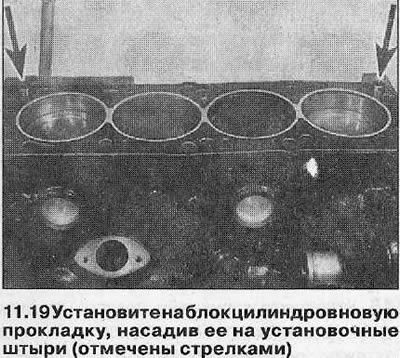
19. Make sure that the mounting pins are in the working position (see illustration).
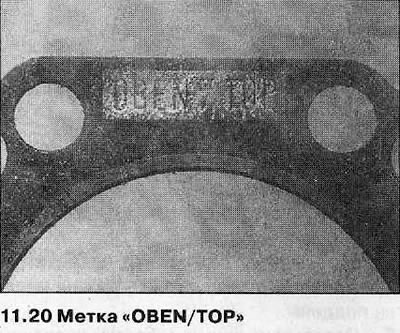
20. Install a new head gasket on the cylinder block with the "OBEN" (or "TOP") mark facing up and toward the front of the engine (see illustration).
21. Carefully install the cylinder head, guiding it along the pins.
22. Install the washers on the new cylinder head bolts, then carefully insert the bolts into position and tighten them by hand only for now.
23. Working in the sequence shown, gradually tighten all bolts to the Stage 1 tightening torque specified Specifications (see illustration).
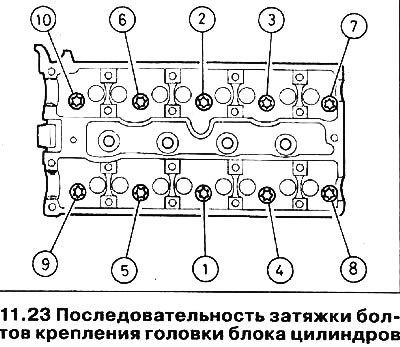
24. In the same sequence, tighten the bolts to the angle of Stage 2 (see Specifications), using the socket and extension rod. It is recommended to use an angle template to ensure accuracy.
25. Again working in the sequence shown, tighten all bolts to the Stage 3 angle (see Specifications).
26. In the same sequence, tighten the bolts to the angle of Stage 4 (see Specifications).
27. Perform Stage 5 of tightening in the same manner (see Specifications).
28. Make sure the mating surfaces are clean and dry, then install the breather tube onto the cylinder block and tighten the mounting bolts to the tightening torque specified in the Specifications.
29. Connect the cooling system hoses and secure them with clamps.
30. Install the timing belt inner cover mounting bolts and tighten them to the tightening torque specified in the Specifications.
31. Install the camshafts as described in Chapter 10.
32. Align all timing marks on the sprockets to position the camshafts and crankshaft at TDC, then install the timing belt as described in Chapter 7.
33. Install the camshaft cover and timing belt cover (see Chapters 4 and 5).
34. Install the intake and exhaust manifolds and connect the wiring (see the relevant section).
35. Make sure all pipes and hoses are securely attached, then top up the coolant level to the correct level and install the spark plugs (see the relevant section).
36. Connect the battery, then start the engine and check its joints for leaks.
Visitor comments