


Attention! New balancer block mounting bolts will be required during installation.
Removal
1. Remove the oil pan and oil pump suction tube/strainer (see Chapter 12).
2. Install the socket on the crankshaft sprocket bolt and turn the shaft in the direction of its rotation so that the notch on the pulley rim aligns with the pointer on the timing belt cover. This will bring piston #1 to TDC. In this case, the chamfers on the ends of the balance shafts should be in the same plane (see point 5).
3. Loosen and remove the mounting bolts evenly and gradually, then remove the balancer unit from the cylinder block base together with the spacer shim. The shim is used to adjust the clearance between the balancer unit gear teeth (see point 10).
Installation
4. If any procedures have been performed on the crankshaft or a new balancer is installed, the clearance between the teeth of the balancer gears must be adjusted before installation. If the old balancer unit is installed and the crankshaft has not been reground, the unit can be installed with the old spacer gasket without checking the gear engagement clearance.
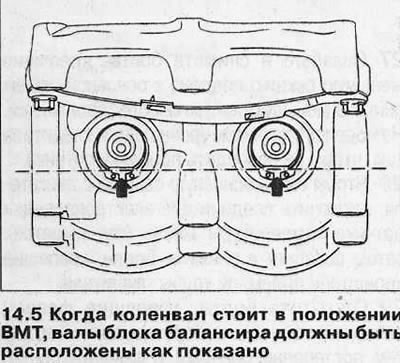
5. Make sure the crankshaft pulley notch is still flush with the pointer on the cover, then rotate the balancer gears so that the chamfers on the ends of the shafts are facing down and in a horizontal plane (see illustration).
6. Place the spacer lining on top of the balancer block, then install the balancer onto the cylinder block. Make sure the balancer shaft gear meshes with the crankshaft gear and install new mounting bolts.
7. Tighten all bolts by hand, then check that the crankshaft pulley mark and balancer shaft chamfers are still positioned correctly. If not, remove the balancer unit and make the necessary adjustments, then reinstall the unit.
8. Working in a diagonal sequence, tighten the mounting bolts to the tightening torque (see Specifications). In the same sequence, tighten the bolts to the required angle (see Specifications). It is recommended to use a corner template for this to ensure accuracy.
9. Install the oil pump pickup tube/strainer and pan as described in Chapter 12.
Adjustment
Attention! The following procedure can be performed accurately only with the help of a special tool Opel KM-949 and a micrometer.
Material copied from this website: OpelBook.ru
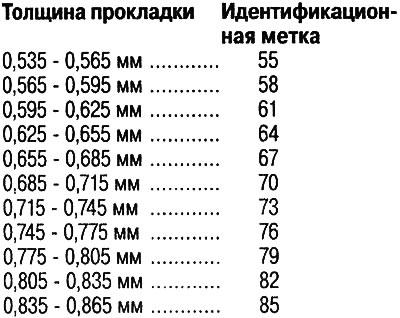
10. To check the clearance between the teeth of the balancer block gears (see point 4) proceed as follows. The engagement gap depends on the thickness of the spacer lining installed between the balancer and the cylinder block. The thickness of the linings available on the market varies as follows (the thickness can be determined by measurement or by the identification mark).
11. The engagement clearance is measured after the balancer is installed on the cylinder block. If a new balancer block is installed, purchase the thickest spacer shim possible (identification mark 85) and install the balancer on the cylinder block using the old mounting bolts (see points 5-8).
12. Bring the piston of cylinder No.1 to TDC (see point 2) and install the special tool KM-949. Place the measuring lever to the right shaft (intake manifold side) into a horizontal position, then screw the adjusting knurled screws into the balance shafts and tighten them securely. Position the micrometer at right angles to the measuring lever so that its probe fits into the groove of the lever (see illustration).
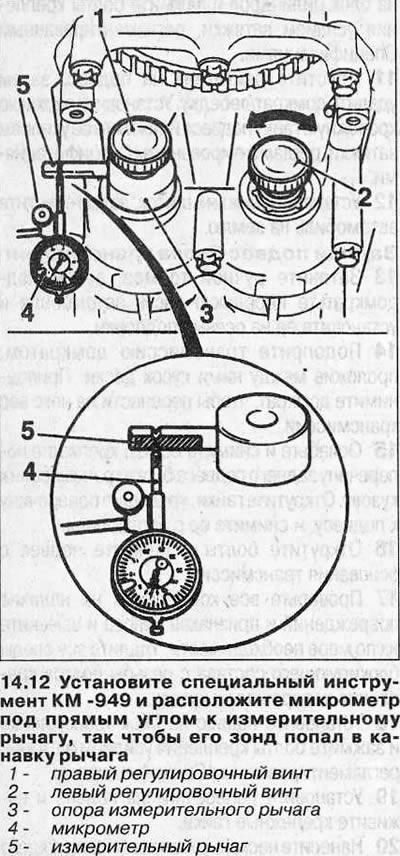
13. Using the adjusting screw, turn the left balance shaft (exhaust manifold side) clockwise until it stops, then set the micrometer pointer to zero. Turn the shaft counterclockwise until it stops and record the value obtained on the micrometer scale (it shows the displacement of the lever).
14. Move the micrometer probe away from the measuring arm, then turn the crankshaft 45° (the balance shafts will turn 90°). Loosen the right adjusting screw, return the measuring arm to the horizontal position and tighten the screw securely, then measure the engagement clearance again.
15. Repeat this procedure twice more to obtain four gap measurements.
16. All four results should be within the range of 0.02-0.06 mm. If at least one of the measurements is outside this range, adjustment is necessary.
17. In this case, remove the balancer from the cylinder block and remove the spacer gasket. Determine the thickness of the latter (see point 10). The engagement gap decreases when a thinner shim is installed and vice versa. Calculate the thickness of the shim required. For example, if a shim with the identification mark "67" is installed and the engagement gap is 0.07 mm, replacing the shim with a component with the mark "64" will reduce the gap by approximately 0.02 mm.
18. Obtain a spacer of the required thickness, then install the balancer unit as described in steps 5-9.
Visitor comments