
OpelBook.ru
Cars AvtoVAZ Cars Mitsubishi Cars BMW Cars Mercedes Cars Nissan Cars Toyota Cars Chevrolet
English Русский
Български
Беларускі
Український
Српски
Hrvatski
Română
Polski
Slovenský
Magyar
 |  Sitemap  |  Contacts  |    


Main Astra Corsa Insignia Kadett Omega Vectra Zafira Others Articles
Astra F (1991-1998, petrol) Astra G (1998-2004, petrol) Astra G (1998-2004) Astra H (2004-2009) Astra J (2009-2015, petrol)
  • Main
  • Astra
  • Astra G
  • Power unit
  • DOHC gasoline engines
  • Removal, installation and adjustment of the crankshaft balancing mechanism (2.0 l engines)

Removal, installation and adjustment of the crankshaft balancing mechanism (2.0 l engines) (Opel Astra G)

            0

Contents: Removal ⬇ Installation ⬇

Removal


Removal


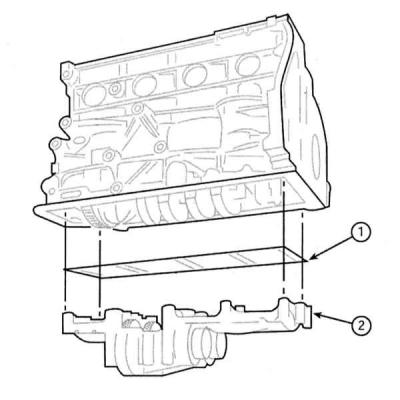
Some 2.0L DOHC engines are equipped with a balancing unit (2) installed between the cylinder block and the main section of the oil pan. The unit consists of two counter-rotating balancing shafts driven by the crankshaft.

1. Remove the oil pan assembly with the oil pickup (see Removal and installation the oil pan).

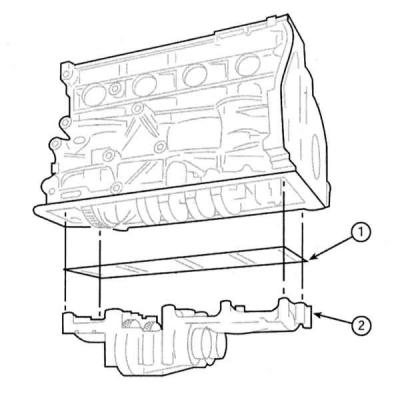
2. Loosen the mounting bolts one by one in several stages, unscrew them and remove the balancing mechanism from the cylinder block together with the adjusting gasket (1) installed between the balancing assembly and the cylinder block.
2. Loosen the mounting bolts one by one in several stages, unscrew them and remove the balancing…


Installation


If the crankshaft has been serviced or the engine balancing mechanism has been replaced, the clearance of the drive gear teeth will need to be adjusted before installing the latter.


When installing the previous mechanism, provided that no work was done on the crankshaft, there is no need for this adjustment.


Correct adjustment of gear engagement outside the conditions of an Opel service station can only be performed using a special device KM-949.

1. Prepare a special device. Bring the engine to the TDC position of the end of the compression stroke of the piston of the first cylinder (see Bringing the piston of the first cylinder to the position of the top dead center of the compression stroke (TDC).

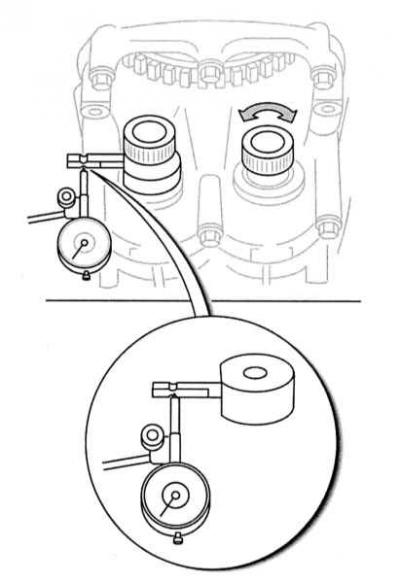
2. Turn the balance shaft gears so that the journals of the latter are positioned with the flats down and strictly horizontal.
2. Turn the balance shaft gears so that the journals of the latter are positioned with the flats…


3. Install the adjusting shim on the upper mating surface of the balancing assembly. Press the assembly onto the cylinder block. Make sure that the mechanism shaft gear engages with the crankshaft gear, then screw in the mounting bolts and tighten them to the required torque.

4. Secure the KM-949 tool. Screw the long knurled bolt into the end of the balance shaft journal from the intake manifold side. Set the measuring lever to the "9 o'clock" position when looking at the engine from the rear. Tighten the bolt by hand.


5. Screw the short knurled bolt into the end of the second balance shaft. Tighten the bolt by hand.

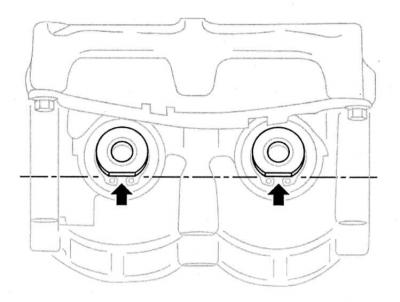
6. Install the dial gauge on the balancing assembly or cylinder block so that its plunger rests against the measuring lever between the recesses on the smooth surface of the lever.

Material copied from this portal (OpelBook)
6. Install the dial gauge on the balancing assembly or cylinder block so that its plunger rests…


7. Using the knurled bolt, turn the left balance shaft clockwise until it stops and reset the gauge to zero.

8. Turn the shaft counterclockwise until it stops, read the instrument readings and record the result.

9. Having obtained the results of all four measurements, turn the crankshaft by its gear bolt clockwise so that the measuring lever on the "inlet" balance shaft is at the "6 o'clock" position. Loosen the knurled bolt and move the lever to the "9 o'clock" position. Repeat the measurement and take two more readings, each time turning the balance shaft.

10. If the result of at least one of the measurements is outside the acceptable range (see Specifications), therefore, the gear engagement play needs to be adjusted. Adjustment is achieved by selecting spacer shims installed between the cylinder block and the balancing assembly. The shims are marked according to thickness (see Specifications), - the code is stamped directly on the surface of the gasket.


11. Having determined the gap size and knowing the thickness of the old gasket, you can calculate the thickness of the required replacement gasket. Gaskets are produced with a thickness step of 0.02 mm. Let's say, for example, the gap size with the installed gasket "70" was 0.08 mm. If the gasket is replaced with No.67, the gap size will be reduced to 0.06 mm.

Installation of several gaskets at once is not permitted!


12. After selecting the gasket and installing the balancing unit together with it, perform a series of control measurements. If necessary, repeat the gasket selection procedure.

13. Remove the gauge and unscrew the bolts from the ends of the balance shafts.

14. Install the oil pan (see Removal and installation the oil pan).


This article is available at russian, bulgarian, belarusian, ukrainian, serbian, croatian, romanian, polish, slovak, hungarian
Checking the article: Pavlovsky Nikolay

Share information:

Previous articles
Opel Astra G: DOHC gasoline engines
Next articles

Checking the condition and replacing the powertrain suspension supports
Replacing crankshaft seals
Removal, checking condition and installing flywheel/drive disk
Removal, maintenance and installation of the oil pump
Removal and installation the engine oil level sensor
Removal and installation the oil pan


See similar ones from other Opel car manuals:
▶ Crankshaft balancing system (engines since 1998) Opel Omega B (1993-1999)
▶ Removal and installation of gear wheels of crankshaft and… Opel Corsa B (1993-2000)
▶ Technical characteristics of the valve timing mechanism of… Opel Kadett E (1984-1995)
▶ Toothed drive belt and sprockets (without automatic… Opel Vectra A (1988-1995, petrol)
▶ Gearshift mechanism drive lever — replacement and adjustment Opel Zafira A (1999-2005, petrol)
Link to this page in different formats

Visitor comments


No comments yet


How much will 36 + 31 =


Astra J (2009-2015, petrol) 
  • General information
  • Vehicle device
  • User manual
  • Faults en route
  • Maintenance
  • Power unit
  • Engine repair
  • Cooling and lubrication system
  • Engine power system
  • Exhaust system
  • Transmission
  • Clutch
  • Car gearbox
  • Drive shafts
  • Chassis
  • Front suspension
  • Rear suspension
  • Steering
  • Brake system
  • Wheels and tires
  • Body
  • Exterior
  • Interior
  • Doors and windows
  • Body Care
  • Heating and air conditioning
  • Security systems
  • Electrical equipment
  • Equipment and devices
  • Lighting and signaling
  • Power devices
  • Electrical circuits
Astra H (2004-2009) 
  • General information
  • Introduction to the guide
  • Troubleshooting
  • User manual
  • Maintenance
  • Power unit
  • Engine repair
  • Cooling and heating
  • Power and exhaust system
  • Ignition system
  • Launch and charge system
  • Transmission
  • Mechanical gearbox
  • Automatic gearbox
  • Drive shafts
  • Chassis
  • Brake system
  • Car suspension
  • Steering
  • Body
  • Interior
  • Exterior
  • Electrical equipment
  • Equipment and devices
  • Electrical circuits
Astra G (1998-2004) 
  • General information
  • Introduction to manual
  • User manual
  • Maintenance
  • Power unit
  • SOHC gasoline engines
  • DOHC gasoline engines
  • Diesel engines 1.7 and 2.0
  • Engine repair
  • Cooling system
  • Supply system
  • Injection system (gasoline)
  • Injection system (diesel)
  • Exhaust system
  • Charge and launch system
  • Ignition system (gasoline)
  • Preheat system (diesel)
  • Transmission
  • Manual gearbox
  • Automatic gearbox
  • Clutch
  • Drive shafts
  • Chassis
  • Brake system
  • Wheel suspension
  • Steering
  • Body
  • Exterior
  • Interior
  • Doors and windows
  • Ventilation and heating
  • Electrical equipment
  • Equipment and devices
  • Electrical circuits
Astra G (1998-2004, petrol) 
  • General information
  • User manual
  • Car care
  • Maintenance
  • Power unit
  • Single shaft engines
  • Twin shaft engines
  • Engine repair
  • Cooling and heating
  • Fuel and exhaust systems
  • Starting and charging system
  • Ignition system
  • Transmission
  • Clutch
  • Mechanical gearbox
  • Automatic gearbox
  • Drive shafts
  • Chassis
  • Brake system
  • Car suspension
  • Steering
  • Body
  • Interior
  • Exterior
  • Electrical equipment
  • Equipment and devices
  • Wiring diagrams Opel Astra
  • Wiring diagrams Opel Zafira
Astra F (1991-1998, petrol) 
  • General information
  • Maintenance
  • Power unit
  • Engine in car
  • Engine removed
  • Cooling system
  • Heating and ventilation
  • Fuel supply (carburetor)
  • Fuel supply (injector)
  • Emission control
  • Ignition system
  • Transmission
  • Clutch
  • Mechanical gearbox
  • Automatic gearbox
  • Drive shafts
  • Chassis
  • Brake system
  • Car suspension
  • Steering
  • Body
  • Exterior
  • Interior
  • Electrical equipment
  • Equipment and devices
  • Electrical circuits
OpelBook.ru © 2017–2026 · Mobile version · · Sitemap: EN BG BY UA RS HR RO PL SK HU · Feedback · Site search
Astra F, petrol · Astra G, petrol · Astra G · Astra H · Astra J, petrol · Corsa B · Corsa C, petrol · Corsa C · Insignia A · Kadett D · Kadett E · Omega A · Omega B · Omega B2 · Vectra A, petrol · Vectra A · Vectra B, petrol · Vectra B · Vectra C · Zafira A, petrol · Frontera A, petrol · Frontera B · Ascona C · Vivaro A ·
We want your visit to be comfortable 🤝! We use cookies 🍪 to make that happen.