


Contents: Removal ⬇ Installation ⬇
The cylinder head can be removed without removing the engine.
A bad gasket can cause a loss of power, coolant leakage, oil leakage, or coolant in the oil. It can also cause a loss of compression in two adjacent cylinders. In addition, a defective gasket can cause bubbles in the coolant. To diagnose, remove the expansion tank cap and start the engine. Vigorously bubbling coolant is an indication of a defective cylinder head gasket.
Removal
Caution: Remove the cylinder head only on a cold engine (room temperature 20°C).
Disconnect the ground cable from the battery.
Remove the air filter.
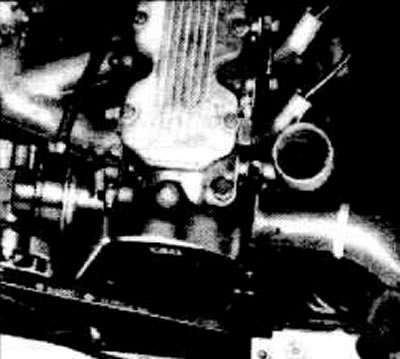
Disconnect the lower coolant hose from the radiator, drain the liquid into a container, it may be needed again.
Remove the upper hose from the thermostat housing.
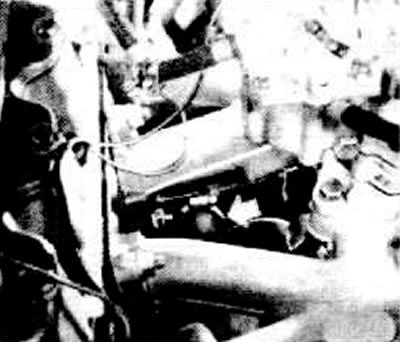
Loosen and crush the lower coolant pump hose.
Crush the fuel line from the fuel pump.
Mark and remove all cables and electrical wires from the carburetor.
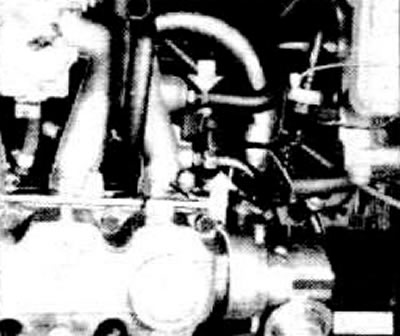
Crush the heater and vacuum hoses from the intake manifold.
Remove the wire from the temperature sensor on the intake pipe.
Remove the timing belt protective cover.
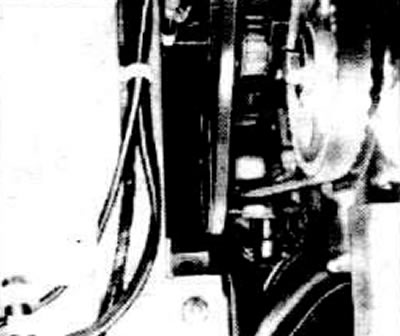
Remove the timing belt.
Caution: The timing belt must not be bent or twisted excessively.
Note: To facilitate installation, the piston of the first cylinder should be installed on the ignition coil, see item 23.6.
Mark and remove the spark plug wire ends
Remove the ignition distributor, see item 23.6.
Disconnect the coolant pipe holder from the intake manifold.
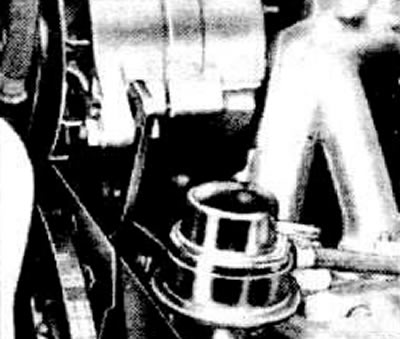
Disconnect the generator tension bar and remove the V-belt.
Unscrew the intake pipe from the exhaust manifold, see p. 8.1.
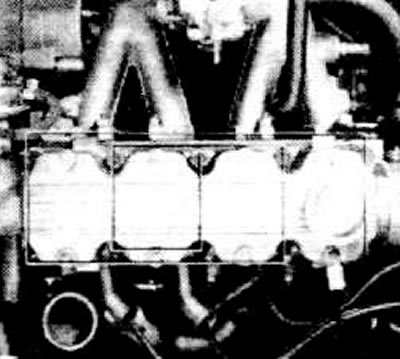
Loosen all cylinder head screws in a spiral, from the outside in, first a quarter turn, then a half turn. Only then can the screws be completely unscrewed.
Remove the camshaft housing.
Raise the cylinder head and remove the head gasket.
Installation
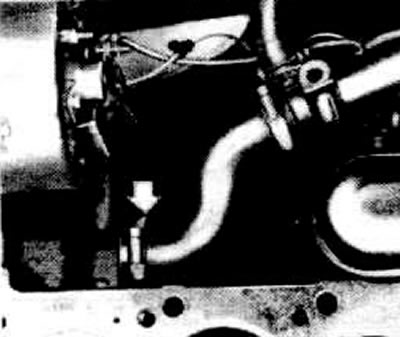
Connect the lower coolant hose to the water pump.
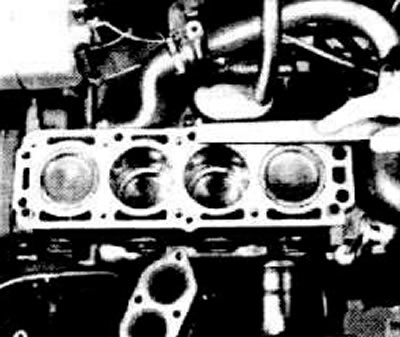
Clean the mating surface of the cylinder block from the remains of the old gasket.
Check the mating surface of the cylinder block for deformation, see p. 1.20.
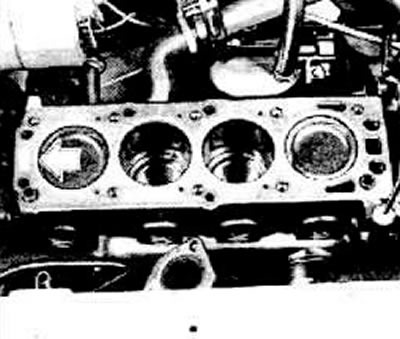
Place a new gasket without sealant on the degreased mating surface, do not forget about the "Oben" mark (arrow). The gasket for 1.2-liter engines contains 2 slots on the flywheel side.
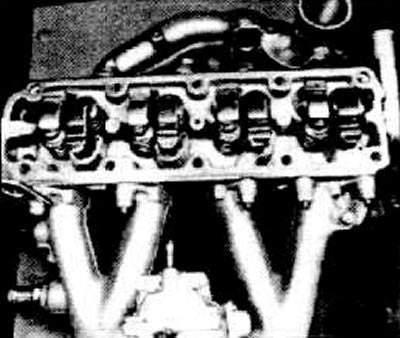
Remove the levers and pressure elements.
Pull out the hydraulic valve clearance compensators.
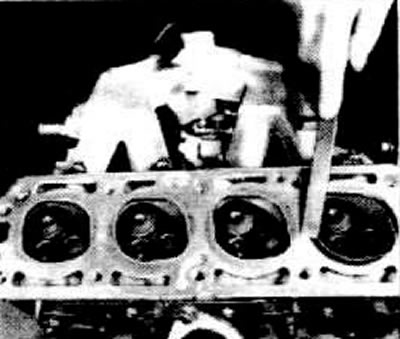
Clean the mating surface of the cylinder head.
Check the mating surface of the cylinder head for deformation, See paragraph 1.19.
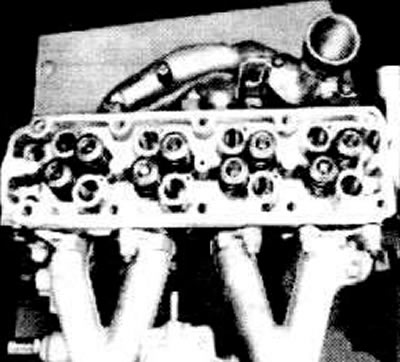
Clean the mating surfaces of the cylinder head and camshaft housing.
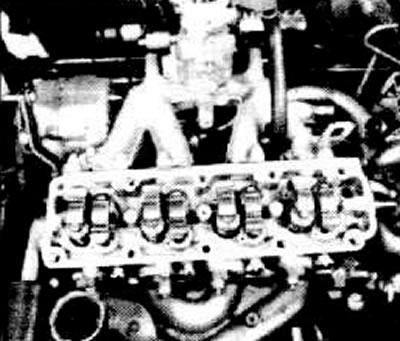
Install the cylinder head.
 |
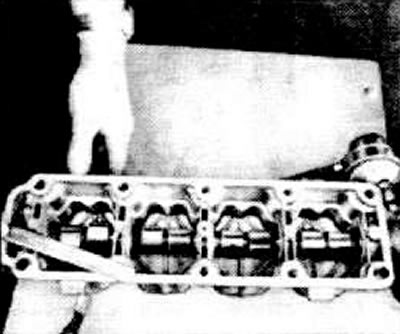 |
Lubricate the valve clearance compensators with engine oil and insert. Lightly lubricate the pressure elements and levers with MoS ₂ paste and install them.
Clean the mating surface of the camshaft housing and apply a small amount of OPEL ET-No. 1503166 sealant, See Figure A9304.
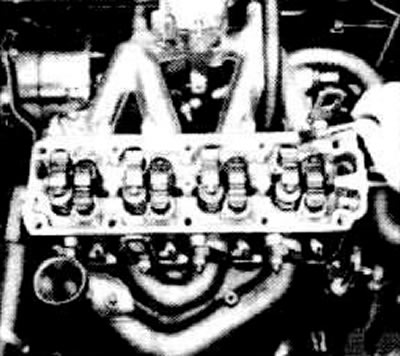
Spread the sealant evenly.
Caution: Replace all cylinder head bolts. Lubricate bolts with engine oil.
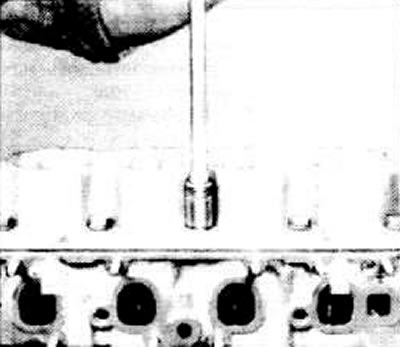
Install the camshaft housing and tighten the cylinder head bolts evenly in a spiral pattern from the inside to the outside.
Caution: New cylinder head bolts must be used for each repair. Lubricate the bolts with engine oil.
Caution: Cylinder head bolts must be tightened in 4 stages. A properly functioning torque wrench is required to tighten the bolts.
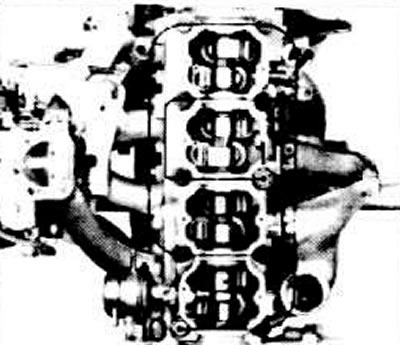
Using this key, tighten the bolts in a spiral from inside to outside with a torque of 25 Nm. Start with the 1st one.
But on the second pass, tighten the bolts in a spiral from the inside to the outside longer but 60° with a hard wrench.
But on the third pass - another 60°, in a spiral.
On the fourth - further by 60° along the spiral (1.2-/1.3-l engines - 30°).
In order to maintain the 60° and 30° angles when tightening, it is advisable to make corresponding marks on the camshaft housing cover. To do this, place the wrench on the bolt and make marks with chalk at an angle of 60°/30°. HAZET supplies a special angle disc for adjusting the rotation angle.
Caution: When the engine is warm, the cylinder head bolts should be tightened again.
Tightening of cylinder head bolts should be done with great care. If possible, check the accuracy of the torque wrench in advance.
Install and tension the timing belt, see p. 1.3.
Install the timing belt cover.
Install and tension the V-belt, see item 22.3.
Install the low pressure and heater hose.
Connect all electrical connections to the oil temperature and pressure sensors, as well as to the ignition coil.
Install the distributor and adjust the ignition timing, see item 23.6.
Install the breaker cover and distributor cover.
Connect the spark plug cables.
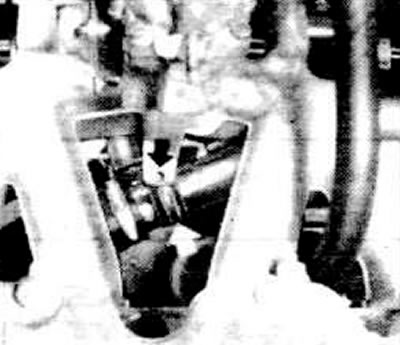
Secure the coolant pipe clamp to the outlet pipe.
Secure the coolant hose to the thermostat housing with a clamp.
Where available, screw the brake booster low pressure hose onto the exhaust manifold, while holding the hex nut at the back.
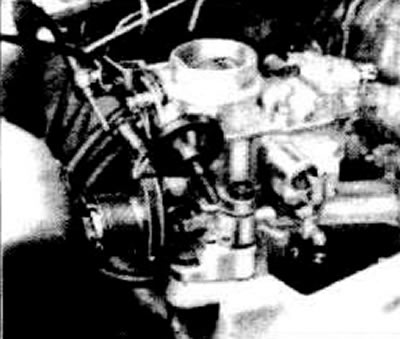
Connect the hoses to the fuel pump cover and to the carburetor and secure them with clamps.
Install the throttle control cable.
Install the air damper actuator.
Screw the inlet pipe to the exhaust manifold.
Fill the expansion tank with coolant, see p. 3.2.
If the cylinder head gasket has been damaged, the oil should be changed.
Install the air filter, see paragraph 4.44.
Check the engine oil level and top up if necessary.
Connect the ground cable to the battery.
Check the ignition timing, see item 23.9.
Warm up the engine (to oil temperature of 60°.) Tighten the cylinder head bolts.
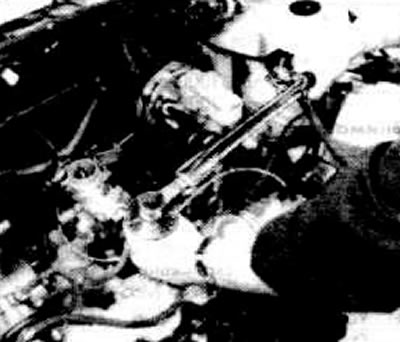
Tighten the cylinder head screws further in a spiral from inside to outside by 30°, see above.
In this case, you can use a welding electrode, which is installed on a torque wrench at an angle of 30°-50°. Further tightening of the bolts is not required.
Check the coolant level, see p. 3.2.
Adjust idle speed, see item. 4.11, 4.24, 4.39, 5.1.
Visitor comments