


Contents: Examination ⬇ Adjustment ⬇
Examination
To check the tension of the toothed belt, the KM-510 A control device is required. The KM-421 key facilitates the squeezing of the water pump in order to tension the toothed belt.
Careful installation and correct tension have a significant impact on the service life of the timing belt.
If possible, a new timing belt should be installed on a cold engine. The engine temperature should be below +25°C.
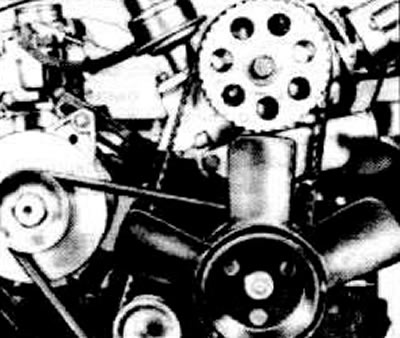
Remove the timing belt protective cover.
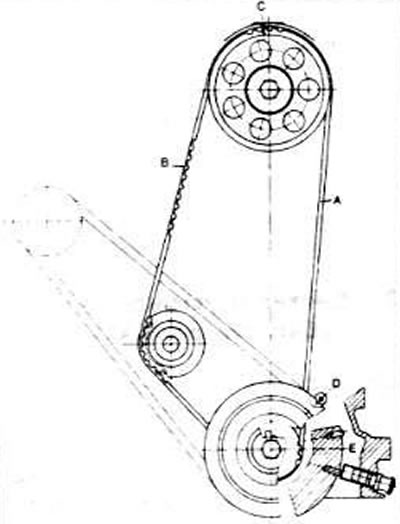
Check the tension in the driven branch -B- on the side of the belt that is not subject to load. The test device should be installed at the top of the toothed belt.
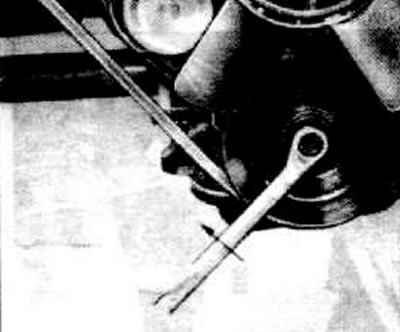
Tighten the branch -A-. To do this, use a wrench to turn the crankshaft half a turn (turn in the direction of engine rotation). The first cylinder should be at top dead center, see the picture below.
Text copied from an online resource: opelbook.ru
Place the cocked tester above the generator on the unloaded branch of the toothed belt and slowly reduce the force on the key, See Figure B5504.
The timing belt should pass between points A-B and C. The tension gauge should fit into the cavity between the teeth.
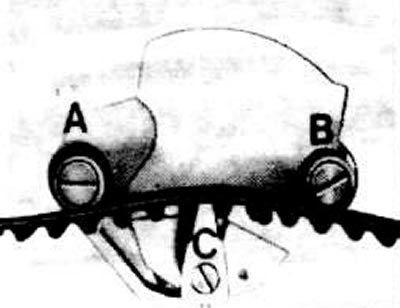
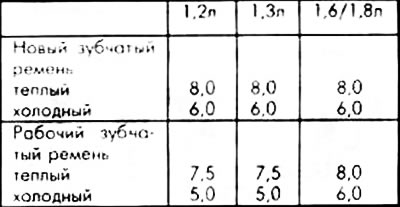
Read the toothed belt tension value on the control device. Compare the read value with the required value. If necessary, adjust the belt tension, See Figure B5504.
Note: In vehicles with headlight washers, the fluid reservoir makes it difficult to read the instrument readings. Therefore, use a mirror to read the instrument readings.
Timing Belt Tension
Adjustment
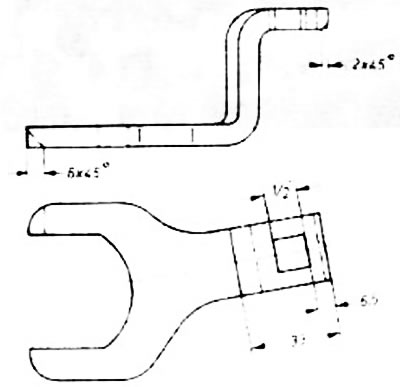
Engines 1.2-p and 1.3 l key OPEL KM-424-A. Engines 1.6-l and 1.8-l key OPEL KM-509.
Loosen the water pump sprinkling boots.
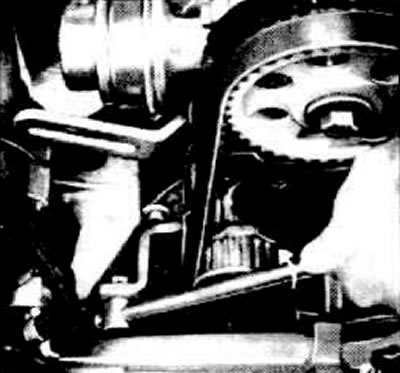
Use a special key for the water pump KM 509/421 or a regular 41 mm key to adjust the toothed belt, turning it up increases the tension, turning it down decreases it. When adjusting with a regular key, remove the generator.
Tension the toothed belt to the specified value.
Tighten the coolant pump mounting screws. 1.2/1.3-l engines 8 Nm. 1.6-/1.8-l engines 25 Nm.
Remove the tester. Turn the crankshaft in the opposite direction. Make one full revolution of the crankshaft in the direction of working rotation. Finally, check the belt tension again.
Caution: The timing belt tension should be adjusted until the instrument shows a constant value.
Make another full revolution of the crankshaft and check the timing belt tension again.
Reinstall the timing belt cover.
Caution: If you do not have a timing belt tension tester at hand, temporarily adjust the belt so that when you press it at point B, Fig. A7872, it deflects by about 10 mm. Avoid high speeds. Check with a tester at the next opportunity.
Visitor comments