OpelBook.ru
Cars AvtoVAZ Cars Mitsubishi Cars BMW Cars Mercedes Cars Nissan Cars Toyota Cars Chevrolet
English Русский
Български
Беларускі
Український
Српски
Hrvatski
Română
Polski
Slovenský
Magyar
 |  Sitemap  |  Contacts  |    


Main Astra Corsa Insignia Kadett Omega Vectra Zafira Others Articles
Zafira A (1999-2005, petrol)
  • Main
  • Zafira
  • Zafira A
  • Power unit
  • Engine repair
  • Timing Belt — Checking Condition, Adjusting Tension and Replacing

Timing Belt — Checking Condition, Adjusting Tension and Replacing (Opel Zafira A)

            0

Contents: Checking the status ⬇ Checking and adjusting tension,…⬇
All operations related to servicing the timing belt must be carried out in strict accordance with the specified frequency (see "Periodic maintenance").

Note. The belt should be replaced earlier than the period specified in the maintenance schedule if during the inspection it is found that its surface has tears, abrasions, cracks or traces of oil and coolant getting on the belt. The work is shown on the example of adjusting the 1.6 DOHC engine. On other engines, the operation is performed similarly.


Checking the status


1. Prepare the car for work (see "Preparing the car for maintenance and repair").

2. Remove the air filter (see "Air filter - removal and installation"),

3. Disconnect the camshaft position sensor wiring harness from the top cover.
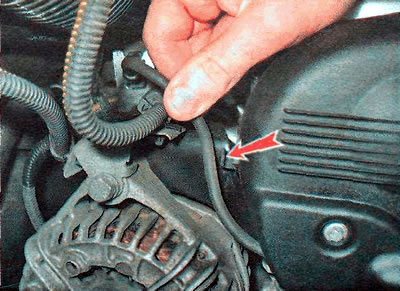
3. Disconnect the camshaft position sensor wiring harness from the top cover.


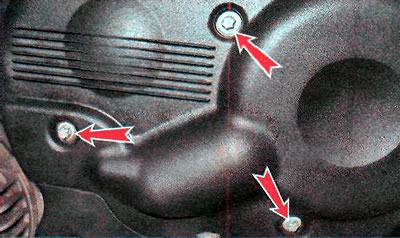
4. Using a TORX E10 key, unscrew the three bolts securing the front upper timing belt cover.

4. Using a TORX E10 key, unscrew the three bolts securing the front upper timing belt cover.

5. Remove the upper timing belt cover.
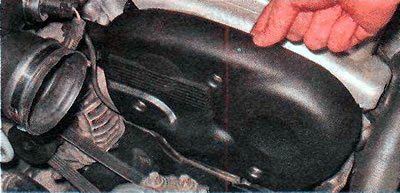


5. Remove the upper timing belt cover.


6. On vehicles with manual transmission, engage fourth or fifth gear.

7. Raise the right front side of the car using a jack (see "Preparing the car for maintenance and repair").

8. Rotate the right front wheel clockwise (the engine crankshaft will also rotate) and inspect the timing belt for breaks, cracks and abrasions. If there is any damage, the belt must be replaced (see below).

Note: On cars with automatic transmission, turn the crankshaft using the bolt securing its pulley.


Checking and adjusting tension, replacement


1. Remove the accessory drive belt (see "Accessory Drive Belt - Checking Condition and Replacing").

2. Remove the auxiliary drive belt tensioner (see "Accessory Drive Belt - Tensioner Replacement").

3. On vehicles with a manual transmission, the assistant presses the brake pedal, while using a TORX E18 socket wrench, unscrew the crankshaft pulley mounting bolt.
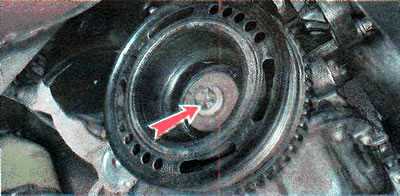
3. On vehicles with a manual transmission, the assistant presses the brake pedal, while using a…


Note: On vehicles with automatic transmission, it is necessary to lock the crankshaft from turning with a strong screwdriver through the hole in the crankcase.


4. Remove the crankshaft pulley and screw its mounting bolt back into place.
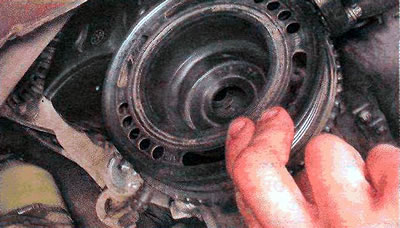
4. Remove the crankshaft pulley and screw its mounting bolt back into place.


5. Using the TORX E10 key, unscrew the bolt securing the bottom cover.
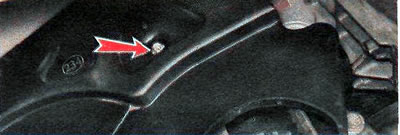
5. Using the TORX E10 key, unscrew the bolt securing the bottom cover.


6. Disengage the four bottom cover holders one by one (for clarity, the location of the holders is shown on the removed cover).
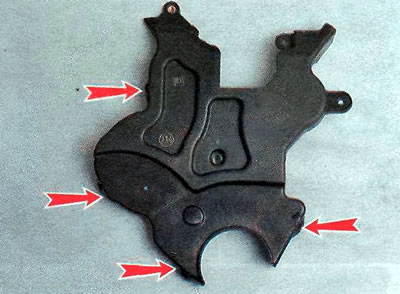
6. Disengage the four bottom cover holders one by one (for clarity, the location of the holders is…


7. Remove the bottom cover.

7. Remove the bottom cover.


8. Using a TORX E18 key with an extension, rotate the engine crankshaft by the bolt securing its pulley, achieving alignment of the timing marks on the camshaft pulleys.
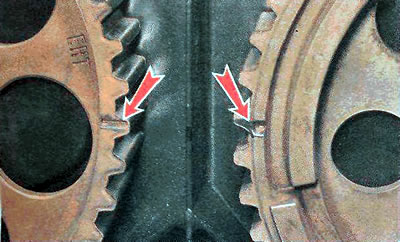


8. Using a TORX E18 key with an extension, rotate the engine crankshaft by the bolt securing its…


In this case, the mark on the toothed pulley of the crankshaft should coincide with the mark on the rear cover of the timing belt.
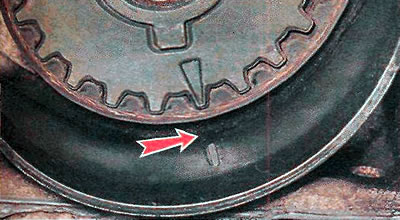
In this case, the mark on the toothed pulley of the crankshaft should coincide with the mark on the…


When the timing belt is tensioned normally, the protrusion on the moving part of the tensioner should coincide with the notch on its fixed part.
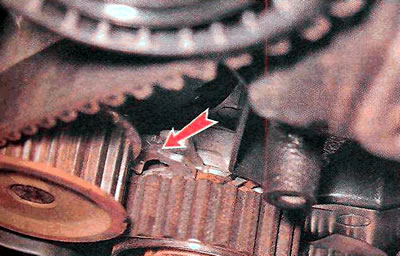
When the timing belt is tensioned normally, the protrusion on the moving part of the tensioner…


If the protrusion is offset counterclockwise relative to the cutout, then the belt tension is insufficient and therefore the tension should be adjusted (see below). If the protrusion is offset clockwise, there are two possible options: the timing belt is overtightened or the automatic tensioner is faulty. In this case, you first need to adjust the tension (see below), and then, if this does not help or the timing belt is clearly weak, you need to replace the tensioner (see "Timing Belt - Tensioner Replacement").


The following operations are required to adjust the timing belt tension.

9. Using a TORX T40 key, loosen the timing belt tension roller mounting bolt.
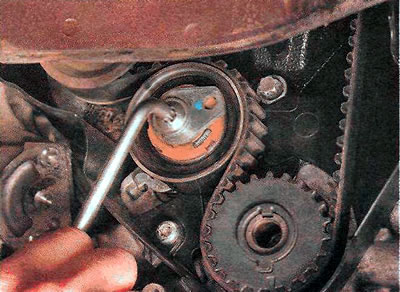
9. Using a TORX T40 key, loosen the timing belt tension roller mounting bolt.


10. Using a 6 mm Allen key, adjust the timing belt tension (clockwise to increase tension, counterclockwise to decrease tension) so that the marks on the tensioner are aligned.
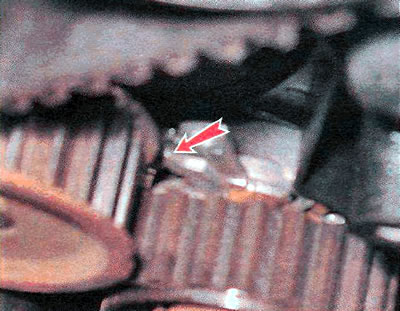
10. Using a 6 mm Allen key, adjust the timing belt tension (clockwise to increase tension,…


11. Turn the engine crankshaft two revolutions and check the alignment of the marks. If the marks do not match, the belt must be replaced.

The following operations are necessary to remove the timing belt.

Note: The timing belt must be replaced after removal, regardless of the mileage and degree of wear.


12. Once again, check the alignment of the timing marks.

13. Disconnect the camshaft position sensor wiring harness connector (see "Camshaft Position Sensor - Replacement").


14. Loosen the belt tension as much as possible (see above).

15. Remove the right support of the power unit (see "Powertrain Mounts and Rods - Replacement").

16. Remove the timing belt from all toothed pulleys.
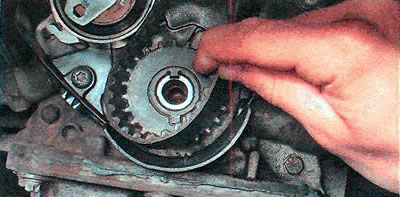
16. Remove the timing belt from all toothed pulleys.


17. Check for any play or jamming when rotating the tensioner roller 1, coolant pump pulley 2 and guide rollers 3, 4.
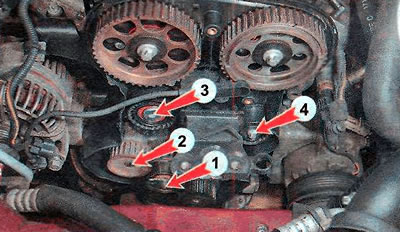
17. Check for any play or jamming when rotating the tensioner roller 1, coolant pump pulley 2 and…


If the above faults are present, we replace the damaged parts (see "Coolant Pump - Replacement", "Timing Belt - Tensioner Replacement").

To replace the guide roller 3, use the TORX T50 key to unscrew the mounting bolt and remove it.
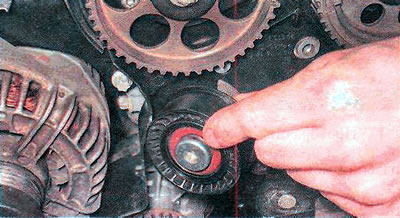
To replace the guide roller 3, use the TORX T50 key to unscrew the mounting bolt and remove it.


To replace the guide roller 4, use the TORX E10 key to unscrew its mounting bolt and remove it.
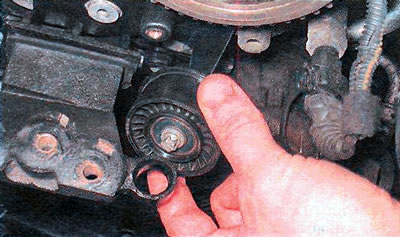


To replace the guide roller 4, use the TORX E10 key to unscrew its mounting bolt and remove it.


18. Install the parts in the reverse order. After installing the timing belt, adjust its tension (see above).

Comment.
  • 1. The timing belt may have its rotation direction indicated on it.
  • 2. The notch on the crankshaft pulley must align with the protrusion on the toothed pulley of the crankshaft.
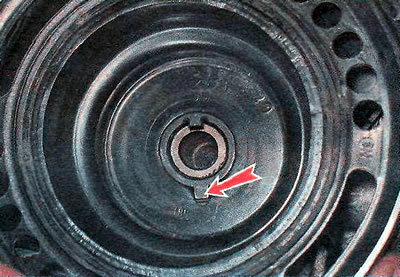

2. The notch on the crankshaft pulley must align with the protrusion on the toothed pulley of the…


This article is available at russian, bulgarian, belarusian, ukrainian, serbian, croatian, romanian, polish, slovak, hungarian
Checking the article: Chernov Alexander

Share information:

Previous articles
Opel Zafira A: Engine repair
Next articles

Accessory Drive Belt — Tensioner Replacement
Accessory Drive Belt — Checking Condition and Replacing
Engine lubrication system 1.8 DOHC — oil and oil filter replacement
Lubrication system of 1.4 and 1.6 DOHC engines — oil and oil filter replacement
Lubrication system — checking oil pressure
Checking the compression in the engine cylinders
Timing Belt — Tensioner Replacement
Cylinder head cover for 1.4 and 1.6 DOHC engines — removal, gasket replacement and installation
1.8 DOHC Engine Cylinder Head Cover — Removal, Gasket Replacement and Installation
Camshaft Seals — Replacement
Hydraulic valve lifters — replacement
Valve stem seals — replacement


See similar ones from other Opel car manuals:
▶ Checking the condition, adjusting the tension and replacing… Opel Frontera A (1991-1998, petrol)
▶ Checking the condition of the timing belt, guide and… Opel Astra H (2004-2009)
▶ Checking and adjusting the timing belt tension Opel Kadett D (1979-1984)
▶ Checking and adjusting the timing belt tension Opel Vectra A (1988-1995)
▶ Checking the condition and replacing the auxiliary drive… Opel Corsa B (1993-2000)
Link to this page in different formats

Visitor comments


No comments yet


How much will 30 + 45 =


Zafira A (1999-2005, petrol) 
  • General information
  • Governing bodies
  • User manual
  • Maintenance
  • Power unit
  • Engine repair
  • Control system
  • Cooling system
  • Exhaust system
  • Transmission
  • Clutch
  • Mechanical gearbox
  • Automatic gearbox
  • Front wheel drives
  • Chassis
  • Hubs, wheels and tires
  • Front suspension
  • Rear suspension
  • Steering
  • Brake system
  • Body
  • Maintenance and care
  • Exterior
  • Side doors
  • Climate control
  • Electrical equipment
  • Equipment and devices
  • Power devices
  • Lighting and signaling
  • Windshield wipers and washers
  • Electrical circuits
OpelBook.ru © 2017–2026 · Mobile version · · Sitemap: EN BG BY UA RS HR RO PL SK HU · Feedback · Site search
Astra F, petrol · Astra G, petrol · Astra G · Astra H · Astra J, petrol · Corsa B · Corsa C, petrol · Corsa C · Insignia A · Kadett D · Kadett E · Omega A · Omega B · Omega B2 · Vectra A, petrol · Vectra A · Vectra B, petrol · Vectra B · Vectra C · Zafira A, petrol · Frontera A, petrol · Frontera B · Ascona C · Vivaro A ·
We want your visit to be comfortable 🤝! We use cookies 🍪 to make that happen.