


- a) there is no noise or knocking in the engine (see "Engine - technical condition check"), indicating that the connecting rod or main bearings are turning or the oil pump is faulty;
- b) the engine is filled with oil with the appropriate characteristics (see "Lubrication system - oil and oil filter replacement");
- c) the oil level in the engine oil pan is within the norm (see "Checking the levels of technical fluids") and there are no oil stains under the engine;
- d) the oil pressure sensor is in good condition and its wire is not shorted to ground (see "Oil Pressure Sensor - Checking and Replacing").
Warning! Operating a vehicle with emergency engine oil pressure will result in serious engine damage and costly repairs.
To determine the exact oil pressure in the lubrication system, a pressure gauge is required.
Sequence of execution
1. Prepare the car for work (see "Preparing the car for maintenance and repair").
2. Remove the emergency oil pressure sensor (see "Oil Pressure Sensor - Checking and Replacing").
(Material copied from this portal: «OpelBook»)
3. Screw the pressure gauge tip into the sensor mounting hole.
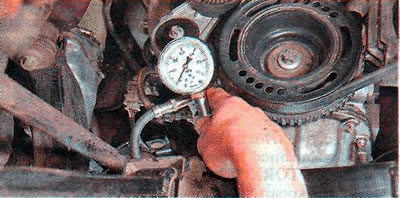
4. Start the engine and check the oil pressure. In a serviceable engine warmed up to operating temperature, the oil pressure at idle speed should be at least 30 kPa (0.3 kgf/cm²).
If the pressure is lower, the oil pump is faulty (see "Oil pump - removal, inspection and installation"), the crankshaft liners or the crankshaft itself are worn out (for verification, please contact a specialized service).
Visitor comments