


To perform the work you will need an impact screwdriver, a set of flat feeler gauges, and a caliper. It is more convenient to perform the work on a flyover or inspection pit.
Removal
1. Prepare the car for work (see "Preparing the car for maintenance and repair").
2. Remove the engine oil pan (see "Engine oil pan - removal and installation").
3. Using a 10 mm socket wrench, unscrew the three bolts securing the oil intake.
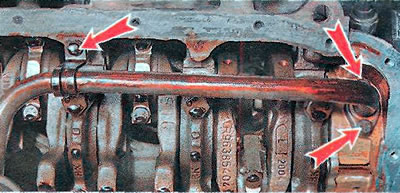
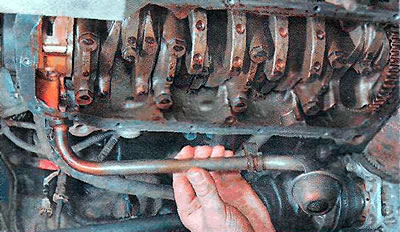
4. Remove the oil intake.
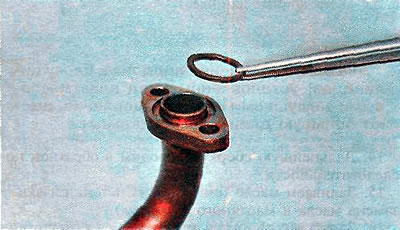
5. Remove the oil intake sealing ring. It must be replaced with a new one during assembly.
6. Remove the rear timing belt cover (see "Camshaft Seals - Replacement") and disconnect the wiring harness block from the emergency oil pressure sensor (see "Oil Pressure Sensor - Checking and Replacing").
7. If the crankshaft position sensor is installed near its pulley, move the sensor to the side without disconnecting the wiring harness block (see "Crankshaft Position Sensor - Replacement").
The further execution of the operation is similar for all cars. There are only visual differences in the shape of the front cover of the oil pump: on some cars, it has a lug for attaching the crankshaft position sensor.
8. Using a 10 mm socket wrench, unscrew the seven bolts securing the oil pump to the cylinder block.
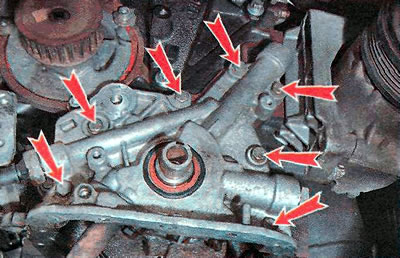
9. Lightly tap the oil pump body with a rubber-headed hammer to separate it from the cylinder block.
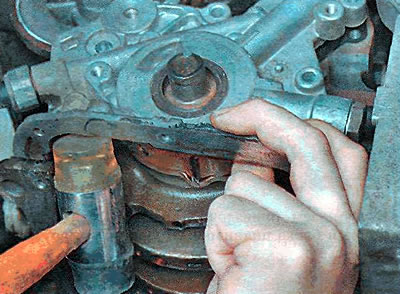
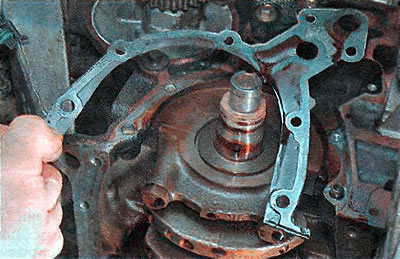
10. Remove the oil pump gasket. It must be replaced with a new one during assembly.
Examination
1. Using an impact screwdriver, carefully unscrew...
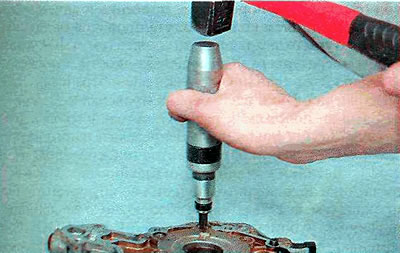
...five screws securing the oil pump cover.
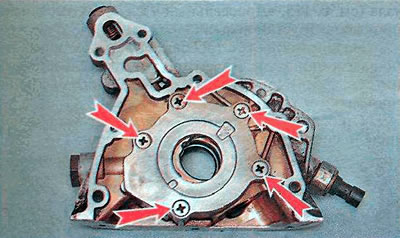
2. Remove the oil pump cover and clean the oil pump parts from oil deposits.
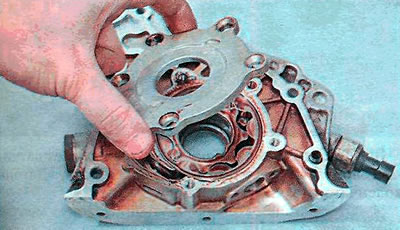
3. Place the caliper edgewise against the oil pump body. Measure the gap between the pump body and the output rotor. The gap should be within 0.400–0.484 mm. If the gap is greater than the specified value, the pump will not develop the required pressure and must be replaced.
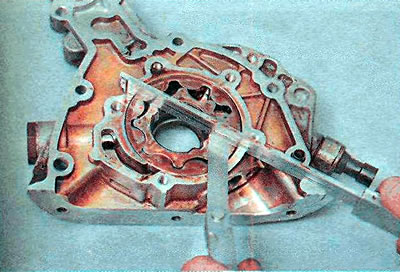
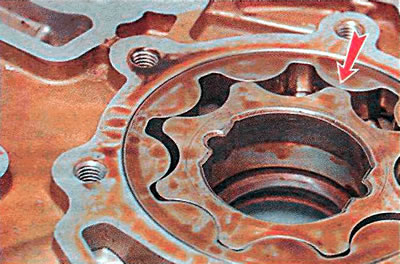
4. Measure the lateral clearance of the inner rotor. The clearance should be within 0.035-0.085 mm. If the clearance is greater than the specified value, the pump will not develop the required pressure and should be replaced.
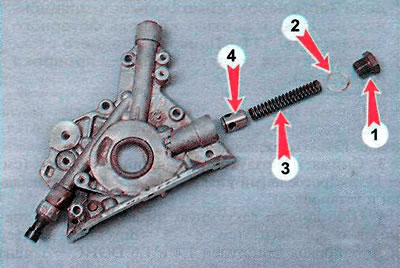
5. Using a 24 mm wrench, unscrew the plug of the pressure reducing valve.
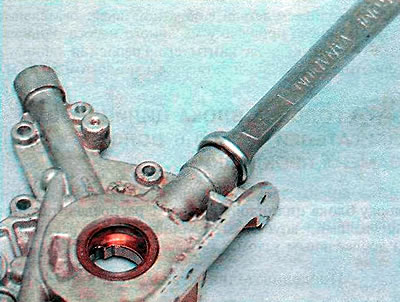
6. Remove sealing ring 2 from plug 1 (when assembling it must be replaced with a new one) and remove the pressure reducing valve spring 3 and the valve 4 itself from the oil pump housing. Clean the parts from oil deposits.
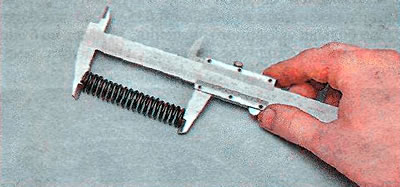
7. Measure the length of the spring in a free state. It should be 81 mm. In case of deviations from the specified values, the spring must be replaced.
8. Inspect the pressure reducing valve. Its holes should not be clogged with oil deposits and there should be no damage on its surface. If there is damage and the holes cannot be cleaned, the valve must be replaced.
9. Assemble the oil pump in reverse order. Apply Loctite 242 sealant to the oil pump cover mounting screws and tighten the screws to 8 Nm. Tighten the pressure relief valve plug to 30 Nm.
Installation
We install the parts in the reverse order. We apply RTV sealant to the new oil pump gasket, and Loctite 242 sealant to the screws of its fastening and tighten with a torque of 30 Nm.
Visitor comments