


Adjusting the parking brake
The process of adjusting the parking brake depends on the design of the rear wheel service brake. It is different for drum and disc brakes.
For drum brakes - up to mid-1995
The parking brake is adjusted by the self-adjusting mechanism of the service brake. Pulling the brake cable may cause the brake lever travel to increase, requiring adjustment. To reset the brake pads to their original position, press the brake pedal until the automatic pad installation mechanism no longer clicks. Two people are required to perform the adjustment.
1. Raise the rear of the vehicle and place it on stands.
Material was taken from a resource OPELBOOK.ru
2. Release the parking brake completely.
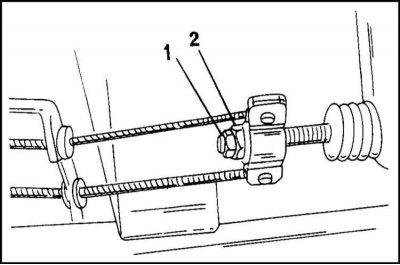
3. Loosen the adjusting rod nut (1) and tighten the adjusting nut (2) to tighten the cable. In this case, the brake pads should lightly touch the brake drum, i.e. the brake is just beginning to work.
4. Apply the parking brake three or four times and check that the wheels are locked when the brake lever is positioned on the fourth tooth of the sector.
5. In this position, tighten the lock nut to 12 Nm.
6. Release the parking brake and turn the wheels. They should rotate freely. Check the rotation of both wheels, as when one wheel rotates, the other may jam.
7. Move the parking brake lever back to 4 teeth and check if the wheels are locked.
8. Perform the test several times by applying and releasing the brake.
9. If the adjustment is successful, lower the vehicle to the ground.
10. Check the brake operation on a slope.
For disc brakes - since mid-1995
Here the gap between the brake pads and the disc drum is adjusted from the inside of the drum. The specified clearance must be adjusted before adjusting the drive cable tension.
1. Raise the rear of the vehicle and place it on stands.
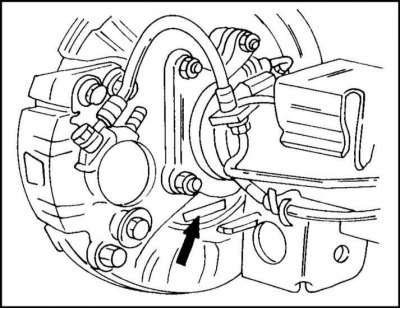
2. Remove the rubber plug from the adjustment hole on the back of the brake shield at the location shown in the illustration.
3. Insert a screwdriver into the hole and move the adjusting bolt wheel down until the brake shoes touch the drum.
4. From this position, gradually rotate the wheel until the drum becomes stationary.
5. Turn the adjusting bolt wheel in the opposite direction so that the drum can begin to turn. Usually, to do this, you need to turn the wheel back 7 - 8 teeth.
6. Finally, turn both wheels, making sure that the brake drums are not pinched by the shoes.
7. Adjust the tension of the parking brake cables as described above. The difference in this case is that the brake lever must hold the wheels when it is positioned between the 5th and 7th teeth of the sector.
For drum brakes
The drive consists of two cables, which are attached on one side to the brake pads of the rear brakes and on the other side to the equalizer located under the bottom of the car. The cables are replaced in pairs.
Removal
1. Raise the rear of the vehicle and place it on stands.
2. Use a ruler to measure the length of the protruding threaded end of the adjusting rod.
3. Record the size and loosen the adjusting nut.
4. Disconnect both cables from the equalizer.
5. Remove the brake pads and disconnect the cables from them as described above.
6. Remove the spring clip on each cable from the back of the brake shield using pliers (at the point of pressure on the shield).
7. Disconnect the cables from the guides on the floor and the wheel suspension. This may require bending the holders. Remember the cable routing diagram.
Installation
The installation of the cables is carried out in the reverse order of removal.
1. Lay the cables.
2. Install the brake pads as described in Section 3.
3. When assembling, maintain the size of the protruding part of the adjusting rod obtained earlier.
4. Adjust the parking brake as described above.
5. Lower the car onto its wheels.
6. Install the wheels and secure them.
With disc brakes
The cables are replaced in the same way as described above. The difference is that here it is not the brake drums that are removed, but the disc brakes.
Removal
1. Measure the protruding threaded end of the adjusting rod.
2. Loosen the nuts and remove the equalizer.
3. Disconnect the cables from the drive levers on the calipers.
4. Disconnect the cables from the guides on the floor and the bridge bracket.
Installation
Installation of the disc brake is performed in the reverse order of removal. Pay attention to the correct routing of the cables.
1. Tighten the cable holder mounting bolts to a torque of 9 Nm.
2. Screw on the adjusting nuts to achieve the previously obtained size.
3. Adjust the cables as described above.
Visitor comments