
OpelBook.ru
Cars AvtoVAZ Cars Mitsubishi Cars BMW Cars Mercedes Cars Nissan Cars Toyota Cars Chevrolet
English Русский
Български
Беларускі
Український
Српски
Hrvatski
Română
Polski
Slovenský
Magyar
 |  Sitemap  |  Contacts  |    


Main Astra Corsa Insignia Kadett Omega Vectra Zafira Others Articles
Frontera A (1991-1998, petrol) Frontera B (1998-2004) Ascona C (1981-1988) Vivaro A (2001-2014)
  • Main
  • Opel
  • Frontera A
  • Chassis
  • Brake system
  • Anti-lock braking system (ABS) — removal and installation

Anti-lock braking system (ABS) — removal and installation (Opel Frontera A)

            0

Contents: Replacing the front wheel speed…⬇ Replacing the rear wheel speed…⬇ Wheel Speed Sensor Guidelines ⬇ Replacing the front wheel sensor…⬇ Replacing the rear wheel sensor rotor ⬇
ABS consists of an electronic control unit, sensors located on the wheels, a hydraulic unit, valves and relays.

The ABS unit is located between the master cylinder and the brakes. The presence of ABS does not affect the design of the vacuum booster and the master brake cylinder.
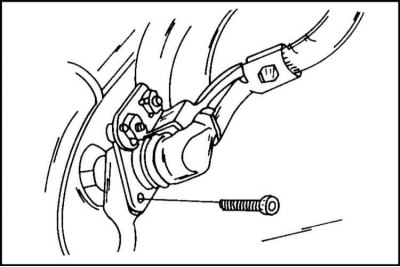
The front wheel sensors are located in the steering knuckles as shown. They control the number of…


The front wheel sensors are located in the steering knuckles as shown. They control the number of revolutions of the vehicle's wheels through gear rings mounted on the front drives.
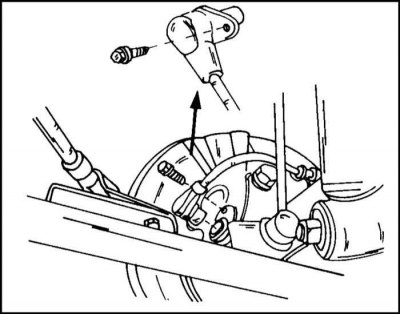
The rear wheel sensors are mounted to the rear axle beam as shown.


The rear wheel sensors are mounted to the rear axle beam as shown.


If any problems with the ABS system occur, you should contact an Opel auto repair shop that has special diagnostic equipment. If the ABS indicator lights up, you can continue driving, but the system does not work.

Replacing the front wheel speed sensors


The front wheel sensors are removed and installed as follows:

Removal


1. Disconnect the ground cable from the battery.

2. Raise and support the front of the vehicle on stands.

3. Remove the wheel, allowing access to the sensor cable.

4. Remove the plug connection in the wheel housing from the holder and unplug it using a screwdriver.

5. If there are multiple plug connections, determine which one is for the ABS sensor.

6. Disconnect the cable from the mount.

7. Use a socket wrench to unscrew the sensor mounting bolt and carefully separate it with a screwdriver.

Installation


The sensor is installed in the reverse order of removal.

1. Tighten the mounting bolt to a torque of 9 Nm.

2. Be careful not to twist the sensor cable. The cable is marked with a white line.

3. When tightening the cable mounting bolts, pay attention to the different tightening torques.

4. The lower cable mounting bolt is secured with a torque of 27 Nm, the upper cable with a torque of 6 Nm.

5. Make sure that the speed sensor is not dirty or damaged.

6. After completing the work, return the ignition key to the working position and check that the ABS indicator goes out.

Replacing the rear wheel speed sensors


Removal


1. Disconnect the ground cable from the battery, raise and support the rear of the vehicle on stands.


2. Locate the sensor cable and unplug the connector, disconnect the cable from the mount.
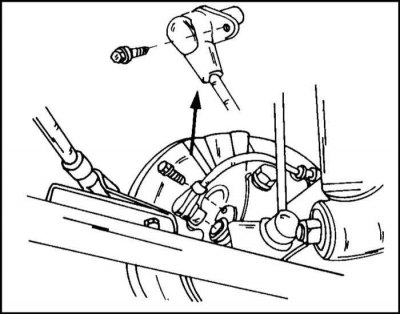
3. Unscrew the sensor. The location of the sensor on the rear suspension is shown in the…


3. Unscrew the sensor. The location of the sensor on the rear suspension is shown in the illustration.

Installation


The sensor is installed in the reverse order of removal.

1. Be careful not to twist the cable when connecting. For correct installation, the cable is marked with a white line.

2. Tighten the sensor mounting bolts to a torque of 22 Nm, and the cable mounting bolts to a torque of 27 Nm.

Wheel Speed Sensor Guidelines


The wheel speed sensor consists of a magnetic core and a coil. The operating principle of the sensor is explained in the diagram in the illustration.
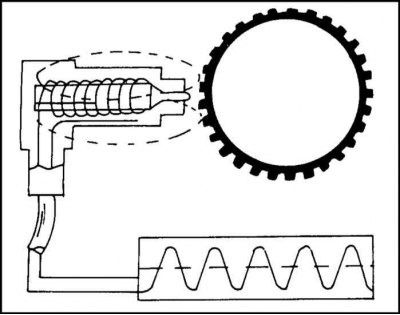
A diagram explaining the operating principle of the wheel speed sensor

A diagram explaining the operating principle of the wheel speed sensor


The pole piece projection is surrounded by a magnetic field. During rotation, the teeth of the toothed rotor intersect the magnetic field. This leads to a distortion of the field, which in turn indicates an alternating voltage in the sensor coil. The frequency of voltage change corresponds to the number of wheel revolutions. The corresponding information is sent to the control unit.

Toothed rotors (otherwise they are called impulse rings) have 54 teeth. At the front, the rotors are secured with three bolts to the inside of the hub/brake disc assembly. At the rear, the toothed rotors are pressed onto the drives.

Replacing the front wheel sensor rotor


1. Remove the front hub as described in the appropriate section.
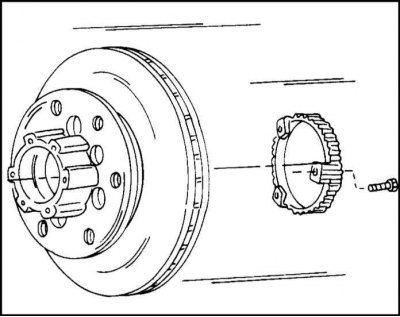
2. Remove the rotor from the inside of the wheel hub.


2. Remove the rotor from the inside of the wheel hub.

3. If the removed rotor is installed back, the tooth surfaces must be checked. They must not have any damage.

Text copied from a web portal [OpelBook.ru]

4. When installing, tighten the bolts to a torque of 18 Nm.

Replacing the rear wheel sensor rotor


1. Raise and support the rear of the vehicle on stands.

2. Remove the rear drive as described in the relevant section.


3. Remove and install the toothed rotor in connection with the replacement of the drive bearing.

4. The work mentioned is also described in Chapter Brake system


This article is available at russian, bulgarian, belarusian, ukrainian, serbian, croatian, romanian, polish, slovak, hungarian
Checking the article: Meshcheryakov Damir

Share information:

Previous articles
Opel Frontera A: Brake system
Next articles

Brake hoses for front and rear brake mechanisms
Pressure regulator — removal and installation
Parking brake — removal, installation and adjustment
Vacuum brake booster — removal and installation
Bleeding the brake system
Master Brake Cylinder — Removal and Installation


See similar ones from other Opel car manuals:
▶ Anti-lock braking system (ABS) Opel Astra F (1991-1998, petrol)
▶ General information about the anti-lock braking system Opel Corsa C (2000-2006, petrol)
▶ Anti-lock braking system and traction control system Opel Insignia A (2008-2017)
▶ Technical characteristics of the anti-lock braking system Opel Kadett E (1984-1995)
▶ Anti-lock Braking System (ABS) — Precautions Opel Omega A (1986-1993)
Link to this page in different formats

Visitor comments


No comments yet


How much will 13 + 27 =


Vivaro A (2001-2014) 
  • General information
  • User manual
  • Power unit
  • Petrol engine F4R
  • Diesel engine F9Q
  • Diesel engine G9U
  • Transmission
  • Clutch and drive shafts
  • Manual gearbox
  • Chassis
  • Front suspension
  • Rear suspension
  • Brake system
  • Body
  • Exterior
  • Interior
  • Electrical equipment
  • Heating and ventilation
  • Air conditioner
  • Equipment and devices
  • Electrical diagrams
Ascona C (1981-1988) 
  • General information
  • Maintenance
  • Power unit
  • Gasoline engines
  • Diesel engines
  • Cooling system
  • Fuel and exhaust system
  • Contact ignition system
  • Contactless ignition system
  • Transmission
  • Clutch
  • Mechanical gearbox
  • Automatic gearbox
  • Drive shafts
  • Chassis
  • Steering
  • Brake system
  • Car suspension
  • Body
  • Exterior
  • Interior
  • Doors and windows
  • Electrical equipment
  • Equipment and devices
  • Power devices
  • Electrical circuits
Frontera B (1998-2004) 
  • General information
  • User manual
  • Maintenance
  • Power unit
  • Petrol engines 2.2 l
  • Petrol engines 3.2 l
  • Diesel engines 2.2 l
  • Cooling system
  • Fuel system (petrol)
  • Fuel system (diesel)
  • Ignition system
  • Transmission
  • Clutch
  • Manual gearbox MUA5C
  • Automatic gearbox 4L30E
  • Chassis
  • Suspension and axles
  • Steering
  • Brake system
  • Body
  • Exterior
  • Interior
  • Doors, locks and windows
  • Heating and air conditioning
  • Electrical equipment
  • Power devices
  • Equipment and devices
  • Lighting and signaling
  • Electrical diagrams
Frontera A (1991-1998, petrol) 
  • General information
  • Introduction to guide
  • User manual
  • Maintenance
  • Power unit
  • Engine repair
  • Lubrication system
  • Cooling system
  • Power and exhaust system
  • Engine electrics
  • Transmission
  • Clutch
  • Mechanical gearbox
  • Cardan shafts
  • Chassis
  • Brake system
  • Front suspension
  • Rear suspension
  • Steering
  • Body
  • Repair and care
  • Electrical equipment
  • Equipment and devices
  • Electrical circuits
OpelBook.ru © 2017–2026 · Mobile version · · Sitemap: EN BG BY UA RS HR RO PL SK HU · Feedback · Site search
Astra F, petrol · Astra G, petrol · Astra G · Astra H · Astra J, petrol · Corsa B · Corsa C, petrol · Corsa C · Insignia A · Kadett D · Kadett E · Omega A · Omega B · Omega B2 · Vectra A, petrol · Vectra A · Vectra B, petrol · Vectra B · Vectra C · Zafira A, petrol · Frontera A, petrol · Frontera B · Ascona C · Vivaro A ·
We want your visit to be comfortable 🤝! We use cookies 🍪 to make that happen.