


Contents: Dimensions and weight ⬇ Mounting position ⬇ Service ⬇ Conditions for replacing the ABS…⬇ Hydro unit ⬇ ABS 8.0 ESP pressure and temperature…⬇ Technical data of the pressure sensor ⬇ Service ⬇ ABS Control Unit Wiring Harness…⬇ Wiring of contacts of the ABS…⬇ ABS Control Unit Wiring Harness…⬇ Wiring of contacts of the ABS…⬇ Bleeding the brake system ABS 8.0…⬇
The Corsa-C model, produced in 2004, uses a new anti-lock braking system ABS 8.0 in combination with all engine variants.
The ABS 8.0 system is a modular system with 8 electromagnetic valves. Its basic design corresponds to the ABS 5.3 system and is also available with the Electronic Stability Program (ESP).
With the introduction of the ABS 8.0 ESP system, for the first time in Opel vehicles the "Brake system temperature" parameter is taken into account when adjusting the brake system.
By measuring the temperature in the hydraulic unit, it is possible to determine from the characteristics whether there is a risk of overheating of the braking system when driving downhill.
The ABS/hydraulic control unit assembly has been modified. The weight of the ABS/hydraulic control unit assembly has been reduced by 25% thanks to modern microprocessor technology. At the same time, the external dimensions have been changed and, consequently, the volume of the assembly has been reduced by 30% compared to the ABS 5.3 system.
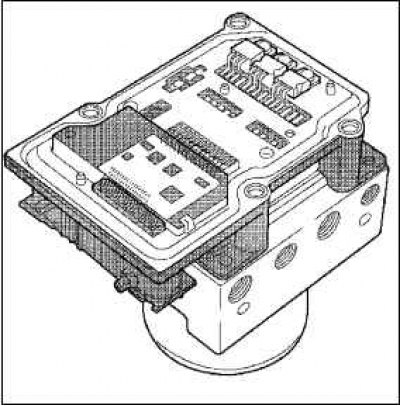
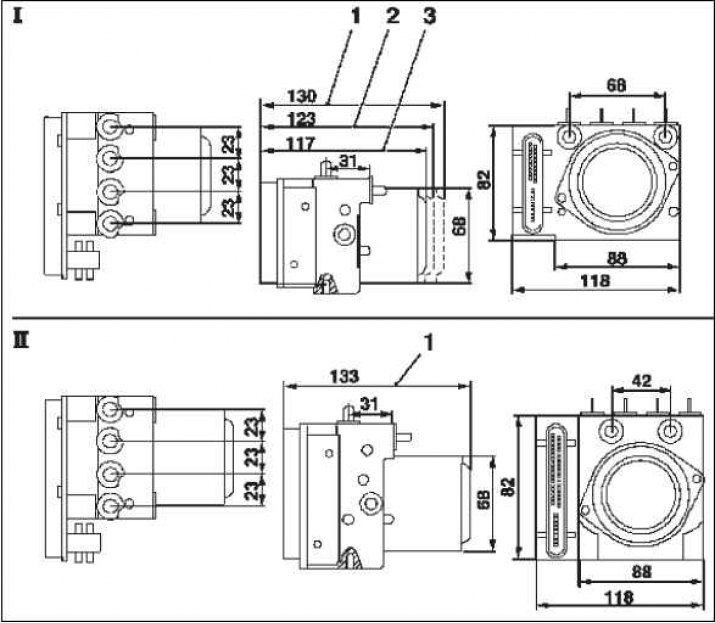
The ABS control unit can be removed from the hydraulic unit while still mounted, thanks to the horizontal mounting position in the Corsa-C model.
Externally, the ABS 8.0 system and the ABS 8.0/ESP system differ not only in size.
The diameter of the hydraulic connections on the ABS control unit from the brake master cylinder in the ABS 8.0 system is smaller than in the ABS 8.0/ESP system.
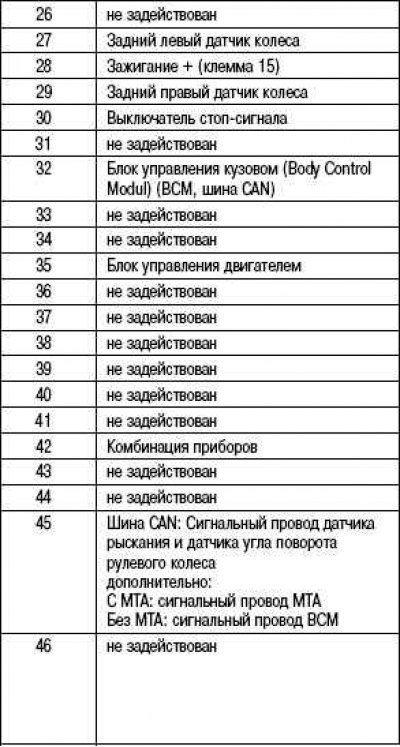
The electrical connection on the ABS control unit is 26-pole in the ABS 8.0 system and 46-pole in the ABS 8.0/ESP system.
Dimensions and weight
The weight also varies depending on the ABS 8.0 system variant.

Mounting position
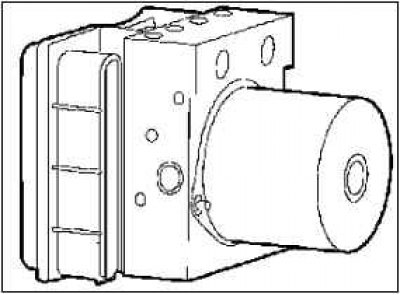
The installation position of the ABS/hydraulic unit control unit in the Corsa-C is horizontal. The hydraulic unit motor with its axle is mounted horizontally, and the connections of the individual brake drive circuits point upwards. The advantage of this installation position is that the ABS control unit can be removed during installation or repair work without removing the entire unit.
(Information taken from the website opelbook.ru)
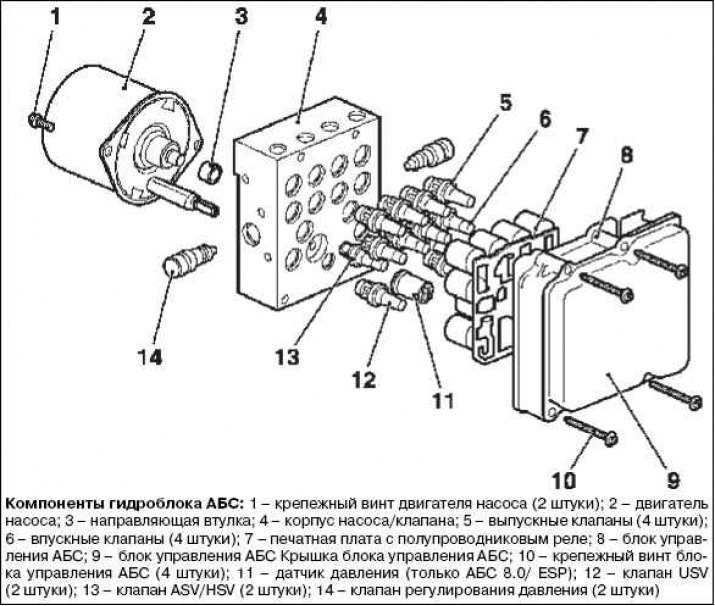
The ABS 8.0 control unit is based on the latest pulse and chip technology and is designed to connect 4 active or 4 passive wheel sensors. The Corsa-C uses active wheel sensors. The ABS 8.0 control and monitoring function is protected by two separate microprocessors 1. These microprocessors are reprogrammed accordingly. The individual components of the ABS control unit are not replaceable. In case of a defect, the entire ABS control unit must be replaced.
The electric motor of the pump in the hydraulic unit of the ABS 8.0 system is controlled via the pump housing. The electromagnetic valves of the hydraulic unit are actuated via solenoid coils. These coils are directly connected to a semiconductor relay in the ABS control unit and are thus integrated into the ABS control unit.
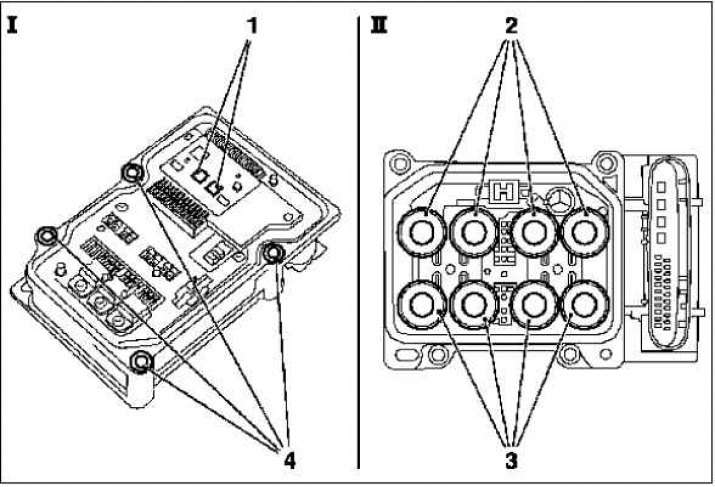
The ABS control unit is connected to the hydraulic unit by four mounting screws (4) and can be disconnected from the vehicle's hydraulic unit and removed.
Service
During repair work, it is possible to replace the components of the ABS control unit and the disconnected hydraulic unit.
The hydraulic unit is supplied pre-filled in the service department. The ABS control unit seal is not sold separately. If there is a leak between the hydraulic unit and the ABS control unit, the entire ABS control unit/hydraulic unit assembly must be replaced.
Conditions for replacing the ABS control unit
This unit should only be replaced with a new unit if the diagnostic result "ABS control unit malfunction" is inconclusive (when diagnosed using Tech 2 and the fault code "Control unit defective") or if there is visible damage to the housing or plug connector of the ABS control unit.
If the ABS control unit is disconnected from the hydraulic unit in the mounted state, attention should be paid to maximum cleanliness in the surrounding area, since even the smallest contamination in the area of the hydraulic unit valves can lead to incorrect operation.
The ABS control unit cover must not be pressed in under any circumstances. This will result in externally invisible defects in the control unit (ASG). When installing, grasp the ABS control unit only by the outer edge of the housing and pay attention to installation without applying force.
The ABS control unit must never be attached to the hydraulic unit using the mounting screws. This will result in damage to the ABS control unit and/or the hydraulic unit.
Replacement of ABS 8.0 system components, particularly in the area of the ABS control unit/hydraulic unit, may only be carried out by trained personnel with the appropriate specialist knowledge of replacement conditions and maintenance technology.
Only new parts listed in the electronic spare parts catalogue should be used as spare parts.
Hydro unit
The hydraulic unit is connected to the ABS control unit when assembled. In the version with ESP, the pressure sensor is no longer mounted externally on the hydraulic unit, as in the ABS 5.3 TC/ESP system, but is integrated into the hydraulic unit. Individual components of the hydraulic unit cannot be replaced or repaired. In the event of a defect, the hydraulic unit as a whole or the ABS control unit/hydraulic unit must be replaced accordingly.
The hydraulic connections to the master cylinder are located on the hydraulic unit in a completely different way for the ABS 8.0 and ABS 8.0 E systems. The diameter of the hydraulic connections also differs between the ABS 8.0 and ABS 8.0 ESP versions, so that it is not possible to install the wrong version of the hydraulic unit.
The spring contact pins mounted on the end surface of the ABS control unit must not be touched due to possible electrostatic discharge and no measurements must be taken. The spring contact pins cannot be replaced separately. In order to avoid damage, the gold-plated surface of the contact pins must not be machined or treated with liquids, such as, for example, liquid for treating electrical contact connections.
Also, no measurements can be made on the plug contacts for the pump motor. The contacts are not replaceable and are made at the bottom of the hydraulic unit through the valve block to the ABS control unit.
ABS 8.0 ESP pressure and temperature sensor
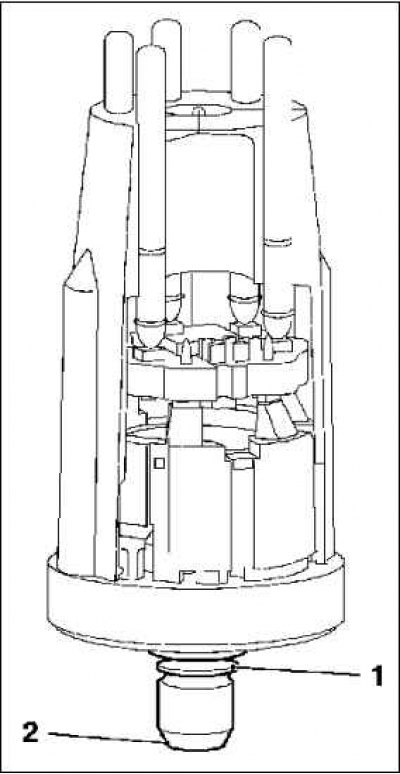
In the ABS 8.0 ESP system, the pressure sensor is no longer mounted externally on the hydraulic unit, as in the ABS 5.3 TC/ESP system, but is integrated into the hydraulic unit. The electrical connection to the ABS control unit is made via gold-plated spring contact pins. The pressure sensor is fixed in the hydraulic unit with self-locking 1 and cannot be removed. Sealing is carried out on the conical surface 2.
The pressure sensor also has a temperature sensor built into it. The temperature sensor measures the temperature of the hydraulic unit. The ABS control unit uses this data to draw conclusions about the brake system load based on the characteristics. This way, for example, it is determined whether there is a risk of overheating of the brake system when driving downhill. Due to the braking process when driving downhill, the brake discs heat up so much that the resulting heat is transferred by the brake discs through the caliper of the disc wheel brake to the brake fluid. This also increases the temperature in the hydraulic unit.
The pressure and temperature sensor, independent of the ABS control unit, has the following properties:
self-diagnosis function;
full self-diagnostic function with detection of sensitivity errors and zero offset;
2 analog outputs for pressure;
2 digital outputs for temperature.
Technical data of the pressure sensor
Pressure sensor measurement range: (0–250) bar.
Temperature sensor measurement range: (–40...+120)°C.
Power supply: 5V DC.
Service
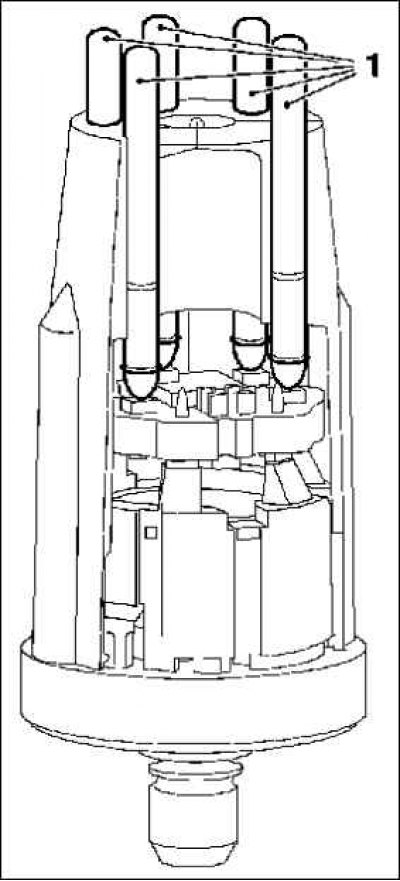
The pressure sensor is not replaced separately. The contact plate for the pressure sensor in the ABS unit, as well as spring contacts 1, has a gold-plated surface. It does not need to be subjected to mechanical processing.
The position of the pressure sensor cannot be changed (for example, by turning). The pressure sensor housing must not be subjected to mechanical stress, otherwise damage that is not visible from the outside may occur. If the pressure sensor is defective, (except for leaks) the entire hydraulic unit should be replaced. If damage to the pressure sensor is subsequently detected when the system is started, the ABS control unit should be replaced.
If there are signs of a brake fluid leak at the pressure sensor, the ABS control unit/hydraulic unit assembly should be replaced as a complete unit, since in this case damage to the ABS control unit by brake fluid can no longer be ruled out.
ABS Control Unit Wiring Harness Connector
The plug connection on the ABS control unit is designed for the 26-pole ABS 8.0 1 system and the 46-pole ABS 8.0 ESP 2 system. For both variants, there are 4 power contacts with one sealing gasket on the wiring harness connector. The dimensions of the power contacts are (2.8 x 0.8) mm.
For the ABS 8.0 system, 22 additional signal contacts are provided (for ABS 8.0 ESP system: 42 signal contacts) with dimensions (0,63 x 0,63) mm. The signal contacts are protected by a silicone seal on the ABS control unit connector
The wiring harness connector is secured after being inserted by inserting a plastic clip.
Wiring of contacts of the ABS control unit of the ABS 8.0 ESP system
See the figure with the block diagram of the hydraulic drive – ABS 8.0.
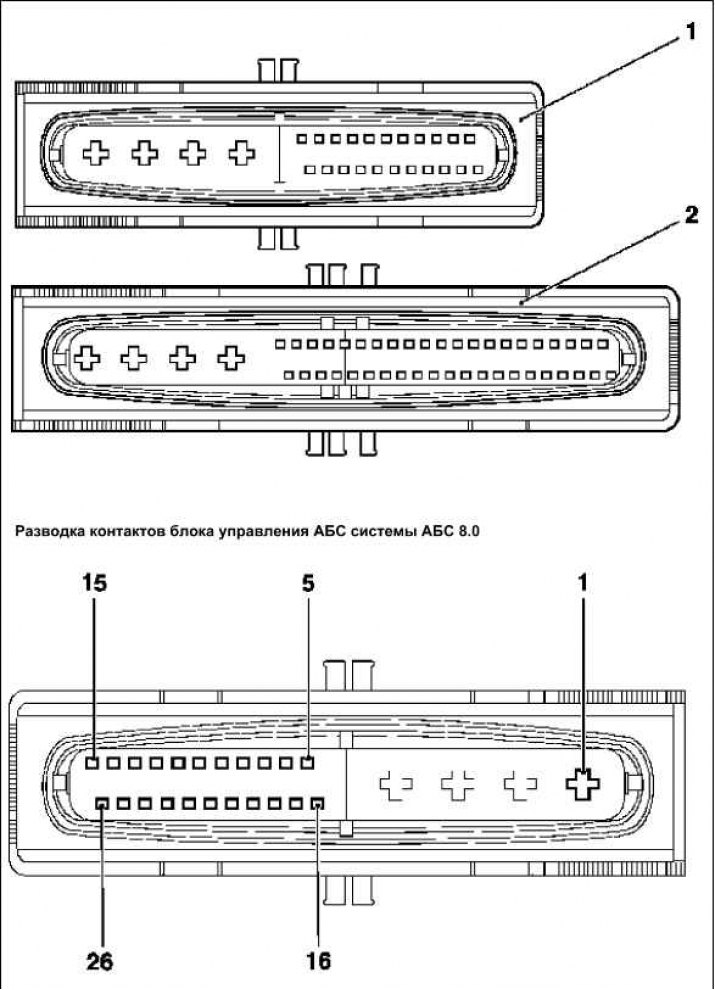
ABS Control Unit Wiring Harness Connector

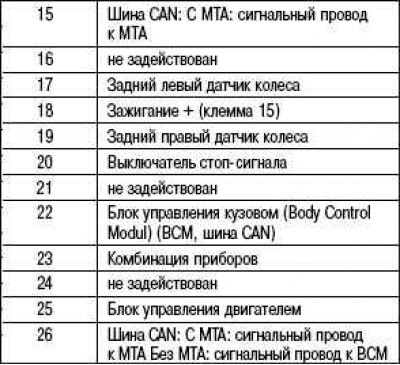
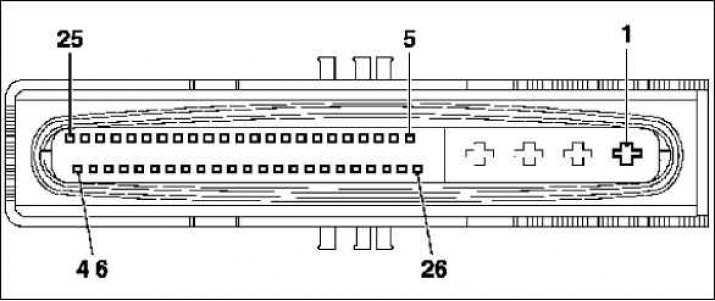
Wiring of contacts of the ABS control unit of the ABS 8.0 ESP system

Bleeding the brake system ABS 8.0 and ABS 8.0 ESP
The air is removed from the hydraulic drive of the ABS 8.0 system in the following sequence: rear right, rear left, front right and front left. In this case, you should use a brake bleeding device, which is available in the service department.
The brake fluid enters the reserve tank and is compressed by the pre-pressure of the brake bleeding device through the master brake cylinder and through the hydraulic unit into the wheel brake cylinder. The threaded air bleed plug of the corresponding brake drive circuit to be bled is opened (in the example for front right). All other air bleed screw plugs are closed.
During bleeding, the pedal can be pressed to maintain the pre-pressure and thus improve the result. The corresponding brake circuits should be bled until the brake fluid without bubbles and foam comes out and is recognized. Bleeding should logically be repeated on the other 3 wheels.
The following hydraulic diagram of the ABS 8.0 system shows an example of correct bleeding on the front left brake circuit.
Visitor comments