


General information
The anti-lock braking system (ABS) is included as standard in all models under consideration. The anti-slip system (TCS) can be installed as an optional accessory on the 2.0L models.
When a vehicle is equipped with a conventional braking system, abruptly pressing the foot brake pedal causes the wheels to lock. This disrupts the tread's grip on the road surface and the vehicle may skid, causing it to lose control. The anti-lock braking system (ABS) prevents premature wheel locking by continuously controlling the speed of the wheels during braking by modulating the hydraulic fluid pressure in each brake mechanism.
ABS consists of two main subsystems: electrical and hydraulic. The electrical part of the system includes four wheel speed sensors, a control processor, and a set of connecting electrical wiring. The hydraulic part includes a pressure modulator, disc brake calipers, and hydraulic lines connecting the components.
Operating principle of ABS brake circuit parallel configuration
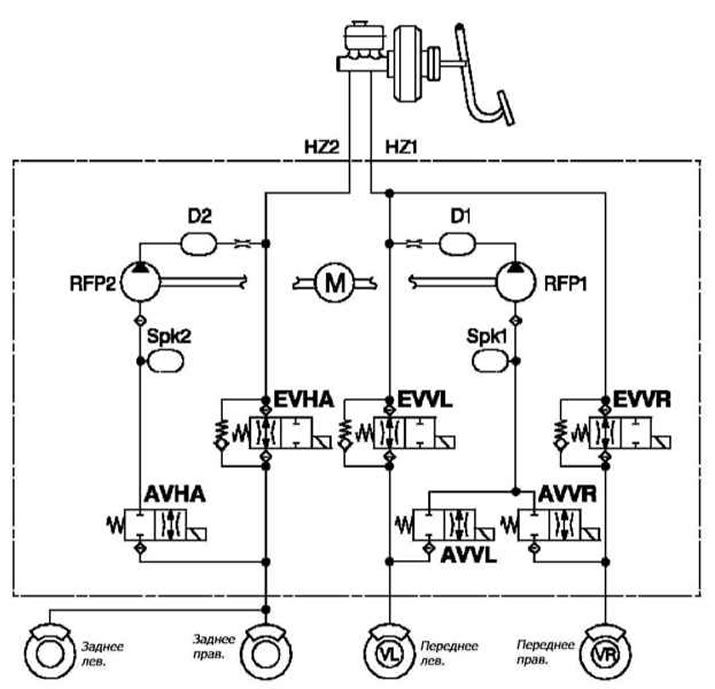
V — Front brake mechanisms
R — Right wheel brake mechanism
H - Rear brake mechanisms
L — Left wheel brake mechanism
EV — Intake Valve
AV — Exhaust valve
Normally open when there are no signs of wheel locking, the inlet solenoid valve (EV) supplies full hydraulic pressure to the wheel brakes. The "pressure holding" mode is activated when the valve is supplied with power. The required pressure reduction is achieved by actuating the outlet (AV) and inlet (EV) valves, as well as the return pump (RFP).
Operating principle of ABS brake circuit of diagonal configuration
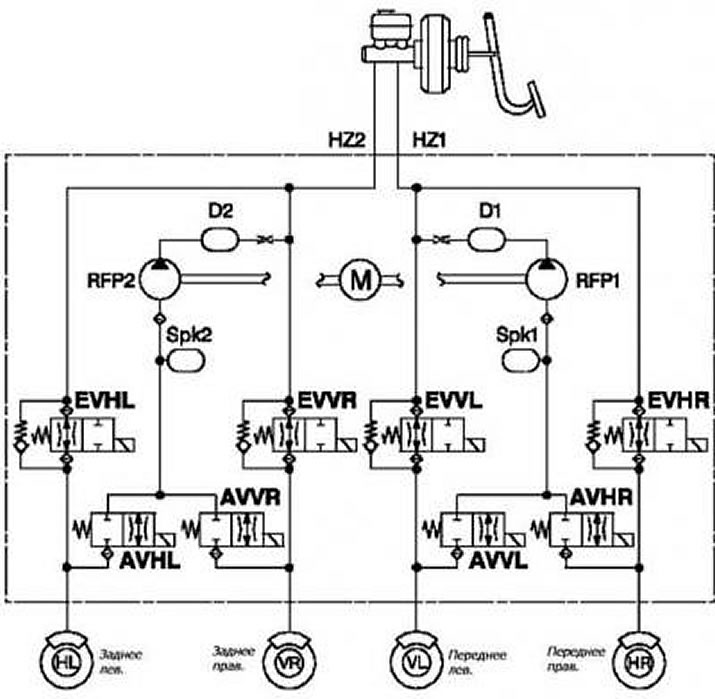
V — Front brake mechanisms
R — Right wheel brake mechanism
H - Rear brake mechanisms
L — Left wheel brake mechanism
EV — Intake Valve
AV — Exhaust valve
The brake fluid enters the accumulator and is pumped by the return pump (RFP) through the damper chamber (D) back to the master cylinder, which smooths out pressure peaks, thereby reducing noise. Control valves connected in parallel to the EV valve provide the ability to quickly reduce pressure when releasing the brake pedal.
(Material copied from this portal: «OpelBook»)
The principle of the system's operation is quite simple. Each wheel is equipped with an individual speed sensor. The sensor consists of a rotor (rings with teeth evenly spaced around their perimeter) and a sensitive element in the form of a magnetized coil. The sensitive element of the sensor records the moments when the rotor teeth pass by it and converts the information received into electrical signals that are continuously transmitted to the ABS control processor. Based on the results of processing the incoming signals, the processor receives information about the relative rotation speed of each of the wheels. While all four wheels rotate at the same frequency, the ABS is in a passive state. As soon as any of the wheels begins to lock, the processor records a change in the incoming signal and generates a command to trigger the modulator, which instantly releases the hydraulic fluid pressure in the brake mechanism of the corresponding wheel (see illustrations Operating principle of ABS brake circuit parallel configuration and Operating principle of ABS brake circuit of diagonal configuration). Immediately after the normal rotation of the wheel is restored, the processor suspends the operation of the modulator.
On models equipped with the TCS system, an additional set of control electromagnetic valves is included in the hydraulic circuit. This system operates at speeds up to 60 km/h. Control is performed based on signals coming to the control unit from wheel sensors. As soon as any of the drive wheels begins to lose traction with the road surface, the control unit issues a command to brake it, which eliminates wheel slippage when starting off from a standstill and during sharp acceleration.
In order to prevent the operation of ABS and TCS from being affected by false signals, a special safety circuit is built into their control system. When an inadequate signal is received by the control unit, as well as when the supply voltage level drops excessively, the system is automatically switched off, and the ABS indicator lamp lights up on the instrument panel (see Chapter User manual). The braking system continues to function normally.
In reality, the operation of the ABS and TCS systems is much more complex than it may seem, so the authors of this Manual do not recommend that car owners attempt to repair the system themselves. In the event of a malfunction, it would be most reasonable to contact a car service specialist, where the appropriate diagnostics will be performed using a scanner reader connected to the DLC connector (see Chapter Power and exhaust systems).
Reading ABS fault codes
When the engine is started, the ABS warning lamp on the dashboard of the vehicle should briefly come on and almost immediately go out again. If, due to some malfunction, the lamp remains on after the engine has been started, the ABS processor records the corresponding digital code in the memory of the self-diagnostic unit. The codes are read using a special scanner connected to the 16-pin diagnostic connector located under the front sill trim of the driver's door of the vehicle. If you do not have a scanner at hand, the vehicle should be driven to a service station for reading the memory and performing the necessary repairs. The identification card of ABS diagnostic codes is provided in Specifications.
Any restoration work should be carried out by car service specialists.
Clearing ABS CPU Memory
After eliminating the detected faults in the system, the processor memory must be cleared. To clear the memory, you will need a scanner again, if you do not have one at hand, the car will have to be driven to a service station. More detailed information on the scanner reader is given in Chapter Engine electrical equipment.
Visitor comments