


1. With the engine not running, press the brake pedal 4-5 times and leave the pedal pressed.
2. Start the engine. As the RPM increases, you should feel a decrease in the pedal pressure on your foot, indicating that a vacuum has developed in the booster.
3. Let the engine run for 2 minutes and stop it.
4. Press the brake pedal (ask for an assistant) and put your ear as close to the vacuum booster as possible. When you press the pedal, you should hear a "hissing" sound accompanying the process of vacuum formation. The sound disappears after 4-5 presses of the pedal.
Removal
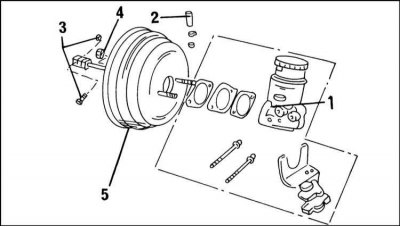
View of the brake booster
Explanations for the positions are given in the text.
1. The vacuum booster is removed in accordance with the illustration View of the vacuum brake booster.
The description applies to the model produced since mid-1995. On earlier models, the removal process is performed in a similar manner.
2. Disconnect the ground cable from the battery.
3. Remove the brake master cylinder (1) as described for the vehicle of the corresponding year of manufacture.
4. Loosen the clamp and remove the vacuum hose (2) from the pipe on the vacuum booster.
5. Disconnect the plug (3) from the brake pedal from the passenger compartment side. To do this, remove the spring clip from the end of the pusher pin.
6. Unscrew the four nuts (4) securing the amplifier (5) from the front wall of the engine compartment. The lower nut can be unscrewed using a swivel head with an extension.
7. Remove the amplifier from the engine compartment by turning it accordingly.
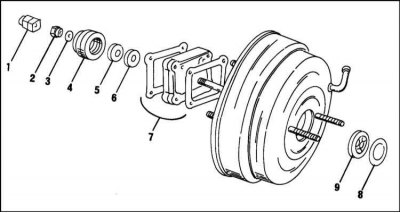
External parts of the vacuum booster
Only the parts shown in the illustration are subject to replacement during repair. Explanations for the positions are given in the text.
1. Unscrew the lock nut (2) and the fork (1).
2. Remove the clamp (3).
3. Remove the protective cover (4) from the valve body.
4. Remove the shock absorber (5).
5. Remove the filter (6), two seals and one spacer washer (7).
6. Using a screwdriver, remove the holder (8) on the other side of the brake booster and push out the bar and seal (9).
Before installing any parts, check the fork, boot, shock absorber, filter and sealing bar and replace if necessary.
Assembly
Assembly is carried out in accordance with the illustration External parts of the vacuum booster in the sequence shown. The fork mounting nut is tightened to a torque of 20 Nm.
Material taken from an internet portal OpelBook
The vacuum booster is installed in the manner described below. If the vacuum booster is replaced, it must be adjusted. It is necessary to distinguish between the old and new versions:
1. Install the vacuum booster and secure it with nuts. On vehicles produced before mid-1995, tighten the nuts to a torque of 21 Nm.
2. When installing the vacuum hose, pay attention to the direction of the arrow on the hose. The arrow should point towards the engine.
3. Other work is carried out in the reverse order of removal.
4. Finally, check the functionality of the vacuum pump as described at the beginning of this section.
If the vacuum booster was replaced with a new one
If the vacuum booster of the new series produced since mid-1995 has been replaced, the tappet cannot be adjusted by conventional means, since this requires a vacuum pump and a gauge. Here we can only hope that the adjustment of the removed part corresponds to the adjustment of the new part.
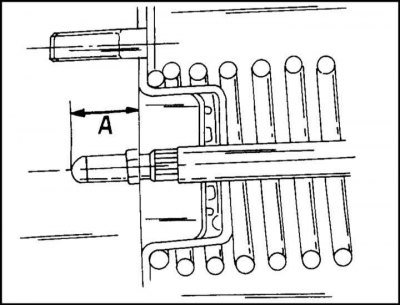
On an older vehicle, the tappet can be measured and adjusted. The protruding part of the pusher is measured from the plane of the flange on the vacuum booster to the end of the pusher. In the illustration, this is dimension "A". If this dimension is beyond 18.0-18.2 mm, the tappet lock nut is loosened and the tappet is turned. The nut is tightened to a torque of 27 Nm.
Visitor comments