


Examination
Press the brake pedal several times with the engine off to create the same pressure in the vacuum booster cavities, close to atmospheric. At the same time, by the force applied to the pedal, determine whether the valve body is jammed. Stop the brake pedal in the middle of its travel and start the engine. If the vacuum booster is in good condition, the brake pedal should move forward after starting the engine. If the pedal does not move forward, check the fastening of the hose tip, the condition of the fastening of the flange of the tip in the booster, the condition of the hose and the nipple. On cars with diesel engines, check the operability of the vacuum pump.
Removal
1. Remove the lower instrument panel trim.
2. Working under the driver's side dash, disconnect the pedal pushrod from the booster piston.
3. Remove the rubber seal from the top of the engine compartment bulkhead.
4. Remove the brake master cylinder.
5. Remove the wiring harness above the brake booster.
6. Remove the ABS hydraulic modulator and control unit.
7. Using a pry bar, remove the one-way valve from the brake booster.
8. Remove the nuts and lift the brake booster upwards out of the engine compartment.
Installation
1. Before installing the brake booster, measure the distance from the end of the brake booster pushrod to the mating surface of the brake master cylinder, which should be 149.5 mm.
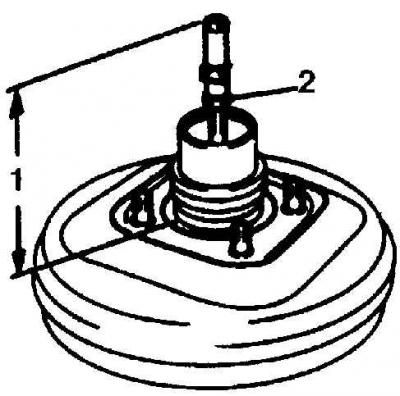
2. If adjustment is necessary, loosen the lock nut (2) and turn the pusher (1) to set the required distance.
3. Install the vacuum booster on the engine compartment bulkhead, aligning it with the pedal pusher, and secure with nuts.
4. Install the one-way valve into the brake booster sealing ring.
5. Install the ABS hydraulic modulator and control unit.
6. Reinstall the wiring harness.
7. Install the master cylinder.
8. Install the rubber seal on the top of the engine compartment bulkhead.
9. Connect the brake pedal to the pushrod.
10. Install the lower instrument panel trim.
Visitor comments