
OpelBook.ru
Cars AvtoVAZ Cars Mitsubishi Cars BMW Cars Mercedes Cars Nissan Cars Toyota Cars Chevrolet
English Русский
Български
Беларускі
Український
Српски
Hrvatski
Română
Polski
Slovenský
Magyar
 |  Sitemap  |  Contacts  |    


Main Astra Corsa Insignia Kadett Omega Vectra Zafira Others Articles
Corsa B (1993-2000) Corsa C (2000-2006, petrol) Corsa C (2000-2006)
  • Main
  • Corsa
  • Corsa B
  • Chassis
  • Brake system
  • Replacing and checking the brake booster servo vacuum pump (diesel models)

Replacing and checking the brake booster servo vacuum pump (diesel models) (Opel Corsa B)

            0

Contents: Replacement ⬇ Examination ⬇

Replacement


The vacuum pump creates the vacuum required for the brake booster to operate. The pump is mounted on the generator and is driven by its shaft.


1. Loosen the V-belt and remove it (see Chapter Vehicle settings and routine maintenance).

2. Disconnect the vacuum hose.

Vacuum pump hoses
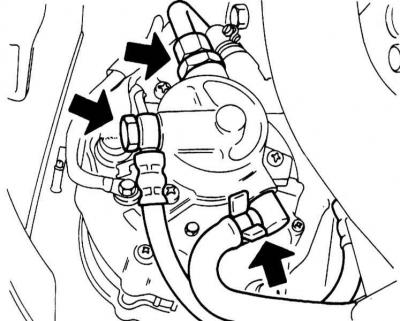
Vacuum pump hoses


3. Disconnect the oil supply hose. Loosen the clamp and disconnect the oil return hose.

4. Loosen the vacuum pump mounting screws and remove the pump with the sealing ring.

Vacuum pump mounting screws
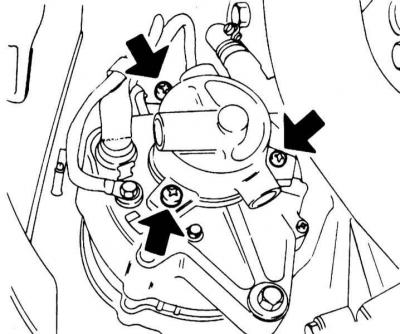
Vacuum pump mounting screws


5. Check the condition of the vacuum pump sealing ring and replace it if necessary.

6. Installation is carried out in the reverse order of disassembly of the components. Tighten the fasteners to the required force. Use a new oil supply hose seal.


Examination


1. The check is carried out using a vacuum gauge.

2. Disconnect the vacuum tube from the pump and connect the vacuum gauge using a suitable piece of hose.

3. Start the engine and let it idle, measure the depth of the vacuum created by the pump - after about one minute the device should register a reading of about 500 mm Hg. A significantly lower result indicates that the pump is out of order - consult with car service specialists. A faulty pump cannot be repaired and is replaced as an assembly.

(Text copied from this portal: «OPELBOOK.ru»)


This article is available at russian, bulgarian, belarusian, ukrainian, serbian, croatian, romanian, polish, slovak, hungarian
Checking the article: Trifonova Emilia

Share information:

Previous articles
Opel Corsa B: Brake system
Next articles

Checking the proper functioning and tightness of the brake booster
Removal, maintenance and installation of wheel cylinders of drum brake mechanisms of rear wheels
Removal, repair and installation of front wheel disc brake calipers
Removal, inspection and installation of the brake drum
Checking the condition, removing and installing the brake disc
Replacing brake linings of drum brakes
Adjusting the parking brake drive
Removal and installation parking brake cables
Replacing the brake light switch sensor
Pressure regulator valve in the hydraulic circuits of the rear wheel brake mechanisms


See similar ones from other Opel car manuals:
▶ Checking the proper functioning of the brake booster servo… Opel Astra G (1998-2004)
▶ Checking the vacuum in the brake booster system Opel Insignia A (2008-2017)
▶ Vacuum brake booster — checking, removal and installation Opel Vectra B (1995-2002)
▶ Vacuum servo unit (booster) — checking the operation Opel Ascona C (1981-1988)
▶ Checking the brake booster Opel Kadett D (1979-1984)
Link to this page in different formats

Visitor comments


No comments yet


How much will 12 + 29 =


Corsa C (2000-2006) 
  • General information
  • Introduction to guide
  • Troubleshooting
  • Vehicle device
  • User manual
  • Maintenance
  • Power unit
  • Engine repair
  • Cooling system
  • Power and exhaust system
  • Control system
  • Engine electrical equipment
  • Transmission
  • Clutch
  • Mechanical gearbox
  • Automatic gearbox
  • Drive shafts
  • Chassis
  • Brake system
  • Wheel suspension
  • Steering
  • Body
  • Exterior
  • Interior
  • Doors and windows
  • Heating and air conditioning
  • Electrical equipment
  • Equipment and devices
  • Lamps and lighting
  • Electrical circuits
Corsa C (2000-2006, petrol) 
  • User manual
  • Car access
  • Governing bodies
  • Seat control
  • Heating and air conditioning
  • Driving and maintenance
  • Engines 1.0 and 1.2 l
  • Engine repair
  • Cooling and lubrication system
  • Injection system
  • Engines 1.4, 1.6 and 1.8 l
  • Engine repair
  • Cooling and lubrication system
  • Injection system
  • Transmission
  • Clutch
  • Mechanical gearbox
  • Automatic gearbox
  • Drive shafts
  • Chassis
  • Wheels and tires
  • Wheel suspension
  • Steering
  • Brake system
  • Body
  • Exterior
  • Doors and windows
  • Electrical equipment
  • Equipment and devices
  • Lighting system
  • Electrical circuits
Corsa B (1993-2000) 
  • General information
  • Introduction to guide
  • User manual
  • Maintenance
  • Power unit
  • SOHC gasoline engines
  • DOHC gasoline engines
  • Diesel engines
  • Engine repair
  • Cooling system
  • Supply system
  • Injection system (gasoline)
  • Injection system (diesel)
  • Exhaust systems
  • Control system (gasoline)
  • Preheat system (diesel)
  • Charge and launch system
  • Transmission
  • Mechanical gearbox
  • Automatic gearbox
  • Clutch and drive shafts
  • Chassis
  • Brake system
  • Front suspension
  • Rear suspension
  • Steering
  • Body
  • Ventilation and heating
  • Exterior
  • Interior
  • Doors and windows
  • Electrical equipment
  • Equipment and devices
  • Lamps and lighting
  • Electrical circuits
OpelBook.ru © 2017–2026 · Mobile version · · Sitemap: EN BG BY UA RS HR RO PL SK HU · Feedback · Site search
Astra F, petrol · Astra G, petrol · Astra G · Astra H · Astra J, petrol · Corsa B · Corsa C, petrol · Corsa C · Insignia A · Kadett D · Kadett E · Omega A · Omega B · Omega B2 · Vectra A, petrol · Vectra A · Vectra B, petrol · Vectra B · Vectra C · Zafira A, petrol · Frontera A, petrol · Frontera B · Ascona C · Vivaro A ·
We want your visit to be comfortable 🤝! We use cookies 🍪 to make that happen.