


Remember that the dust generated during operation of the brake mechanisms may contain asbestos, which is extremely harmful to human health. Never blow off dust with compressed air or inhale it - wear a protective mask or respirator when servicing the mechanisms. Never use gasoline or petroleum-based solvents to wipe brake system components - use only branded cleaning agents or methyl alcohol!
The calipers of both brake mechanisms of one axle must be changed at the same time.
Removal
1. Remove the brake pads (see section Replacing the front disc brake pads).
2. Remove the brake fluid reservoir cap.
3. Fill the reservoir with fresh brake fluid to the top edge. Close the lid and seal the vent hole.
4. Turn the steering wheel so that the brake caliper is facing outward.
5. Disconnect the pressure hose from the caliper. Do not lose the hollow bolt sealing rings.
Fastening the caliper pressure hose
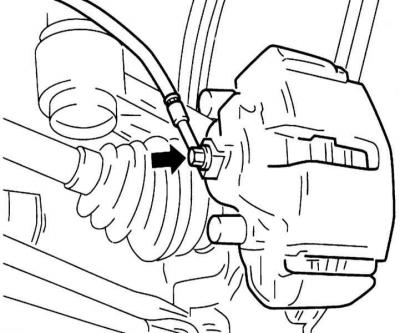
Keep the area around the brake hose and caliper clean. No dirt should get into the brake system.
6. Remove the mounting bolts and disconnect the caliper assembly from the steering knuckle.
Bolts for mounting the caliper to the steering knuckle
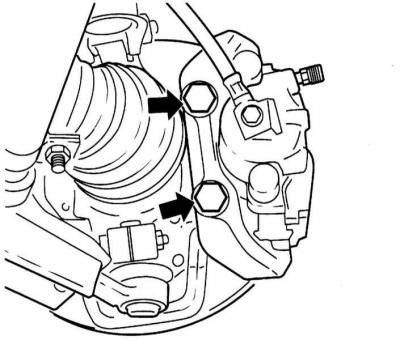
Repair
The calipers used on 1.7 l and 2.0 l diesel models are not subject to repair and, in the event of malfunction, are replaced as a whole.
1. Transfer the caliper to a workbench and thoroughly clean it from dirt and rust using a special cleaner or methyl alcohol.
Never use petroleum-based solvents to clean brake mechanisms!
2. Remove the piston from the caliper cylinder and remove the dust boot. The piston should be easily removed by hand - if necessary, connect a source of compressed air with low supply pressure to its nipple (it is most reasonable to use a foot pump) and place a wooden block between the piston and the caliper bracket.
On models with a monolithic anchor bracket, the piston is made of plastic.
Text copied from this portal [www.opelbook.ru]
3. Using a plastic applicator, remove the piston cuff from the cylinder - try not to damage the cylinder mirror.
Removal the piston sealing cuff from the mounting groove in the caliper cylinder
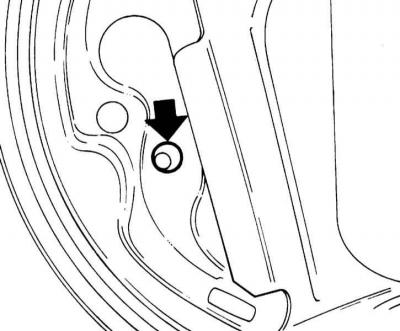
4. Press the guide bushings out of the caliper body.
5. Thoroughly wash all components with a special cleaner and dry them with compressed air - do not forget to wear safety glasses.
6. Replace damaged and worn parts. Carefully examine the condition of the working surfaces of the piston and cylinder; if defects are detected, replace the corresponding components. Check the condition of the guide pins and the holes for their fit - the pins must be free from damage and move easily enough in their seating sockets. If you are not sure of the condition of the components, replace them.
7. If you plan to install the old caliper in place, prepare all the necessary repair parts. The sealing cuffs and piston dust boots must be replaced without fail.
8. Before assembly, make sure that all components are absolutely clean and dry.
9. Place the piston and new sealing cuff in clean brake fluid, and lubricate the cylinder bore with it.
10. Use your fingers to insert the cuff into the groove of the cylinder - using any tools may damage the working surface! Fasten a new dust boot to the piston, turn it with the outer edge facing up, then insert the piston into the cylinder. Carefully press the piston into the cylinder, making rotary and reciprocating movements to avoid distortions - the outer edge of the dust boot should fall into the receiving groove on the caliper.
11. Insert the guide bushings into the caliper housing.
Installation
1. Install the caliper on the steering knuckle and tighten the mounting bolts with force 95 Nm.
2. Install the brake pads (see section Replacing the front disc brake pads).
3. Tighten the brake hose hollow bolt with force 40 Nm.
4. Check the ability to move the caliper.
5. Remove air from the hydraulic circuit of the brake system (see section Bleeding the brake system).
6. Install the front wheels so that the car is lowered to the ground and tighten the wheel mounting bolts with force 110 Nm.
Visitor comments