


Contents: Removal ⬇ Installation ⬇
Removal
To avoid the car pulling to one side during braking, the brake pads must be replaced simultaneously on both front/rear brake mechanisms. Remember that the dust generated during operation of the brake mechanisms may contain asbestos, which is extremely harmful to human health. Never blow off dust with compressed air or inhale it - wear a protective mask or respirator when servicing the mechanisms. Never use gasoline or petroleum-based solvents to wipe the brake system components - use only branded cleaning agents or methyl alcohol!
1. Set the parking brake, jack up the front of the car and place it on supports. Remove the front wheels.
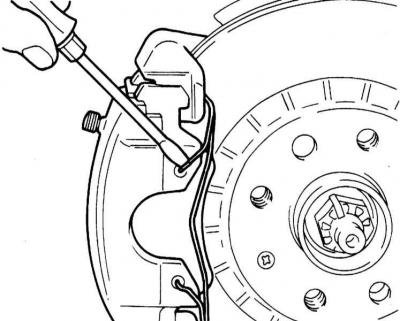
2. Use a screwdriver to disconnect the retaining clips from the brake caliper.
Removal the retaining spring from the front brake caliper
3. Use a screwdriver to pry off the two guide pin covers.
4. Unscrew the guide pins from the bracket.
Location of guide pins
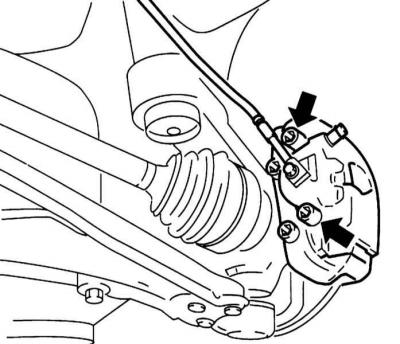
Leave the brake hose connected so that you don't have to bleed the brake system later.
5. Remove the caliper assembly with the inner brake pads and hang it on a wire from the shock absorber strut. The brake hose should not be twisted or stretched.
6. Remove the outer brake shoe from the guide.
7. Press the inner brake shoe away from the piston. The shoe is secured in the piston with a retaining clip.
If the removed brake pads are intended to be used again, they should be marked when removed. Swapping the pads around is not allowed, as this may result in uneven braking. Use original brake pads or pads approved by Opel. All front disc brake pads are replaced as a set, even though only one of them may be worn out.
Installation
Do not press the brake pedal with the brake pads removed, otherwise the piston may come out of the housing.
1. Clean the guide surface and the seat of the pads with a soft brush or wipe with a rag soaked in alcohol.
Do not use solvents containing mineral oils or sharp-edged tools for this purpose
2. Before installing the pads, check the brake disc for grooves. If there are deep grooves, give the disc a resurfacing if it is still thick enough.
3. Measure the thickness of the brake disc (see section Checking the condition, removing and installing the brake disc).
4. Check the boot for cracks. Replace a damaged boot.
5. Press the piston using a suitable device. This can be done using a wooden block or a hammer handle. Make sure that the piston is not warped and that the piston surface and dust boot are not damaged.
Pressing the piston using a special device
[Article published on the website: www.OPELBOOK.ru]
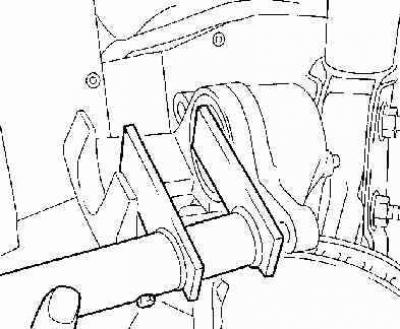
When the piston is pressed, brake fluid is squeezed out of the brake cylinder into the reservoir. Make sure that the fluid does not spill out of the reservoir and pump it out if necessary. Remember that brake fluid is poisonous. Leaked brake fluid can damage the paintwork and lead to corrosion.
6. If the brake pads are heavily worn, check the ease of movement of the piston. To do this, insert a wooden block into the caliper and ask an assistant to press the brake pedal. The piston should move in and out easily. Make sure that the piston is not pressed out completely. If the piston does not move smoothly, take the caliper in for repair.
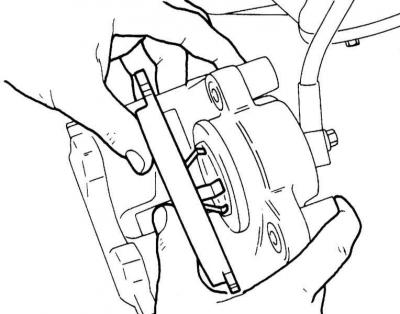
7. Install the inner brake shoe into the piston.
Installing the inner brake shoe
8. Insert the outer brake shoe into the guide.
9. Insert the caliper assembly through the brake disc from above into the guide groove.
10. Tilt the caliper assembly down and press it down.
11. Lubricate the guide pins with a locking sealant such as Loctite Type 262 and tighten them firmly 30 Nm.
12. Install the guide pin covers.
13. Insert the retaining clips into the brake caliper.
14. Install the front wheels so that the marks made during removal match. Lower the car to the ground and tighten the wheel mounting bolts with force 110 Nm.
15. Press the brake pedal hard several times until you feel resistance. This will cause the brake pads to adhere to the brake disc and take their place.
16. Check the brake fluid level in the reservoir and, if necessary, add fluid to the MAX mark.
17. Brake the car several times from 80 km/h to 40 km/h by gently pressing the brake pedal.
Avoid heavy braking for the first 200 km of driving.
Visitor comments