
OpelBook.ru
Cars AvtoVAZ Cars Mitsubishi Cars BMW Cars Mercedes Cars Nissan Cars Toyota Cars Chevrolet
English Русский
Български
Беларускі
Український
Српски
Hrvatski
Română
Polski
Slovenský
Magyar
 |  Sitemap  |  Contacts  |    


Main Astra Corsa Insignia Kadett Omega Vectra Zafira Others Articles
Corsa B (1993-2000) Corsa C (2000-2006, petrol) Corsa C (2000-2006)
  • Main
  • Corsa
  • Corsa B
  • Chassis
  • Brake system
  • Checking the condition and replacing brake lines and hoses

Checking the condition and replacing brake lines and hoses (Opel Corsa B)

            0

Approximately every six months, lift the car and check all flexible hoses connecting the steel tubes of the hydraulic circuits to the brake mechanisms of the wheels for cracks, signs of damage to the protective shell, traces of fluid leaks, swelling and other damage. Hoses are a critical and most vulnerable component of the braking system, so they must be inspected with the utmost care - use a pocket flashlight and a small mirror. If any questionable signs are detected, the suspected hose must be replaced.

Replacement steel and flexible brake lines can always be purchased at the manufacturer's branded service station, as well as in branded car accessory stores.

Under no circumstances use any replacement tubes other than branded ones, specially designed for installation in the brake circuit of your vehicle.


1. When installing brake lines, ensure that they are located at least 20 mm away from moving or vibrating components of the body, suspension or steering gear.

2. To release the union nut connections of the flexible hoses with the steel tubes of the hydraulic lines, use special open-end wrenches with a slotted head. After releasing the nut, remove the retainer and release the brake hose from the support bracket.
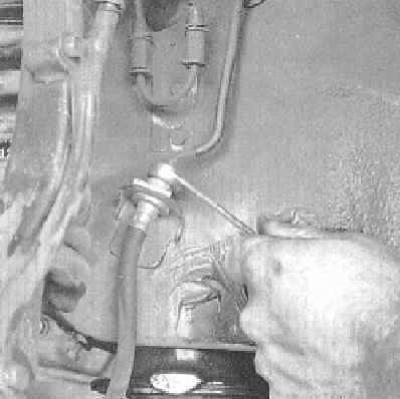
Releasing the nipple connections of flexible hoses with steel lines must be done using a special…

Releasing the nipple connections of flexible hoses with steel lines must be done using a special open-end wrench with a split head
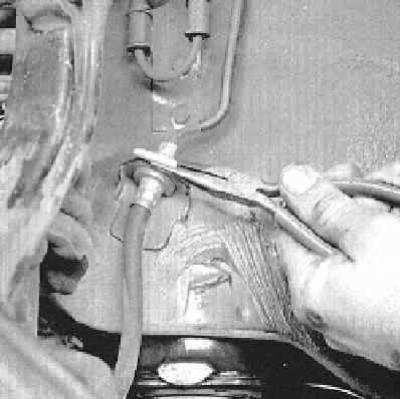


After loosening the nut, remove the retainer and release the brake hose from the bracket

After loosening the nut, remove the retainer and release the brake hose from the bracket


3. To disconnect the brake hose from the caliper, unscrew the hollow bolt of the union nut and discard its old sealing washers - during assembly, the washers must be replaced without fail.

Sealing washers for nipple connection

Sealing washers for nipple connection


4. Disconnect the two hoses using regular open-end wrenches. When connecting the units, make sure that the hoses do not twist.

5. Rigid tubes of hydraulic lines are usually fixed along their entire length in special clamps. When removing the line, make sure that it is released from all clamps. Do not forget to replace any faulty clamps when installing the lines on the car.

6. When replacing brake lines, make sure that the replacement components exactly match the size and type characteristics of the old sections removed from the vehicle. Never replace steel tubes with copper ones!


7. When installing steel tubes, ensure that they are securely fastened in all provided brackets, clamps and clips. Avoid laying the tubes too close to moving components of the suspension and steering gear.

8. After installing the new hydraulic line sections, check the fluid level in the master cylinder reservoir. If necessary, make the appropriate adjustments. Bleed the brake system (see section Bleeding the brake system). Before operating the vehicle, make sure that the brakes are functioning properly.


This article is available at russian, bulgarian, belarusian, ukrainian, serbian, croatian, romanian, polish, slovak, hungarian
Checking the article: Trifonova Emilia

Share information:

Previous articles
Opel Corsa B: Brake system
Next articles

Bleeding the brake system
Anti-lock Brake System (ABS) — General Information and Error Codes
General information about the brake system
Brake system specifications
Replacing the front disc brake pads
Removal and installation brake shoes
Replacing brake linings of drum brakes
Checking the condition, removing and installing the brake disc
Removal, inspection and installation of the brake drum
Removal, repair and installation of front wheel disc brake calipers


See similar ones from other Opel car manuals:
▶ Checking the condition and replacing brake lines and hoses Opel Astra H (2004-2009)
▶ Checking the condition and replacing brake lines and hoses Opel Vectra C (2002-2008)
▶ Checking brake lines and hoses Opel Insignia A (2008-2017)
▶ Checking the condition and replacing the engine compartment… Opel Frontera A (1991-1998, petrol)
▶ Rear Brake Pads — Checking and Replacing Opel Omega B2 (1999-2003)
Link to this page in different formats

Visitor comments


No comments yet


How much will 27 + 27 =


Corsa C (2000-2006) 
  • General information
  • Introduction to guide
  • Troubleshooting
  • Vehicle device
  • User manual
  • Maintenance
  • Power unit
  • Engine repair
  • Cooling system
  • Power and exhaust system
  • Control system
  • Engine electrical equipment
  • Transmission
  • Clutch
  • Mechanical gearbox
  • Automatic gearbox
  • Drive shafts
  • Chassis
  • Brake system
  • Wheel suspension
  • Steering
  • Body
  • Exterior
  • Interior
  • Doors and windows
  • Heating and air conditioning
  • Electrical equipment
  • Equipment and devices
  • Lamps and lighting
  • Electrical circuits
Corsa C (2000-2006, petrol) 
  • User manual
  • Car access
  • Governing bodies
  • Seat control
  • Heating and air conditioning
  • Driving and maintenance
  • Engines 1.0 and 1.2 l
  • Engine repair
  • Cooling and lubrication system
  • Injection system
  • Engines 1.4, 1.6 and 1.8 l
  • Engine repair
  • Cooling and lubrication system
  • Injection system
  • Transmission
  • Clutch
  • Mechanical gearbox
  • Automatic gearbox
  • Drive shafts
  • Chassis
  • Wheels and tires
  • Wheel suspension
  • Steering
  • Brake system
  • Body
  • Exterior
  • Doors and windows
  • Electrical equipment
  • Equipment and devices
  • Lighting system
  • Electrical circuits
Corsa B (1993-2000) 
  • General information
  • Introduction to guide
  • User manual
  • Maintenance
  • Power unit
  • SOHC gasoline engines
  • DOHC gasoline engines
  • Diesel engines
  • Engine repair
  • Cooling system
  • Supply system
  • Injection system (gasoline)
  • Injection system (diesel)
  • Exhaust systems
  • Control system (gasoline)
  • Preheat system (diesel)
  • Charge and launch system
  • Transmission
  • Mechanical gearbox
  • Automatic gearbox
  • Clutch and drive shafts
  • Chassis
  • Brake system
  • Front suspension
  • Rear suspension
  • Steering
  • Body
  • Ventilation and heating
  • Exterior
  • Interior
  • Doors and windows
  • Electrical equipment
  • Equipment and devices
  • Lamps and lighting
  • Electrical circuits
OpelBook.ru © 2017–2026 · Mobile version · · Sitemap: EN BG BY UA RS HR RO PL SK HU · Feedback · Site search
Astra F, petrol · Astra G, petrol · Astra G · Astra H · Astra J, petrol · Corsa B · Corsa C, petrol · Corsa C · Insignia A · Kadett D · Kadett E · Omega A · Omega B · Omega B2 · Vectra A, petrol · Vectra A · Vectra B, petrol · Vectra B · Vectra C · Zafira A, petrol · Frontera A, petrol · Frontera B · Ascona C · Vivaro A ·
We want your visit to be comfortable 🤝! We use cookies 🍪 to make that happen.