


Brake pads must be replaced as a set on both wheels. You cannot replace the pads on only one side if, for example, the pads on the other side are in good condition. The result of such a replacement may be uneven braking.
Brake pad material may contain asbestos, which is harmful to human health. Currently, manufacturers are replacing asbestos-containing materials with other, less harmful ones. However, the owner may not know what material his car's brake pads are made of. Therefore, do not blow off brake dust with compressed air. Avoid inhaling brake dust. Do not use gasoline-based fluids to clean brake system components - they may cause the rubber parts of the system to swell. For this purpose, it is necessary to use alcohol or special liquids.
The brake pads are removed as follows:
1. Check the fluid level in the master cylinder reservoir. If the level is higher than the set value, the liquid must be sucked out to prevent the possibility of it overflowing.
2. Remove the bolt from the bottom of the cylinder as shown and pull it out from the inside.
3. Tilt the cylinder body upward.
4. Remove both brake pads from the sides of the brake disc. This releases the washers and latches at the bottom and top.
5. Tie the support in the raised position with wire.
6. Blow compressed air or wipe the guide planes and mating surfaces in the housing with a cloth. In this case, do not use mineral solvents or tools with sharp edges.
[Material copied from this resource Opelbook.ru]
7. Check the reliability of the protective cap and the retaining ring in the caliper. Replace damaged caps.
When purchasing a brake pad repair kit, you need to find out if they match the brake booster in terms of brake pad material. Therefore, when ordering pads, it is necessary to indicate the chassis number and year of manufacture of the vehicle.
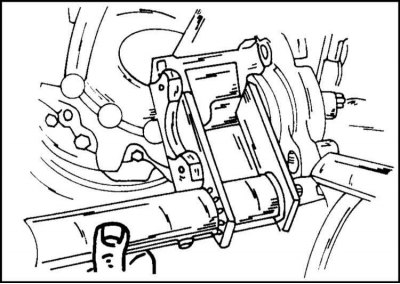
1. When installing the brake pads, press the wheel cylinder piston into the hole as shown. At the same time, it is necessary to monitor the level of brake fluid in the reservoir.
2. Install the washers and latches onto the bracket.
3. Put on the brake pads on the right and left.
4. The wear indicator on the underside of the pads should face inward.
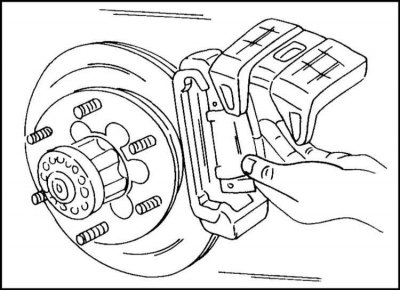
5. Lower the bracket as shown.
6. Insert the guide pin from below and secure.
7. Depending on the year of manufacture, there are design differences:
On vehicles produced before mid-1995, the tightening torque of the guide pins is 32 Nm.
On later production vehicles, the tightening torque is 74 Nm.
8. Fill the brake master cylinder reservoir with fluid to the specified level.
9. Press the brake pedal several times to position the pads relative to the brake disc.
It takes some time for the brake pads to break in. It is recommended not to press the pedal sharply during this time when braking.
Visitor comments