


Removal
Before removing and repairing the caliper, make sure you have a repair kit.
1. Raise the front of the vehicle and support it on stands.
2. Loosen the nuts and remove the wheels.
3. Remove the brake pads as described in the previous subsection.
4. To prevent fluid from leaking out of the system, it is necessary to close the tank. The best way to do this is to unscrew the tank cap and cover the hole with polyethylene. After this, the cork is screwed back on.
5. On the back of the caliper, unscrew the hollow bolt and remove the brake hose.
6. There are sealing washers on the left and right that need to be removed. At the same time, some liquid flows out. Plug the end of the hose (for example, wrap it with duct tape).
7. Unscrew the two bolts and remove the caliper.
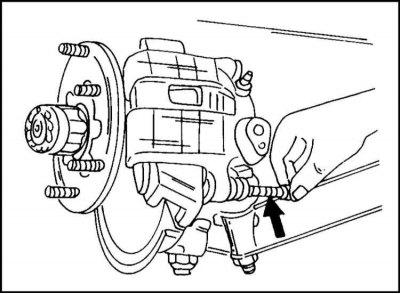
8. One of the bolts is shown in the illustration. There is a second bolt on the top side.
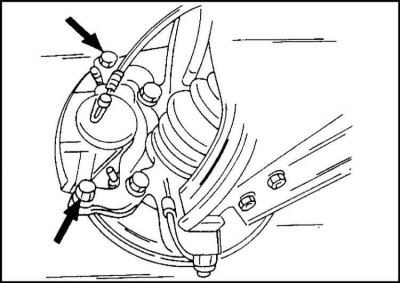
9. If necessary, remove the two steering knuckle mounting bolts. The bolts are shown in the illustration.
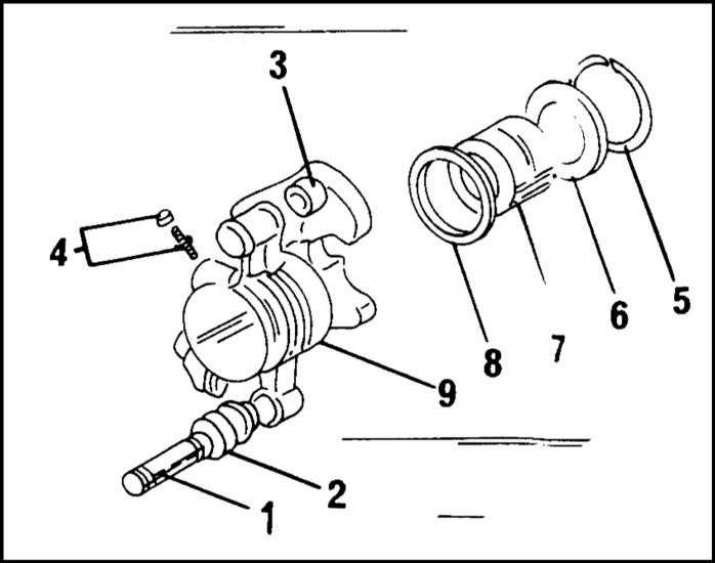
Front brake caliper parts for vehicles manufactured before mid-1995: 1 - sliding sleeve; 2 - protective cover; 3 - protective cover; 4 - air bleed nipple; 5 - retaining ring; 6 - dust ring; 7 - piston; 8 - cuff; 9 - cylinder
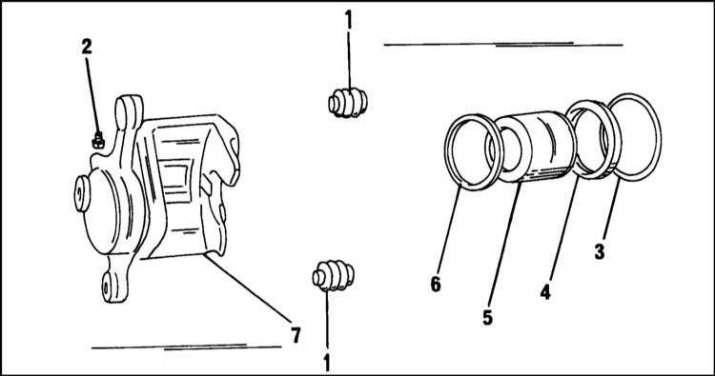
Front brake caliper parts for cars produced since mid-1995 1 - protective cover; 2 - air bleed nipple; 3 - retaining ring; 4 - dust ring; 5 - piston; 6 - cuff; 7 - support
Repair
If, when replacing the brake pads, traces of fluid are found in the area of the wheel cylinder boots, the brake cuffs can be replaced.
1. Clean the caliper thoroughly and clamp it in a vice.
2. Carefully remove the protective caps from the end of the piston and from the caliper using a screwdriver. Be careful not to damage any parts.
3. Insert a wooden block into the caliper hole (in front of the piston) and apply compressed air to the hose connection point.
4. Press the piston out of the cylinder. A foot operated pump can also be used for this purpose.
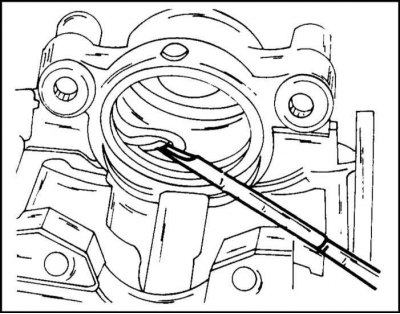
5. Remove with a blunt object (wooden or plastic) brake cuff from the cylinder as shown.
6. The front wheel caliper parts of a car manufactured since mid-1995 are shown in the illustration. Front brake caliper parts of a car manufactured since mid-1995.
Earlier models of cars have bushings inserted inside the rubber boots. New models are equipped with rubber covers that serve only as dust covers.
7. Wash all parts thoroughly in brake fluid or alcohol.
8. If the inner surface of the cylinder shows signs of severe wear, it is best to replace the caliper as a set.
9. The repair kit must be used completely, including all parts.
10. First, insert the cuff into the groove and press it firmly.
11. Lubricate the cuff with brake system lubricant or brake fluid.
12. Insert the dust cover into the piston groove.
13. Wet the piston with brake fluid and insert it into the cylinder.
14. Once the piston is partially in the bore, install the boot into the caliper. Be careful not to damage the boot.
15. Push the piston further into the cylinder until it is in the correct position. Make sure the protective cap is positioned correctly.
16. If necessary, replace the protective boots with or without bushings depending on the year of manufacture. Protective covers are installed with brake grease.
Repair of the caliper cylinder
1. After disassembling the cylinder, always replace the seals.
2. Do not install cylinders that have signs of wear, scoring or corrosion on the working surface.
3. Use only the specified grade of brake fluid. Do not use liquid that has not been used for a long time.
4. The pistons and seals are lubricated with either clean brake fluid or brake grease.
In the calipers of the design under consideration, the cylinder body moves on two sliding bushings. There is a piston inside the housing. Despite the fact that the design of both calipers under consideration is different, their removal, repair and installation are performed in the same way. The existing differences are evident from the illustrations provided.
Installing the caliper
If there are any external defects in the brake hose sealing rings, they should be replaced.
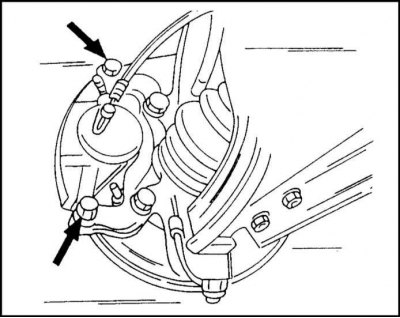
1. If the caliper guide was removed, secure it to the steering knuckle and tighten both mounting bolts shown to 212 Nm.
2. Secure the hose to the caliper, making sure it is in the correct position. In this case, one guide pin must be inserted into the caliper.
3. Tighten the hollow bolt to 35 Nm.
4. Tighten the air bleed nipples to 8 Nm and close with caps.
5. Install the brake pads as described above.
6. Remove the plastic from the tank cap.
7. Check the fluid level. Top up if necessary and close the tank with the cap.
8. Other work is performed in the reverse order of disassembly.
9. Remove air from the system as described below.
10. Finally, check the system for leaks.
11. After completing all work, check the operation of the braking system while the vehicle is moving.
Visitor comments