
OpelBook.ru
Cars AvtoVAZ Cars Mitsubishi Cars BMW Cars Mercedes Cars Nissan Cars Toyota Cars Chevrolet
English Русский
Български
Беларускі
Український
Српски
Hrvatski
Română
Polski
Slovenský
Magyar
 |  Sitemap  |  Contacts  |    


Main Astra Corsa Insignia Kadett Omega Vectra Zafira Others Articles
Frontera A (1991-1998, petrol) Frontera B (1998-2004) Ascona C (1981-1988) Vivaro A (2001-2014)
  • Main
  • Opel
  • Frontera A
  • Chassis
  • Brake system
  • Removal, repair and installation of the rear caliper

Removal, repair and installation of the rear caliper (Opel Frontera A)

            0

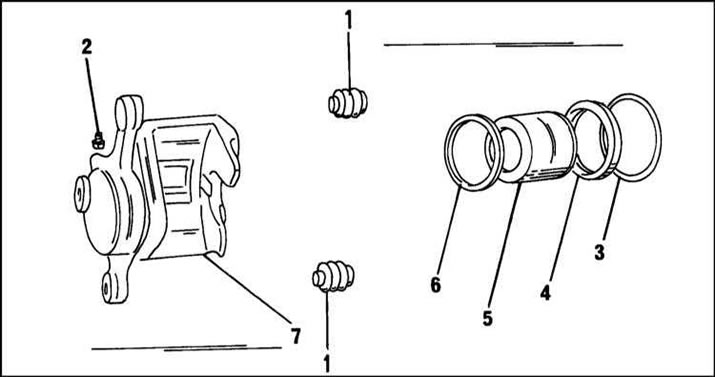
A repair kit for the caliper is available. If it is missing, the caliper must be replaced. Excluding some details, the overall appearance of the caliper is as shown in the illustration.

Front brake caliper parts for vehicles produced since mid-1995: 1 - protective cover; 2 - air bleed…

Front brake caliper parts for vehicles produced since mid-1995: 1 - protective cover; 2 - air bleed nipple; 3 - retaining ring; 4 - dust ring; 5 - piston; 6 - cuff; 7 - support


When repairing the caliper, follow the instructions given in subsection 12.1.2 for the caliper of a vehicle manufactured since mid-1995.

Installing the caliper


If there are any external defects in the brake hose connection seals, they should be replaced.

1. If the shoe guide was removed, install and bolt it to the axle housing.
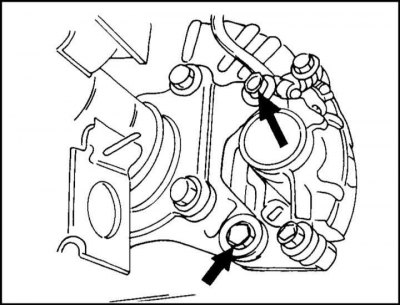
2. Tighten the bolts to a torque of 104 Nm.


2. Tighten the bolts to a torque of 104 Nm.


3. Attach the brake hose to the caliper, making sure the hose is positioned correctly. The guide pin should fit into the caliper hole.

4. Tighten the hollow brake hose connection bolt to a torque of 35 Nm.

5. Tighten the air bleed nipples to 8 Nm and close with caps.

6. Reinstall the brake pads as described above.

7. Remove the polyethylene from the filler neck of the master cylinder reservoir.

8. Add brake fluid if necessary and tighten the reservoir cap.

9. Other work is carried out in the reverse order of removal.

10. Bleed the brake system as described below.

11. After assembly, check the system for leaks.

12. Check the operation of the braking system while the vehicle is moving.

Before removing the brake disc, it must be checked for runout, as the disc may be deformed. The brake disc is secured with a Torx head bolt. However, the bolt does not fully press the disc to the wheel hub. To ensure a complete fit, one of the wheel mounting bolts is screwed with a spacer sleeve into the hub opposite the brake disc mounting bolt and clamps the hub. This ensures uniform fastening on the right and left.

The disc runout test is carried out in accordance with the description given in Section 1. Brake discs can be ground if necessary. The minimum permissible disc thickness is given in Specifications.

The brake disc is removed as follows:

1. If the wheel has already been removed, as was done above, remove the wheel mounting bolt used to check the runout.

2. Remove the brake disc and, as described in Section 2, tie the caliper to the chassis with wire.
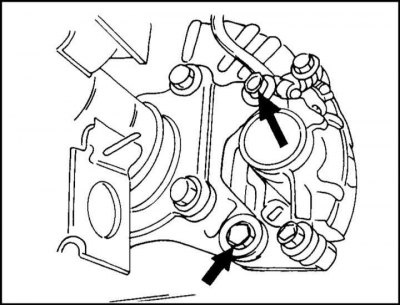


3. Remove both bolts and disconnect the guide from the brake disc.


3. Remove both bolts and disconnect the guide from the brake disc.

4. Use a special key to unscrew the mounting bolt on the end surface of the brake disc. The bolt has a Torx head.

Original posted on the website opelbook

5. Remove the brake disc from the wheel hub. If necessary, you can use a rubber mallet for this purpose.

Before installing the brake disc, clean the mating surfaces of the disc and wheel hub with fine sandpaper. If a new brake disc is installed, it must be cleaned of grease.

1. Install the brake disc and tap it with a rubber hammer.

2. Screw in and tighten the mounting bolt.

3. Check the brake disc for runout as described above.

4. Unexpected beating may be a result of foreign particles getting between the mating planes of the disc and the hub. Then disassemble the connection again, clean and reassemble.

5. Install the guide and tighten its mounting bolts to a torque of 104 Nm.

6. Install the brake shoes as described in Section 2, observing the tightening torque of the guide pins. On the rear calipers, the guide pins are tightened with a torque of 44 Nm.
7. Lower the vehicle onto its wheels and tighten the wheel mounting bolts to 110 Nm.


7. Lower the vehicle onto its wheels and tighten the wheel mounting bolts to 110 Nm.


Please note! Light alloy wheels are secured with a torque of 120 Nm.


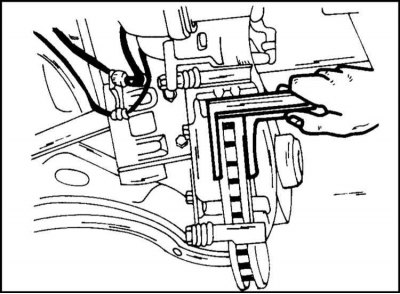
Note: The thickness of the brake discs can be measured without removing them. This is done with a caliper as shown. Please note the differences in execution.


This article is available at russian, bulgarian, belarusian, ukrainian, serbian, croatian, romanian, polish, slovak, hungarian
Checking the article: Meshcheryakov Damir

Share information:

Previous articles
Opel Frontera A: Brake system
Next articles

Removal and installation rear brake pads
Removal and installation the rear brake shield
Rear Wheel Cylinder — Removal and Installation
Replacing rear brake pads
Removal and installation the rear brake drum
Brake discs — removal and installation
Replacing the rear brake disc cover
Replacing the parking brake pads
Master Brake Cylinder — Removal and Installation
Bleeding the brake system
Vacuum brake booster — removal and installation
Parking brake — removal, installation and adjustment


See similar ones from other Opel car manuals:
▶ Rear Wheel Brake Caliper (Rear Disc Brakes) — Removal,… Opel Astra F (1991-1998, petrol)
▶ Rear Brake Caliper — Removal, Repair and Installation Opel Omega A (1986-1993)
▶ Replacing the rear brake caliper bracket Opel Insignia A (2008-2017)
▶ Removal, installation and repair of rear wheel hubs on… Opel Kadett E (1984-1995)
▶ Rear Disc Brake Caliper — Removal, Overhaul and Installation Opel Vectra A (1988-1995, petrol)
Link to this page in different formats

Visitor comments


No comments yet


How much will 46 + 41 =


Vivaro A (2001-2014) 
  • General information
  • User manual
  • Power unit
  • Petrol engine F4R
  • Diesel engine F9Q
  • Diesel engine G9U
  • Transmission
  • Clutch and drive shafts
  • Manual gearbox
  • Chassis
  • Front suspension
  • Rear suspension
  • Brake system
  • Body
  • Exterior
  • Interior
  • Electrical equipment
  • Heating and ventilation
  • Air conditioner
  • Equipment and devices
  • Electrical diagrams
Ascona C (1981-1988) 
  • General information
  • Maintenance
  • Power unit
  • Gasoline engines
  • Diesel engines
  • Cooling system
  • Fuel and exhaust system
  • Contact ignition system
  • Contactless ignition system
  • Transmission
  • Clutch
  • Mechanical gearbox
  • Automatic gearbox
  • Drive shafts
  • Chassis
  • Steering
  • Brake system
  • Car suspension
  • Body
  • Exterior
  • Interior
  • Doors and windows
  • Electrical equipment
  • Equipment and devices
  • Power devices
  • Electrical circuits
Frontera B (1998-2004) 
  • General information
  • User manual
  • Maintenance
  • Power unit
  • Petrol engines 2.2 l
  • Petrol engines 3.2 l
  • Diesel engines 2.2 l
  • Cooling system
  • Fuel system (petrol)
  • Fuel system (diesel)
  • Ignition system
  • Transmission
  • Clutch
  • Manual gearbox MUA5C
  • Automatic gearbox 4L30E
  • Chassis
  • Suspension and axles
  • Steering
  • Brake system
  • Body
  • Exterior
  • Interior
  • Doors, locks and windows
  • Heating and air conditioning
  • Electrical equipment
  • Power devices
  • Equipment and devices
  • Lighting and signaling
  • Electrical diagrams
Frontera A (1991-1998, petrol) 
  • General information
  • Introduction to guide
  • User manual
  • Maintenance
  • Power unit
  • Engine repair
  • Lubrication system
  • Cooling system
  • Power and exhaust system
  • Engine electrics
  • Transmission
  • Clutch
  • Mechanical gearbox
  • Cardan shafts
  • Chassis
  • Brake system
  • Front suspension
  • Rear suspension
  • Steering
  • Body
  • Repair and care
  • Electrical equipment
  • Equipment and devices
  • Electrical circuits
OpelBook.ru © 2017–2026 · Mobile version · · Sitemap: EN BG BY UA RS HR RO PL SK HU · Feedback · Site search
Astra F, petrol · Astra G, petrol · Astra G · Astra H · Astra J, petrol · Corsa B · Corsa C, petrol · Corsa C · Insignia A · Kadett D · Kadett E · Omega A · Omega B · Omega B2 · Vectra A, petrol · Vectra A · Vectra B, petrol · Vectra B · Vectra C · Zafira A, petrol · Frontera A, petrol · Frontera B · Ascona C · Vivaro A ·
We want your visit to be comfortable 🤝! We use cookies 🍪 to make that happen.