


Removal
1. Where applicable, remove the hubcaps, then loosen the rear wheel bolts. Block the front wheels, jack up and support the rear of the vehicle on axle stands. Remove the wheel.
2. Remove the brake pads as described in Chapter 5.
3. When working in the engine compartment, remove the brake fluid reservoir cap and cover the filler neck with a piece of polyethylene, securing it with a rubber band or reinstalling the cap. This will reduce fluid loss during the next procedure.
4. Unscrew the brake pipe coupling nut from the back of the caliper and disconnect the pipe. Try not to deform the pipe. Be prepared for fluid to escape and plug any openings to prevent dirt from entering and further fluid loss.
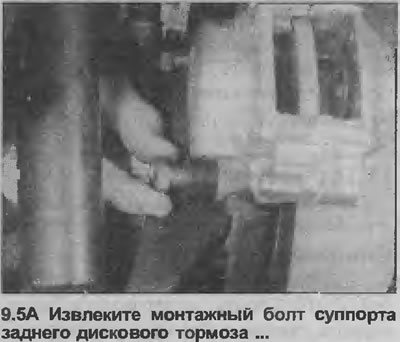
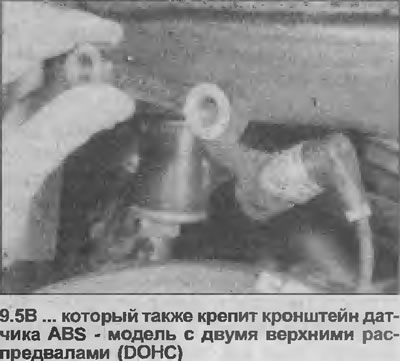
5. Unscrew the two mounting bolts and remove the caliper, bearing in mind that on models with two overhead camshafts (DOHC), the caliper mounting bolts also secure the ABS sensor bracket (see illustrations).
Bulkhead
6. If it is not necessary to disassemble the caliper, proceed to step 20.
7. Clean off any dirt and dust from the caliper, being careful not to inhale any airborne particles.
8. Do not attempt to separate the two halves of the caliper under any circumstances.
9. Using a screwdriver as a lever, remove the mounting brackets from the piston dust seals, then carefully remove the dust seals themselves in the same way.
Article posted on a web portal (opelbook.ru)
10. Use a clamp to secure one of the pistons. By pumping air into the brake hose hole at the rear of the caliper body, for example with a foot pump (air pressure should be low), drive the piston out of the hole. Be careful not to drop the piston - this can lead to damage.
11. Cover the caliper hole using a flat block or something similar. Then remove the clamp from the remaining piston and drive the piston out in the same way
12. Carefully remove the seals from the grooves in the caliper channels using a plastic or wooden tool.
13. Inspect the pistons and caliper bore walls for scratches and other damage. If damage is found, replace the caliper assembly.
14. If the pistons and bores are in good condition, discard the seals and purchase a repair kit containing all the necessary parts. Also purchase a tube of special paste for brake cylinders.
15. Clean the piston and cylinder bore with brake fluid or methyl alcohol.
16. Apply a small amount of brake cylinder paste to the pistons, cylinder walls and piston seals.
17. Begin assembly by installing the seals into the caliper channels.
18. Install the dust seals into the piston bores. Carefully insert the pistons into the bores and push them part way in. You may need to rotate the pistons appropriately to allow them to move in the bore.
19. Insert the dust seals into the edges of the caliper channels and install the mounting brackets.
Installation
20. Install the caliper and tighten the mounting bolts with the specified tightening force Specifications (don't forget to install the ABS sensor bracket where applicable).
21. Connect the brake pipe to the caliper and tighten the connecting nut.
22. Install the brake pads as described in Chapter 5.
23. Remove the polyethylene from the filler neck of the replenishment tank and bleed the corresponding hydraulic line as described in Chapter 3.
24. Install the wheel and lower the vehicle to the ground. Do not fully tighten the wheel bolts until the vehicle is lowered onto the wheels.
Visitor comments