
OpelBook.ru
Cars AvtoVAZ Cars Mitsubishi Cars BMW Cars Mercedes Cars Nissan Cars Toyota Cars Chevrolet
English Русский
Български
Беларускі
Український
Српски
Hrvatski
Română
Polski
Slovenský
Magyar
 |  Sitemap  |  Contacts  |    


Main Astra Corsa Insignia Kadett Omega Vectra Zafira Others Articles
Vectra A (1988-1995, petrol) Vectra A (1988-1995) Vectra B (1995-2002, petrol) Vectra B (1995-2002) Vectra C (2002-2008)
  • Main
  • Vectra
  • Vectra A
  • Chassis
  • Brake system
  • Brake hydraulic system — bleeding

Brake hydraulic system — bleeding (Opel Vectra A)

            0

Contents: General description ⬇ Pumping - a method for two people ⬇ Bleeding - using a non-return valve ⬇ Bleeding - using a pressure bleeding…⬇

General description


1. If any of the brake hydraulic system components has been removed, the system must be bled after its installation.

2. If a component of one of the circuits has been removed, then only that circuit needs to be bled. If the master cylinder or pressure control valve has been removed, or the drop in fluid level has allowed air to enter the system, the system must be bled completely (both contours).

3. There are three bleeding methods (see below). Opel recommends using a pressure bleeding kit.

Pumping - a method for two people


4. Prepare a clean glass container, a plastic or rubber tube of suitable length that fits tightly onto the bleed nipple. You will need the help of a second person.

5. Remove the dust cap and clean the bleed nipple and the mating surface of the corresponding caliper or wheel cylinder (see illustration). Place the tube prepared for bleeding on the nipple. If the entire hydraulic system is being bled, start bleeding each circuit from the front wheel (models without ABS), on models with ABS, bleed the front circuit first.
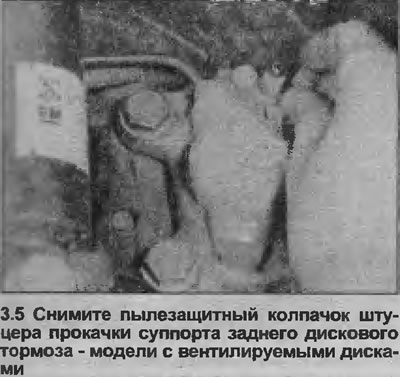
5. Remove the dust cap and clean the bleed nipple and the mating surface of the corresponding…


6. Make sure the master cylinder reservoir is full. Release the vacuum from the booster by pressing the brake pedal several times.


7. Place the other end of the plastic tube into the reservoir, having previously filled it with brake fluid to cover the end of the tube. The reservoir should be installed approximately 300 mm above the bleed nipple.

8. Open the bleeder screw half a turn and have an assistant slowly press and release the brake pedal until it stops. Squeeze the bleeder screw at the end of each pedal stroke to prevent air and fluid removed from the screw from being drawn back into the system.

9. Keep an eye on the end of the tube immersed in the reservoir. When air bubbles stop coming out, tighten the bleed nipple securely. Ask an assistant to keep the pedal depressed while you tighten the nipple.

10. Add fluid to the reservoir. Throughout the bleeding procedure, maintain the fluid level in the reservoir at least above the connecting holes to the master cylinder. If the holes open, air will enter the system and the bleeding will have to be repeated.

11. Bleed the diagonally opposite rear brake in the same way (models without ABS).

12. Remove the plastic tube from the nipple. Never pour the fluid drained during bleeding back into the system.

13. After bleeding, bring the fluid level in the reservoir to normal. Press the brake pedal and make sure that it moves smoothly and without "dips" indicating the presence of air in the system.

Material copied from this website: opelbook.ru

Bleeding - using a non-return valve


14. There are a number of accessory bleeding kits available for this method. It is recommended that you use one of these kits as they make bleeding much easier and also reduce the risk of air and fluid being drawn back into the system.


15. Proceed as described in points 5 and 6.

16. Connect the appropriate tube of the bleeder kit to the nipple, then unscrew the nipple half a turn. Press the brake pedal all the way down and release it slowly. The non-return valve of the kit will prevent the removed air from getting back into the system. Repeat this procedure until the fluid coming out of the nipple is free of air bubbles. Clamp the bleeder nipple and remove the tube.

17. Proceed as described in points 11-13.

Bleeding - using a pressure bleeding kit.


18. Kits are sold at parts stores and are usually powered by a tank of compressed air.

19. Attach the sealed, brake fluid-filled container from the kit to the master cylinder reservoir and to a compressed air tank. Bleed by opening each nipple in turn (in the above sequence) and draining the liquid until it is free of air bubbles.

20. This method has advantages because the large amount of fluid prevents air from entering the master cylinder during bleeding.

21. Bleeding under pressure is especially effective when bleeding "complex" systems, or when completely bleeding the system during the next fluid change. Opel recommends using this method.

22. Start pumping as described in points 5 and 6, then proceed as described in points 11-13.


This article is available at russian, bulgarian, belarusian, ukrainian, serbian, croatian, romanian, polish, slovak, hungarian
Checking the article: Chernov Alexander

Share information:

Previous articles
Opel Vectra A: Brake system
Next articles

Anti-lock braking system (ABS) — general description
General description of the braking system
Brake system specifications
Front brake pads — inspection, removal and installation
Rear Disc Brake Pads — Inspection, Removal and Installation
Rear brake shoes (drum brakes) — inspection, removal and installation
Handbrake pads (rear disc brakes) — inspection, removal and installation
Front Brake Caliper — Removal, Overhaul and Installation
Rear Disc Brake Caliper — Removal, Overhaul and Installation


See similar ones from other Opel car manuals:
▶ Bleeding the hydraulic brake system Opel Astra J (2009-2015, petrol)
▶ Bleeding air from the hydraulic drive of the service brake… Opel Corsa C (2000-2006, petrol)
▶ Bleeding the brake hydraulic system without special… Opel Kadett E (1984-1995)
▶ Hydraulic brake system Opel Insignia A (2008-2017)
▶ Hydraulic system — bleeding Opel Omega A (1986-1993)
Link to this page in different formats

Visitor comments


No comments yet


How much will 22 + 42 =


Vectra C (2002-2008) 
  • General information
  • User manual
  • Vehicle device
  • Maintenance
  • Troubleshooting
  • Power unit
  • Engine repair
  • Cooling system
  • Power and control system
  • Engine electrics
  • Transmission
  • Clutch
  • Car gearbox
  • Drive shafts
  • Chassis
  • Car suspension
  • Steering
  • Brake system
  • Body
  • Exterior
  • Interior
  • Doors, locks and windows
  • Heating and ventilation
  • Electrical equipment
  • Equipment and devices
  • Headlights and lighting
  • Electrical circuits
Vectra B (1995-2002) 
  • General information
  • User manual
  • Weekly checks
  • Maintenance (gasoline)
  • Maintenance (diesel)
  • Troubleshooting
  • Power unit
  • SOHC gasoline engine
  • DOHC petrol engine
  • Diesel engine 1.7 liter
  • Diesel engine 2.0 liters
  • Engine repair
  • Cooling system
  • Fuel system (gasoline)
  • Fuel system (diesel)
  • Charging system
  • Launch system
  • Ignition and preheat
  • Transmission
  • Clutch
  • Mechanical gearbox
  • Automatic gearbox
  • Drive shafts
  • Chassis
  • Brake system
  • Wheel suspension
  • Steering
  • Body
  • Exterior
  • Interior
  • Doors and windows
  • Heating and ventilation
  • Electrical equipment
  • Equipment and devices
  • Electrical circuits
Vectra B (1995-2002, petrol) 
  • General information
  • Maintenance
  • Help with malfunctions
  • Power unit
  • Engine repair
  • Exhaust system
  • Cooling system
  • Fuel system
  • Multec injection system
  • Four point injection
  • Transmission
  • Clutch
  • Gearbox and drive
  • Chassis
  • Wheel suspension
  • Steering
  • Brake system
  • Wheels and tires
  • Body
  • Exterior
  • Interior
  • Electrical equipment
  • Fuses and electronics
  • Power devices
  • Ignition system
  • Lighting and signaling
  • Equipment and devices
  • Heating and ventilation
  • Electrical circuits
Vectra A (1988-1995) 
  • Power unit
  • Engine repair
  • Ignition system
  • Lubrication system
  • Cooling system
  • Injection system
  • Fuel system (carburetor)
  • Fuel system (diesel)
  • Exhaust system
  • Transmission
  • Clutch
  • Car gearbox
  • Chassis
  • Front suspension
  • Rear suspension
  • Steering
  • Brake system
  • Wheels and tires
  • Body
  • Exterior
  • Interior
  • Electrical equipment
  • Electrical circuits
Vectra A (1988-1995, petrol) 
  • General information
  • User manual
  • Maintenance
  • Power unit
  • SOHC engine
  • DOHC engine
  • Cooling and ventilation
  • Fuel system (carburetor)
  • Fuel system (injector)
  • Exhaust converter
  • Transmission
  • Clutch
  • Mechanical gearbox
  • Automatic gearbox
  • Drive shafts
  • Chassis
  • Brake system
  • Car suspension
  • Steering
  • Body
  • Body elements
  • Electrical equipment
  • Power devices
  • Equipment and devices
  • Electrical circuits
OpelBook.ru © 2017–2026 · Mobile version · · Sitemap: EN BG BY UA RS HR RO PL SK HU · Feedback · Site search
Astra F, petrol · Astra G, petrol · Astra G · Astra H · Astra J, petrol · Corsa B · Corsa C, petrol · Corsa C · Insignia A · Kadett D · Kadett E · Omega A · Omega B · Omega B2 · Vectra A, petrol · Vectra A · Vectra B, petrol · Vectra B · Vectra C · Zafira A, petrol · Frontera A, petrol · Frontera B · Ascona C · Vivaro A ·
We want your visit to be comfortable 🤝! We use cookies 🍪 to make that happen.