


Inspection
1. Where applicable, remove the hubcaps, then loosen the rear wheel bolts. Block the front wheels, jack up and support the rear of the vehicle on axle stands. Remove the rear wheels.
2. Inspect the brake linings on the pads of both wheels. Make sure that the thickness of the brake lining pads (including metal base) greater than the minimum value given in Specifications.
3. If any one of the brake pads is worn beyond this limit, replace all rear pads as a set.
Removal
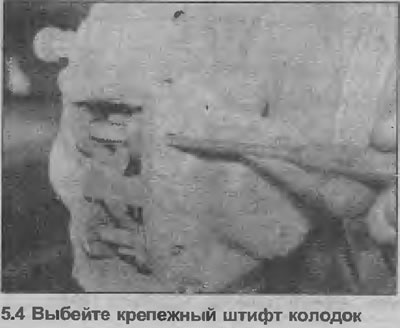
4. Note the location of the brake shoe pressure spring, then knock out the upper and lower shoe mounting pins from the outside of the caliper using a punch (see illustration).
5. Remove the pressure spring (see illustration).
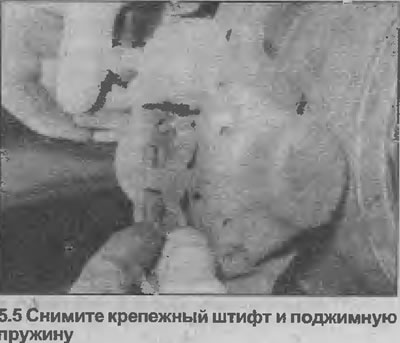
6. Slightly move the pads away from the disc, then use pliers to remove the outer pad and the noise-absorbing gasket, which is installed between the pad and the caliper body.
7. Remove the inner shoe and noise-absorbing pad.
Installation
8. Proceed as described in points 10 and 11 Chapters 4.
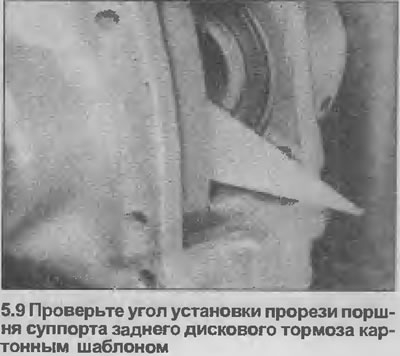
9. Make sure the piston slots are approximately 23° to the horizontal. Make a cardboard template and check the piston installation (see illustration). If necessary, gently turn the pistons to set them in the correct position.
10. Apply a small amount of brake grease to the top and bottom edges of the metal base of the new brake pads.
11. Install new pads and noise-damping shims into the caliper. Make sure the brake pads are facing the disc and that the pads move freely.
12. Install the pressure spring onto the pads, then insert the mounting pins from the inside of the caliper, pressing on the spring. Drive the pins into the caliper.
13. Repeat the above steps on the second wheel.
14. Proceed as described in points 17-20 Chapters 4.
Visitor comments