


Note: Use new brake hose connector bolt O-rings when installing.
Solid Disc Models
Removal
1. Where applicable, remove the hubcaps, then loosen the front wheel bolts and apply the handbrake. Jack up and support the front of the vehicle on axle stands. Remove the wheel.
2. Remove the brake pads as described in Chapter 4.
3. When working in the engine compartment, remove the brake fluid reservoir cap, cover the filler neck with a piece of polyethylene and secure it with a rubber band or reinstall the cap. This will reduce fluid loss during the next procedure.
4. Unscrew the brake fluid hose union bolt from the rear of the caliper and disconnect the hose. Remove the two O-rings from the union bolt. Be prepared for fluid to escape and plug any openings to prevent dirt from entering and further fluid loss.
5. Using a screwdriver as a lever, remove the dust caps from the two caliper bracket mounting bolts, then use a socket wrench to loosen the mounting bolts and remove the caliper assembly.
Bulkhead
6. If necessary, disassemble the caliper as follows.
7. Clean off any dirt and dust from the caliper, being careful not to inhale any airborne particles.
8. Clamp the caliper bracket in a vice. Then separate the caliper body from the mounting bracket by pressing the face of the caliper body down while pulling the body off the mounting pins. Remove the spring guides from the bracket, noting their orientation.
9. Using a screwdriver as a lever, remove the retaining clip from the piston dust seal, then carefully remove the dust seal itself in the same way.
10. Place a thin block in front of the caliper bore to prevent the piston from falling out. By pumping air into the brake hose port at the rear of the caliper body, for example, with a foot pump (air pressure should be low), drive the piston out of the hole.
11. Remove the wooden block and carefully remove the piston.
12. Carefully remove the seal from the groove in the caliper channel, using a plastic or wooden tool as a lever.
13. Inspect the piston and the walls of the caliper bore for scratches and other damage. If such damage is found, replace the caliper assembly.
14. If the piston and bore are in good condition, discard the seals and purchase a repair kit containing all the necessary parts.
15. Clean the piston and cylinder bore with brake fluid or methyl alcohol.
16. Begin assembly by installing the seal into the caliper bore.
17. Install the dust seal into the piston groove. Dip the piston in clean brake fluid and insert it into the caliper bore. Make sure the piston slots are horizontal. If necessary, carefully turn the piston.
18. Partially push the piston into the bore, insert the dust seal into the edge of the caliper bore and install the mounting bracket.
19. Push the piston a little further into the channel (but not all the way), to make sure it moves freely.
20. If necessary, replace the rubber portion of the caliper body mounting pin. Remove the plastic bushing from the pin, then gently squeeze the rubber portion and push it out of the hole in the caliper body (see illustrations).
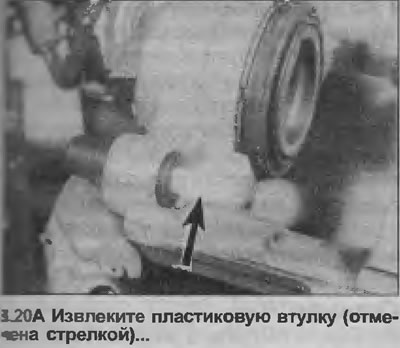
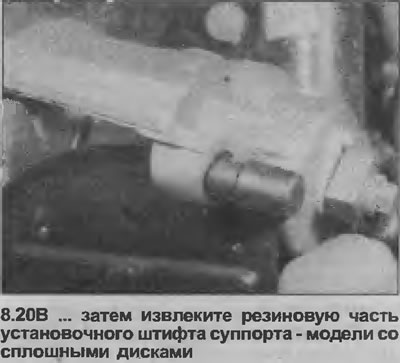
21. Install new rubber pins in reverse order.
22. Clamp the caliper bracket in a vice with soft-padded jaws and install the spring guides in the position marked before removal.
23. Place the caliper body onto the bracket mounting pins.
Installation
24. Install the caliper bracket onto the hub mounting element and tighten the mounting bolts to the specified tightening torque Specifications. Install dust caps on the bolts
25. Connect the brake fluid hose using new O-rings on the coupling bolt.
26. Install the brake discs as described in Chapter 4.
27. Remove the polyethylene from the filler neck of the brake hydraulic system replenishment tank and bleed the corresponding hydraulic line as described in Chapter 3.
28. Install the wheel and lower the vehicle to the ground. Do not fully tighten the wheel bolts until the vehicle is lowered onto the wheels.
Models with ventilated discs
Removal
29. Proceed as described in points 1-4.
30. Remove the caliper housing.
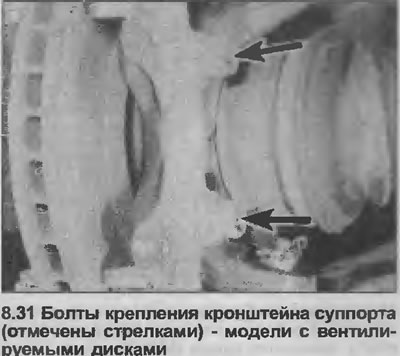
31. If necessary, remove the caliper bracket from the swing arm by unscrewing the two mounting bolts (see illustration).
Bulkhead
32. If there is no need to disassemble the caliper, proceed to step 42.
33. Clean any dirt and dust from the caliper, being careful not to inhale any airborne particles.
34. Carefully remove the dust seal from the end of the piston and the caliper body using a screwdriver as a lever.
35. Proceed as described in points 10-15.
36. Begin assembly by installing the seal into the caliper bore.
37. Install the dust seal into the piston groove. Dip the piston in clean brake fluid and insert it into the caliper bore. Make sure the piston slots are horizontal. If necessary, gently rotate the piston into the correct position.
38. Partially push the piston into the bore, insert the dust seal into the edge of the caliper bore.
39. Push the piston a little further into the channel (but not all the way), to make sure it moves freely.
40. If necessary, replace the rubber portion of the caliper body mounting pin. Remove the plastic bushing from the pin, then gently squeeze the rubber portion and push it out of the hole in the caliper body.
41. Install new rubber pins in reverse order.
Installation
42. Where applicable, install the caliper bracket onto the swing arm and tighten the mounting bolts to the specified torque Specifications.
43. Proceed as described in points 25-28.
Visitor comments