


Contents: Removal ⬇ Installation ⬇
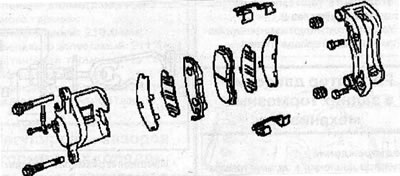
Front brake caliper
The brake mechanism with a sliding caliper has a small number of parts, including seals, and a small mass. Since heat transfer occurs through one cylinder, the brake fluid heats up less. To ensure joint "floating" of the caliper and wheel cylinder relative to the brake pad guide, they are not rigidly connected to the brake pad guide, but by means of guide pins that are installed in the holes of the guide. The piston in the cylinder body presses the inner brake pad against the brake disc, causing the cylinder body to be pushed out of its guides and pressing the brake pad on the other side against the brake disc. Therefore, only one piston is used on the brake mechanism.
Removal
Apply the parking brake, raise the front of the vehicle and secure it on stands. Remove the corresponding front wheel.
Clean the area around the brake hose and caliper connection.
Remove the hollow brake hose mounting bolt, remove and discard the sealing washers.
Warning! To prevent brake fluid from leaking out and contaminants from entering the hydraulic drive of the brake system, close the hole in the hose with a suitable plug.
Remove the guide and locking bolts securing the caliper to the brake pad guide and remove the caliper.
Installation
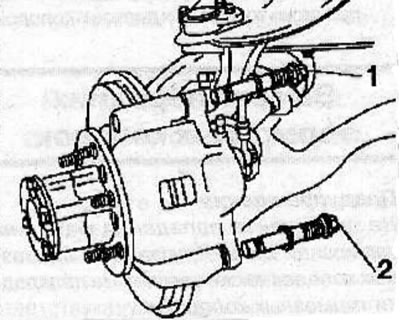
Install the caliper on the brake pad guide and screw in the guide (1) and locking (2) caliper mounting bolts and tighten them to a torque of 74 N·m.
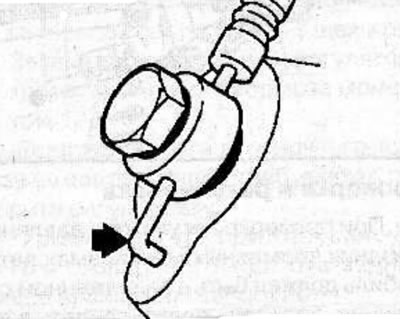
Using a hollow bolt and new sealing washers, secure the brake hose to the caliper, making sure the locating pin (arrow) is properly seated in the caliper bore. Tighten the banjo bolt to 35 Nm.
Install the wheel and secure with nuts, tightening them to a torque of 118 Nm.
Press the brake pedal several times to press the pads against the brake disc.
Add brake fluid to the reservoir and bleed the brake system.
Visitor comments