
OpelBook.ru
Cars AvtoVAZ Cars Mitsubishi Cars BMW Cars Mercedes Cars Nissan Cars Toyota Cars Chevrolet
English Русский
Български
Беларускі
Український
Српски
Hrvatski
Română
Polski
Slovenský
Magyar
 |  Sitemap  |  Contacts  |    


Main Astra Corsa Insignia Kadett Omega Vectra Zafira Others Articles
Frontera A (1991-1998, petrol) Frontera B (1998-2004) Ascona C (1981-1988) Vivaro A (2001-2014)
  • Main
  • Opel
  • Frontera B
  • Chassis
  • Brake system
  • Replacing rear brake pads

Replacing rear brake pads (Opel Frontera B)

            0

Contents: Removal ⬇ Installation ⬇
Before replacing the rear brake pads, read the warnings in chapter "Replacing the front brake pads".

Removal


Remove the cap from the brake system reservoir and use a syringe to pump out 2/3 of the brake fluid.

Raise the rear of the vehicle and support it on stands.

Remove the corresponding rear wheel.

Loosen the brake caliper mounting locking bolt (2) and remove the guide bolt (1).
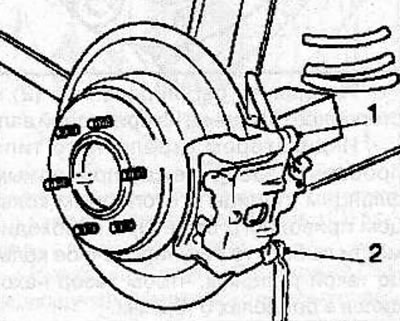
Loosen the brake caliper mounting locking bolt (2) and remove the guide bolt (1).


Warning! Do not press the brake pedal.


Raise the caliper up and secure it to the rear suspension with soft wire.

Remove the clamps, shims and brake shoes from the brake shoe guide. If the brake pads are to be reinstalled, mark them before removing them.
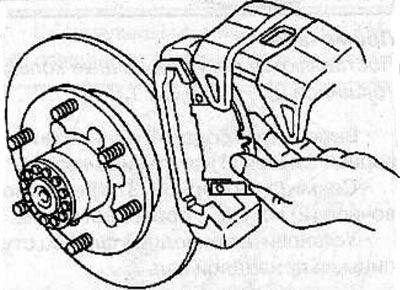
Remove the clamps, shims and brake shoes from the brake shoe guide. If the brake pads are to be…


Material copied from this portal [www.opelbook.ru]


If new brake pads are to be installed, press the piston into the caliper. When the piston is pushed in, the brake fluid is forced out of the brake cylinder into the reservoir. Therefore, constantly monitor the fluid level in the tank and, if necessary, pump it out.

Apply 0.2 g of special lubricant to the contact surfaces of the internal gaskets (2). After installation, wipe off excess lubricant.
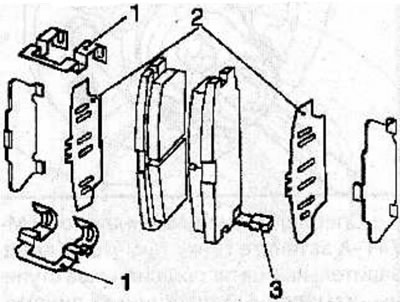
Apply 0.2 g of special lubricant to the contact surfaces of the internal gaskets (2). After…


Installation


Install the clamps (1), brake shoes and linings (2) onto the brake shoe guide, making sure that the wear indicator (3) is positioned at the bottom of the inner brake shoe.

Lower the caliper onto the brake pads and press it into position, then install the guide bolt (1) and tighten the guide and locking bolts (2) to 44 N·m.
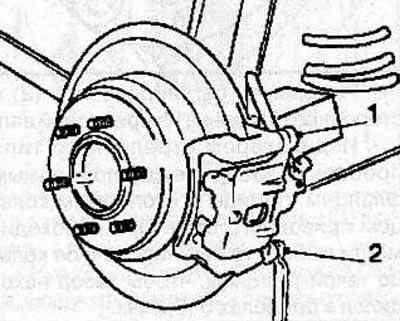
Lower the caliper onto the brake pads and press it into position, then install the guide bolt (1)…


Install the wheel and secure with nuts, tightening them to a torque of 118 Nm.


Press the brake pedal several times to press the pads against the brake disc.

Check the brake fluid level.


This article is available at russian, bulgarian, belarusian, ukrainian, serbian, croatian, romanian, polish, slovak, hungarian
Checking the article: Chernov Alexander

Share information:

Previous articles
Opel Frontera B: Brake system
Next articles

Front brake guard
Front brake disc
Front Brake Caliper Repair
Front brake caliper
Replacing the front brake pads
Grinding in brake discs and pads
Rear Brake Caliper Repair
Rear brake disc
Rear brake guard
Replacing the parking brake pads
Parking brake lever
Parking brake cables


See similar ones from other Opel car manuals:
▶ Replacing the rear wheel disc brake pads Opel Astra H (2004-2009)
▶ Replacing the rear wheel disc brake pads Opel Corsa C (2000-2006)
▶ Replacing rear brake pads Opel Insignia A (2008-2017)
▶ Replacing the brake pads of the rear disc brake mechanisms Opel Kadett E (1984-1995)
▶ Rear Brake Pads — Checking and Replacing Opel Omega B2 (1999-2003)
Link to this page in different formats

Visitor comments


No comments yet


How much will 24 + 36 =


Vivaro A (2001-2014) 
  • General information
  • User manual
  • Power unit
  • Petrol engine F4R
  • Diesel engine F9Q
  • Diesel engine G9U
  • Transmission
  • Clutch and drive shafts
  • Manual gearbox
  • Chassis
  • Front suspension
  • Rear suspension
  • Brake system
  • Body
  • Exterior
  • Interior
  • Electrical equipment
  • Heating and ventilation
  • Air conditioner
  • Equipment and devices
  • Electrical diagrams
Ascona C (1981-1988) 
  • General information
  • Maintenance
  • Power unit
  • Gasoline engines
  • Diesel engines
  • Cooling system
  • Fuel and exhaust system
  • Contact ignition system
  • Contactless ignition system
  • Transmission
  • Clutch
  • Mechanical gearbox
  • Automatic gearbox
  • Drive shafts
  • Chassis
  • Steering
  • Brake system
  • Car suspension
  • Body
  • Exterior
  • Interior
  • Doors and windows
  • Electrical equipment
  • Equipment and devices
  • Power devices
  • Electrical circuits
Frontera B (1998-2004) 
  • General information
  • User manual
  • Maintenance
  • Power unit
  • Petrol engines 2.2 l
  • Petrol engines 3.2 l
  • Diesel engines 2.2 l
  • Cooling system
  • Fuel system (petrol)
  • Fuel system (diesel)
  • Ignition system
  • Transmission
  • Clutch
  • Manual gearbox MUA5C
  • Automatic gearbox 4L30E
  • Chassis
  • Suspension and axles
  • Steering
  • Brake system
  • Body
  • Exterior
  • Interior
  • Doors, locks and windows
  • Heating and air conditioning
  • Electrical equipment
  • Power devices
  • Equipment and devices
  • Lighting and signaling
  • Electrical diagrams
Frontera A (1991-1998, petrol) 
  • General information
  • Introduction to guide
  • User manual
  • Maintenance
  • Power unit
  • Engine repair
  • Lubrication system
  • Cooling system
  • Power and exhaust system
  • Engine electrics
  • Transmission
  • Clutch
  • Mechanical gearbox
  • Cardan shafts
  • Chassis
  • Brake system
  • Front suspension
  • Rear suspension
  • Steering
  • Body
  • Repair and care
  • Electrical equipment
  • Equipment and devices
  • Electrical circuits
OpelBook.ru © 2017–2026 · Mobile version · · Sitemap: EN BG BY UA RS HR RO PL SK HU · Feedback · Site search
Astra F, petrol · Astra G, petrol · Astra G · Astra H · Astra J, petrol · Corsa B · Corsa C, petrol · Corsa C · Insignia A · Kadett D · Kadett E · Omega A · Omega B · Omega B2 · Vectra A, petrol · Vectra A · Vectra B, petrol · Vectra B · Vectra C · Zafira A, petrol · Frontera A, petrol · Frontera B · Ascona C · Vivaro A ·
We want your visit to be comfortable 🤝! We use cookies 🍪 to make that happen.