


Attention: It is necessary to replace all brake pads of one axle of the vehicle at the same time, even if only one of them has reached the wear limit! Use only pads approved for use by the manufacturer!
1. Support the front wheels with wheel chocks, jack up the rear of the car and place it on supports. Remove both rear wheels.
2. Release the parking brake completely and loosen the drive cable by loosening the adjusting nut (see Section 12).
3. Use a screwdriver to press the actuator lever on the rear wheel brake caliper and disconnect the cable end from it, release the lock and release the cable from the support bracket (see accompanying illustration).
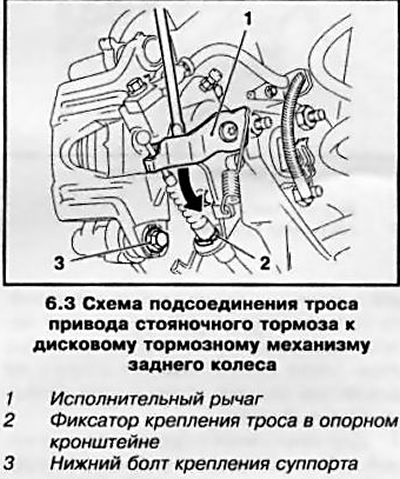
4. Remove the lower bolt (see illustration 6.3) caliper mounts, holding the guide pin from turning with a second wrench.
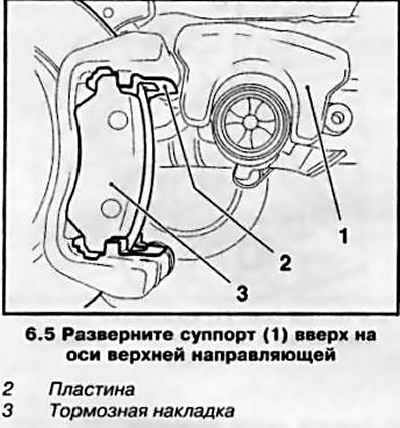
5. Rotate the support upward on the upper guide axis (see accompanying illustration).
6. Press the brake piston using a special tool (see accompanying illustration) until it stops - the piston creates significant resistance.
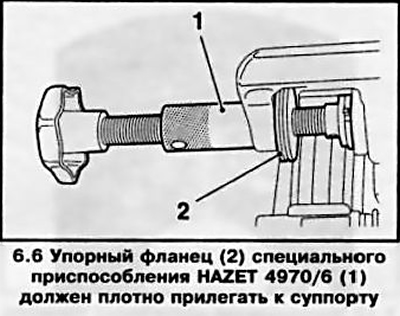
Caution: Do not press the piston using a handy tool - this may result in the parking brake being out of adjustment.
When pressing the piston, watch the brake fluid level in the reservoir. To prevent the brake fluid from leaking, check its level first - pump out the excess if necessary.
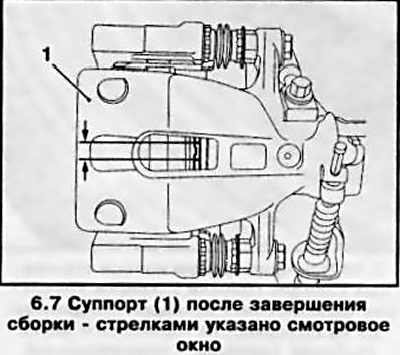
7. Then turn the piston out again so that its groove is in line with the inspection window of the caliper (see accompanying illustration).
8. Remove the upper caliper mounting bolt, holding the guide from turning with a second wrench. Remove the caliper and tie it with wire to the rear suspension spring.
9. Remove the brake pads from the guide, mark the installation position of the pads. Remove the plates from the guide.
10. Perform all checks and recommendations given in paragraphs 7 through 10 Section 5.
11. When installing, it is imperative to replace the plates on the guide, having previously lubricated them with heat-resistant grease (for example, Liqui Moly).
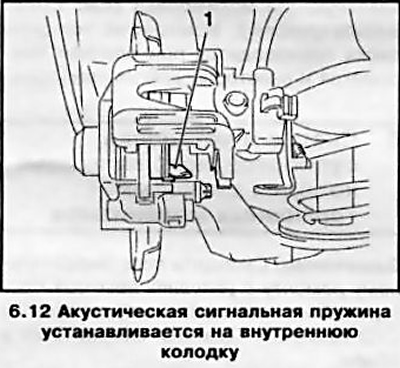
12. Insert new brake pads between the plates. Install a pad with an acoustic wear indicator (with appropriate equipment) (see accompanying illustration). At the same time, ensure that the brake pads are correctly positioned in the guide plates.
13. After installing the pad, remove the protective film from its back side - it contains an adhesive substance for connecting to the caliper.
14. Place the caliper on the guide and pads, making sure that the plates do not bend and that the brake pads do not stick to the caliper too early.
15. Clean and lubricate the threads of the guide bushing bolts with locking compound (for example, Loctite Tour 243), install new bolts if necessary. Screw in the bolts and tighten them to the required torque, holding the bolts from turning with a second wrench.
16. Insert the parking brake cable into the support bracket and secure with the clamp. Press the actuator lever (see illustration 6.3) brake and connect the cable end to it.
17. Press the foot brake pedal several times until you feel a "firm" sensation in its movement.
18. Proceed in a similar manner to replace the brake pads of the opposite wheel.
19. Adjust the parking brake drive cable (see Section 12).
20. Install the wheels, lower the vehicle to the ground and tighten the wheel bolts to the required torque.
21. Check the brake fluid level and make adjustments if necessary (see Chapter 1).
22. Before starting intensive use, allow the brake pads to rub in a little by braking the car several times from 80 km/h to 40 km/h by lightly pressing the pedal. Then allow the brake to cool down.
Note: After replacing the pads, try to avoid sudden braking for approximately 200 km.
Visitor comments