


Attention: It is necessary to replace all brake pads of one axle of the vehicle at the same time, even if only one of them has reached the wear limit! Use only pads approved for use by the manufacturer!
1. The procedures for replacing and checking the condition of the rear brake pads are fundamentally the same as those for the front brakes. All instructions given in Section 5.
2. Support the front wheels with wheel chocks, jack up the rear of the car and place it on supports. Remove both rear wheels.
3. Using a screwdriver, disconnect the spring clips (see accompanying illustration) brake pads from the caliper and remove them.
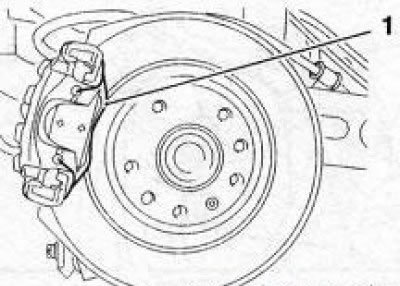
6.3 Rear brake spring clamp
4. Remove the dust caps from the caliper guide pin holes. Unscrew the guide pin mounting bolts (see accompanying illustration) and remove the caliper with the inner brake shoe. Remove the inner shoe from the caliper and tie the caliper to the strut with a piece of wire - do not leave it hanging by the hose.
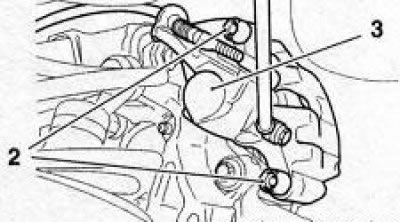
6.4 Bolts (2) for fastening the guide pins of the caliper (3) of the rear brake mechanism
6. Remove the outer guide shoe.
Attention: If you plan to reinstall the same brake pads, when removing them, you must mark their installation locations. It is not allowed to swap the brake pads from the outside to the inside and from the right wheel to the left!
7. Perform all checks.
8. Press the brake piston using a special tool Opel-KM-6007 (see accompanying illustration), using the KM-6007-10 and KM-6007-20 adapters or the Hazeit 4970/6 device. Slowly turn the device handle to the right (clockwise). When you press the piston, the brake fluid will be squeezed into the reservoir, monitor the fluid level, pump out the excess if necessary.
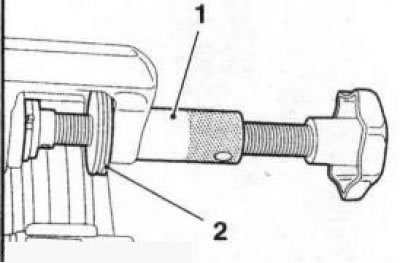
6.8 The thrust flange (2) of the special tool Opel-KM-6007 (1) must fit tightly against the caliper
Attention: The piston should be pressed only with a special tool! Using improvised means may lead to a violation of the parking brake adjustment!
9. Before installing new brake pads, clean the mating surfaces of the brake mechanism and the guide surfaces with alcohol. Lubricate their guide surfaces of the pads (see accompanying illustration) a thin layer of heat-resistant grease.
10. Insert the inner shoe with spring clips (see illustration) so that the springs fit into the piston groove.
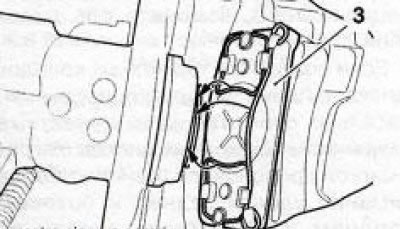
6.10 Installing the inner shoe (3) of the rear brake mechanism with spring clips - the springs must fit into the installation groove on the piston (see arrows)
11. Insert the outer brake shoe into the guide, install the caliper, screw in the guide pin mounting bolts and tighten them to the required torque.
12. Further installation is carried out in the reverse order of removal. Follow the instructions given in Section 5.
13. Before starting intensive operation, allow the brake pads to rub in a little by braking the car several times from 80 km/h to 40 km/h by lightly pressing the pedal. Then allow the brake to cool down.
Note: After replacing the pads, try to avoid sudden braking for approximately 200 km.
Visitor comments