
OpelBook.ru
Cars AvtoVAZ Cars Mitsubishi Cars BMW Cars Mercedes Cars Nissan Cars Toyota Cars Chevrolet
English Русский
Български
Беларускі
Український
Српски
Hrvatski
Română
Polski
Slovenský
Magyar
 |  Sitemap  |  Contacts  |    


Main Astra Corsa Insignia Kadett Omega Vectra Zafira Others Articles
Vectra A (1988-1995, petrol) Vectra A (1988-1995) Vectra B (1995-2002, petrol) Vectra B (1995-2002) Vectra C (2002-2008)
  • Main
  • Vectra
  • Vectra C
  • Chassis
  • Brake system
  • Removal, installation and inspection of the brake disc

Removal, installation and inspection of the brake disc (Opel Vectra C)

            0

Contents: Removal ⬇ Installation ⬇ Checking the condition and wear of…⬇
1. To ensure uniform braking and correct functioning of electronic braking control systems (see Section 2) all brake discs must have the same working surface. For this reason, if necessary, at least both brake discs on one axle must be replaced or ground simultaneously.

Note: When replacing or resurfacing brake discs, new brake pads must be installed on them at the same time.


Removal


2. Raise the car and remove the wheels.

3. Unscrew the mounting bolts of the guide of the corresponding brake mechanism (see sections 7 and 8).

Note: There is no need to disconnect the brake hose or remove the brake pads.


4. Position the brake shoe guide so that the brake hose is not twisted or stretched, or tie it to the stand with wire.

5. To prevent the piston from slipping out, clamp it with a wooden block, placing the latter between the piston and the caliper. Unscrew the mounting screw and remove the brake disc from the wheel hub (see accompanying illustration).
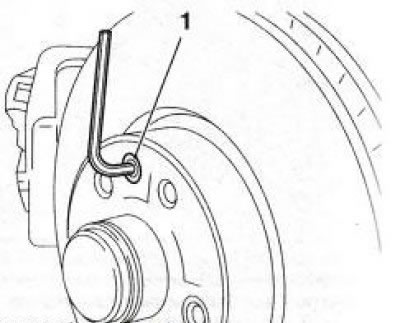
9.5 Loosening the screw (1) securing the brake disc

9.5 Loosening the screw (1) securing the brake disc


6. If, as a result of long-term use, any of the disks has become stuck to the wheel hub, use a plastic hammer and knock the disk off with light blows.

Attention: When removing the disc, strong impacts are not allowed!


Try using a rust dissolving agent as well. If these attempts are unsuccessful, remove the disk using a puller or knock the disk off with a heavy hammer. When removing with a puller, the disk must be replaced with a new one. If a heavy hammer was used, the wheel bearings must be replaced along with the disk.

Installation


7. Check the condition of the brake disc (see below). Measurements when checking the disc must be accurate, so the authors of this Guide recommend contacting a service station or a specialist who has the appropriate measuring tool and the necessary experience in performing these jobs.

8. Installation is performed in the reverse order of dismantling the components. Before installation, make sure that the mating surfaces of the disc and hub are absolutely clean and dry. Lightly lubricate the threaded part of the disc mounting screw with a fixing compound. If the disc is being replaced, remove the protective varnish from the new brake disc with a thinner.

Checking the condition and wear of the brake disc


9. It is best to carry out the check in a stationary workshop, where all the conditions and necessary tools are available. However, in some cases it is possible to check the disks without removing them from the car - this reduces the labor intensity of the work somewhat, but it is more difficult to achieve the required accuracy of measurements. All the dimensions to be checked are given in the Specifications to this Chapter.


10. Perform a visual inspection of the condition of the working surface of the disk (see accompanying illustration).
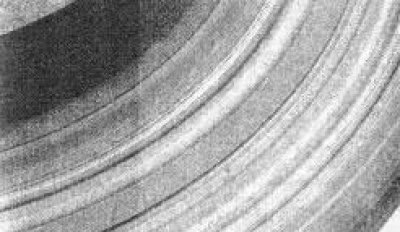
9.10 If the brake pads are excessively worn, the friction lining fasteners make deep grooves on the…

9.10 If the brake pads are excessively worn, the friction lining fasteners make deep grooves on the surface of the brake disc - a disc damaged in this way must be replaced without fail


Minor defects can be removed with fine-grained sandpaper. To remove deep grooves, the disc should be subjected to turning. If there are cracks or grooves deeper than 0.4 mm, replace the brake disc. Remember that the disc should be inspected from both sides. Rusty brake discs create increased noise when braking; if the noise does not disappear after a sufficiently long period of operation, replace the discs.

11. If pulsations of the foot brake pedal are noticed during braking, not related to the operation of the ABS, the lateral runout of the brake disc should be assessed. The lateral runout value is checked using a plunger-type dial gauge. The measurement result should not go beyond the permissible range specified in the Specifications, otherwise the disc must be resurfaced.

Note: The authors of this Manual recommend turning the disks regardless of their condition in order to remove any defects from the working surfaces. In extreme cases, you can limit yourself to processing the disk with fine-grained sandpaper.


12. When turning a disk, special attention should be paid to compliance with the requirements Specifications to its minimum permissible thickness. The thickness of the disk is measured using a micrometer and some other devices.


This article is available at russian, bulgarian, belarusian, ukrainian, serbian, croatian, romanian, polish, slovak, hungarian
Checking the article: Meshcheryakov Damir

Share information:

Previous articles
Opel Vectra C: Brake system
Next articles

Removal and installation rear brake calipers/pad guides
Removal and installation front brake calipers/pad guides
Replacing the rear wheel disc brake pads
Replacing the front disc brake pads
Checking the condition and replacing brake lines and hoses
Bleeding the brake system
Removal and installation of the master brake cylinder (MBC)
Removal and installation the foot brake pedal assembly
Checking, removing and installing the brake booster assembly
Removal and installation the parking brake lever
Removal and installation the parking brake cable


See similar ones from other Opel car manuals:
▶ Brake disc — inspection, removal, installation Opel Astra F (1991-1998, petrol)
▶ Replacing the front disc brake pads Opel Corsa C (2000-2006)
▶ Replacing the front brake disc Opel Insignia A (2008-2017)
▶ Rear wheel disc brake mechanism device Opel Kadett E (1984-1995)
▶ Brake disc — inspection, removal and installation Opel Omega A (1986-1993)
Link to this page in different formats

Visitor comments


No comments yet


How much will 43 + 22 =


Vectra C (2002-2008) 
  • General information
  • User manual
  • Vehicle device
  • Maintenance
  • Troubleshooting
  • Power unit
  • Engine repair
  • Cooling system
  • Power and control system
  • Engine electrics
  • Transmission
  • Clutch
  • Car gearbox
  • Drive shafts
  • Chassis
  • Car suspension
  • Steering
  • Brake system
  • Body
  • Exterior
  • Interior
  • Doors, locks and windows
  • Heating and ventilation
  • Electrical equipment
  • Equipment and devices
  • Headlights and lighting
  • Electrical circuits
Vectra B (1995-2002) 
  • General information
  • User manual
  • Weekly checks
  • Maintenance (gasoline)
  • Maintenance (diesel)
  • Troubleshooting
  • Power unit
  • SOHC gasoline engine
  • DOHC petrol engine
  • Diesel engine 1.7 liter
  • Diesel engine 2.0 liters
  • Engine repair
  • Cooling system
  • Fuel system (gasoline)
  • Fuel system (diesel)
  • Charging system
  • Launch system
  • Ignition and preheat
  • Transmission
  • Clutch
  • Mechanical gearbox
  • Automatic gearbox
  • Drive shafts
  • Chassis
  • Brake system
  • Wheel suspension
  • Steering
  • Body
  • Exterior
  • Interior
  • Doors and windows
  • Heating and ventilation
  • Electrical equipment
  • Equipment and devices
  • Electrical circuits
Vectra B (1995-2002, petrol) 
  • General information
  • Maintenance
  • Help with malfunctions
  • Power unit
  • Engine repair
  • Exhaust system
  • Cooling system
  • Fuel system
  • Multec injection system
  • Four point injection
  • Transmission
  • Clutch
  • Gearbox and drive
  • Chassis
  • Wheel suspension
  • Steering
  • Brake system
  • Wheels and tires
  • Body
  • Exterior
  • Interior
  • Electrical equipment
  • Fuses and electronics
  • Power devices
  • Ignition system
  • Lighting and signaling
  • Equipment and devices
  • Heating and ventilation
  • Electrical circuits
Vectra A (1988-1995) 
  • Power unit
  • Engine repair
  • Ignition system
  • Lubrication system
  • Cooling system
  • Injection system
  • Fuel system (carburetor)
  • Fuel system (diesel)
  • Exhaust system
  • Transmission
  • Clutch
  • Car gearbox
  • Chassis
  • Front suspension
  • Rear suspension
  • Steering
  • Brake system
  • Wheels and tires
  • Body
  • Exterior
  • Interior
  • Electrical equipment
  • Electrical circuits
Vectra A (1988-1995, petrol) 
  • General information
  • User manual
  • Maintenance
  • Power unit
  • SOHC engine
  • DOHC engine
  • Cooling and ventilation
  • Fuel system (carburetor)
  • Fuel system (injector)
  • Exhaust converter
  • Transmission
  • Clutch
  • Mechanical gearbox
  • Automatic gearbox
  • Drive shafts
  • Chassis
  • Brake system
  • Car suspension
  • Steering
  • Body
  • Body elements
  • Electrical equipment
  • Power devices
  • Equipment and devices
  • Electrical circuits
OpelBook.ru © 2017–2026 · Mobile version · · Sitemap: EN BG BY UA RS HR RO PL SK HU · Feedback · Site search
Astra F, petrol · Astra G, petrol · Astra G · Astra H · Astra J, petrol · Corsa B · Corsa C, petrol · Corsa C · Insignia A · Kadett D · Kadett E · Omega A · Omega B · Omega B2 · Vectra A, petrol · Vectra A · Vectra B, petrol · Vectra B · Vectra C · Zafira A, petrol · Frontera A, petrol · Frontera B · Ascona C · Vivaro A ·
We want your visit to be comfortable 🤝! We use cookies 🍪 to make that happen.