


Note: A failed brake master cylinder must be replaced. Manufacturers do not recommend attempting to perform a refurbishment of the brake master cylinder.
1. The brake master cylinder is located in the engine compartment of the vehicle and is attached to the brake booster assembly.
2. Remove the expansion tank from its holders and set it aside. Remove the brake fluid reservoir cap and pump out as much of the fluid as possible (use a syringe or a rubber bulb).
3. Place rags under the fittings and have plugs or plastic bags available to seal the open ends of the brake lines to prevent dirt from entering the system.
Warning: Brake fluid is an aggressive chemical compound and when in contact with body panels it destroys the paintwork. Before starting the procedure, cover the fenders and front panel of the car with special covers or just old blankets.
4. Disconnect the connector and disconnect the brake fluid level switch sensor wiring from the brake master cylinder reservoir (see accompanying illustration).
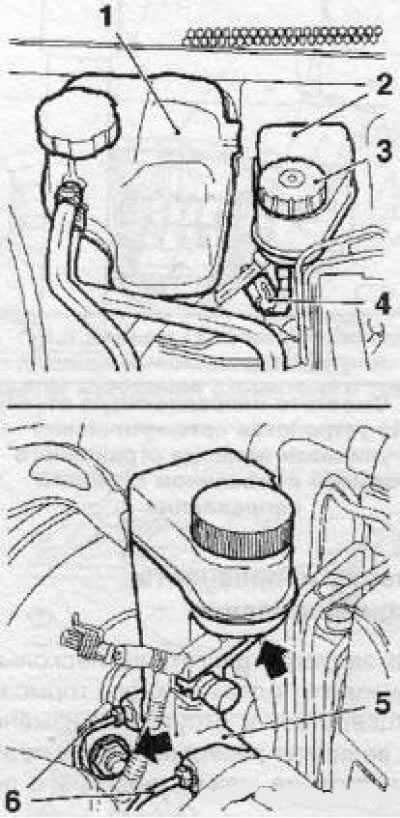
10.4 Master brake cylinder (5) with reservoir (2) - the fastening nuts are indicated by arrows: 1. Expansion tank; 3. Tank lid; 4. Electrical wiring connector; 6. Brake lines
[Text copied from an online resource: OpelBook.ru]
5. Loosen the nuts of the union assemblies connecting the brake lines to the master cylinder (see illustration 10.4). To avoid rounding the nut splines, loosen them using a special open-end wrench with a slotted head. Pulling slightly outward, separate the brake lines from the master cylinder nipples.
6. On models with manual transmission, disconnect the clutch hydraulic line tube from the master cylinder reservoir.
7. Loosen the 2 mounting nuts (see illustration 10.4) and remove the master cylinder together with the reservoir and the switch-sensor from the brake booster assembly - try not to spill the hydraulic fluid filling the cylinder on the painted body panels. Remove the sealing gasket.
8. The brake master cylinder is installed in the reverse order of its removal. Do not forget to replace the removed gaskets.
9. After installation is complete, fill the cylinder and reservoir with brake fluid and bleed the system (see Section 3). Bring the fluid level up to the "MAX" mark (see Chapter 1) and tighten the tank cap securely.
10. Before operating the vehicle, make sure that the brakes are functioning properly.
Visitor comments