


Contents: Engine oil ⬇ Engine coolant ⬇ Windshield/Headlight Washer Fluid ⬇ Battery electrolyte ⬇ Working fluid of the brake system…⬇ Power steering fluid ⬇ Manual transmission oil ⬇ ATF ⬇
Checking fluid levels (engine oil, gearbox, ATF, power steering fluid, coolant, brake fluid, washer fluid).
Note: The following is a list of procedures to be performed on a regular basis. Regularly look under the vehicle, checking for signs of developing fluid leaks. Try not to ignore the occurrence of fluid leaks under the vehicle - such signs indicate the presence of faults that need to be immediately eliminated
Attention! When checking the level of any working fluid, the car must be positioned strictly horizontally! Always use the parking brake when leaving the car!
1. Various hydraulic fluids act as working fluids in lubrication, cooling, braking, clutch, heating and air conditioning, windshield washing, etc. systems. Since all fluids are subject to dilution and wear over time, and also gradually become contaminated during normal operation of the systems, it is necessary to periodically replace them completely. Before adjusting the level or replacing, familiarize yourself with the list of recommended fluid grades for use in the car (see Specifications). The liquids filled into the systems at the manufacturer are indicated in the technical documentation of each vehicle.
Note: Opel offers a wide range of vehicle configurations with different engine types. In connection with this, the location of some check points and the design of individual elements, both the layout of the engine compartment and the test devices, may differ from those listed below. To make it easier to find, the filler caps for engine oil, coolant, windshield and headlight washer fluid, as well as the handle of the engine oil dipstick are painted yellow.
Engine oil
Visual inspection of leaks
2. If the engine is oily and has a high oil consumption, check the most likely places where leaks are developing:
- a) Open the filler cap and check the seal for cracks or damage;
- b) Crankcase ventilation: e.g. ventilation hose from cylinder head cover to air intake hose;
- c) Cylinder head cover gasket;
- d) Cylinder head gasket;
- e) Oil drain plug (sealing ring);
- f) Oil pump gasket;
- g) Oil pan gasket;
- h) Front and rear camshaft and crankshaft oil seals.
Since the oil spreads over the engine surface when there are leaks, it is difficult to immediately identify the leak location. To detect leaks, follow the steps below:
3. Wrap the generator in plastic. Spray the engine with a regular cold cleaner and after a short time rinse with water at a car wash.
4. Sprinkle the outside of the engine component joints with lime or talc.
5. Check the oil level and top up if necessary.
6. Perform a test drive to warm up the oil to normal operating temperature.
7. Finally, examine the engine with a lamp and locate the leaks, eliminating the faults.
Checking the level
8. When the engine oil level drops to the minimum permissible value in the service display field (see Chapter "Controls and operating techniques", Section 16) the corresponding pictogram will be displayed. The current engine oil level is checked using a dipstick inserted into the guide tube and lowered into the engine to the bottom of the oil pan.
9. The oil level should be checked before the first trip of the day, or after about 5 minutes after stopping the engine.
If the check is performed immediately after the engine is turned off, the results will not adequately reflect the situation, since some of the oil will be distributed throughout the internal galleries and components of the engine.
10. Remove the dipstick and the guide tube and wipe the blade dry with a clean rag or paper towel. Insert the dipstick back into the tube until it stops, then remove it again. Inspect the dipstick blade to assess the size of the area wetted with oil. The oil level should be between the upper and lower marks on the dipstick blade (see accompanying illustrations). If necessary, add the appropriate amount of oil of the required grade to the engine.
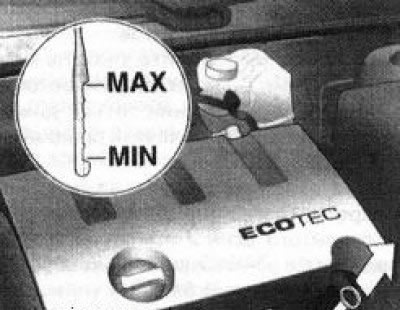
4.10a Engine oil level dipstick - option A
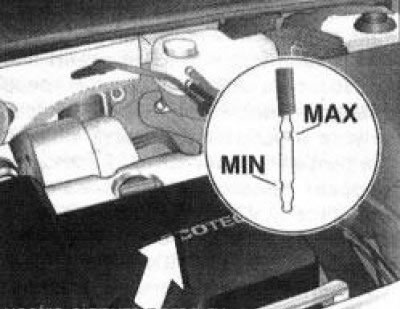
4.10b Engine oil dipstick - option B
11. To raise the level from the lower (MIN) mark on the dipstick to the upper (MAX) mark, it takes approximately 1 l oil. Lowering the level beyond the lower limit of the permissible range leads to the development of oil starvation of the engine, fraught with serious mechanical damage to the latter. Also try not to overfill the oil above the upper mark, as this can lead to "throwing" of spark plugs or failure of the power unit seals as a result of excessive pressure increase - if the oil is overfilled, it should be pumped out using a special device.
12. To fill the engine with oil, remove the threaded filler cap. To avoid oil splashing when filling the engine, use a funnel or a long-nosed oiler. Fill the oil, screw on and tighten the cap securely, then start the engine and carefully inspect the drain plug and the surface of the oil filter mating with the block for signs of leaks. Turn off the engine, wait about 5 minutes, during which the oil will drain into the pan, then check its level again
13. Checking the engine oil level is an important preventive maintenance procedure for the engine. A constant decrease in the level indicates oil leaks due to failure of seals, damage to sealing gaskets, wear of piston rings or valve guides. If the oil is milky in color or consistency, or if there are drops of water in it, this indicates possible damage to the cylinder head gasket, or the formation of cracks in the body of the head(s) or block. The check must be done without delay. When measuring the oil level, always also check its condition. Use your thumb and forefinger to remove traces of oil from the dipstick blade - if there are small metal particles in it, the oil must be replaced.
Engine coolant
Warning! Do not allow antifreeze to come into contact with exposed skin or painted surfaces of the vehicle. Wash away accidental splashes immediately with plenty of water. Remember that antifreeze is a highly toxic liquid and its ingestion, even in small quantities, can have the most serious consequences, including death. Never leave antifreeze stored in a loosely closed container; immediately collect any coolant spilled on the floor. Remember that the sweet smell of antifreeze can attract the attention of children and animals. Consult with your local authorities about how to dispose of used coolant - many regions of the world have special collection points for various types of waste. Never pour old coolant down the drain or onto the ground!
14. All models of cars described in this Manual are equipped with a compensating cooling system operating under excess pressure. The expansion tank of the cooling system, made of translucent plastic, is located on the left (in the direction of travel) rear of the engine compartment next to the brake fluid reservoir and is connected by an overflow hose to the radiator of the cooling system. As the engine warms up during operation, excess expanding coolant is forced into the reservoir. As the coolant cools down, it automatically flows back into the cooling system, which ensures that its level is maintained at a constant value.
15. The coolant level in the expansion tank is checked regularly and with the engine cold (approx +20°C) should not fall below the KALT/COLD mark on the tank wall (see accompanying illustration).When the coolant level drops to the minimum permissible value in the service display field (see Chapter "Controls and operating techniques") the corresponding pictogram will appear. If necessary, make the appropriate adjustment by adding the required amount of fresh mixture to the tank.
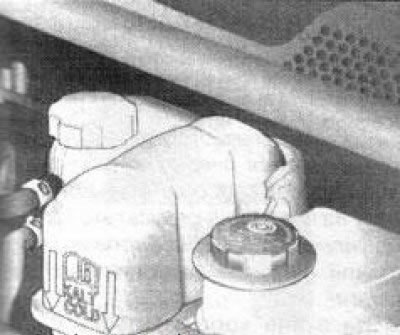
4.15 The coolant level is checked visually through the translucent walls of the expansion tank and should not fall below the KALT/COLD mark
Note: Topping up with cold coolant must be done after the engine has cooled down.
Attention! To adjust the level, use only the required composition of liquids - carefully study the Specifications for this Chapter! Please note that the color of the liquid should be light orange (with prolonged use it may change slightly and become yellow). Using antifreeze of various brands as a coolant (the liquid has a characteristic blue-green color - "sea wave") is unacceptable! Remember that frequent topping up of the cooling system with drinking/distilled water leads to gradual dilution of the antifreeze and loss of frost resistance and anticorrosive properties by the mixture.
16. With a closed cooling system, there is virtually no loss of fluid. A constant drop in the coolant level usually indicates the development of leaks in the system. Check the radiator, connecting hoses, filler cap, drain plugs and water pump housing for signs of leaks.
17. If you need to remove the expansion tank cap, wait until the engine has cooled down completely, then wrap the neck with a thick layer of rags and slowly unscrew the cap to the first stop. If steam is released, allow the engine to cool down a little more, and only then remove the cap completely.
Attention! Never remove the expansion tank cap when the engine is hot!
18. In addition to the level, always check the condition of the coolant, its concentration (see Specifications to this Chapter). The concentration of the liquid is checked using a hydrometer with a special scale; it can be purchased over the counter or checked at a service station. Even if the liquid does not undergo any changes externally, the corrosion inhibitors included in its composition are subject to development over time, so the condition of the coolant should be checked regularly in accordance with the vehicle maintenance schedule (see Section 1).
Windshield/Headlight Washer Fluid
19. Windscreen/headlight washer fluid is poured into a special reservoir located in the left front corner of the engine compartment between the battery and the left front headlight. The filler cap is located on the upper front crossbar of the engine compartment next to the left headlight (see accompanying illustration), - the reservoir is equipped with a dipstick to measure the fluid level. In regions with a moderate climate, clean water can be used as a windshield washer fluid, but do not fill the reservoir more than 2/3 full to compensate for the expansion of water when it freezes during frosts. When operating the car in severe climatic conditions, use only patented windshield wipers that provide an appropriate decrease in the freezing point of the liquid. To avoid freezing of the glass when washing in cold weather, preheat it by blowing air passed through the heater heat exchanger.
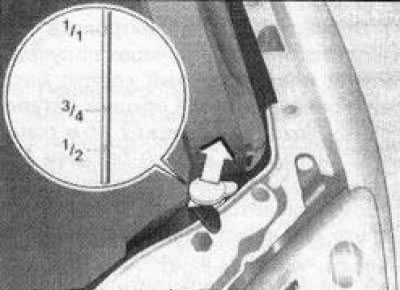
4.19 Windscreen/Headlamp Washer Fluid Reservoir Cap
Attention! The rules for using the liquid are usually printed on the container label. Never use antifreeze used in the cooling system to add to the windshield washer fluid - the latter is aggressive towards the paintwork of the body panels!
Battery electrolyte
Warning! The basis of the battery electrolyte is ACID! Failure to take measures when electrolyte gets on your skin or in your eyes can lead to burns or even loss of vision - immediately rinse them with plenty of water, promptly seek medical help! When handling the battery, wear protective glasses and gloves! After completing work, wash your hands thoroughly, do not keep the rags used to wipe the battery surfaces. Explosive gas is released during battery operation! It is prohibited to use open fire sources or smoke near the battery!
20. Modern storage batteries, if minimal maintenance requirements are met and when used under normal conditions, do not require additional maintenance and are designed, on average, for 4 years. Periodically, especially during hot weather, check the electrolyte level in the battery.
Warning! Do not allow the battery to operate for a long time with an insufficient electrolyte level - this may lead to overcharging of the battery, destruction of the plates and a significant reduction in its service life!
21. Check the electrolyte level visually, through the translucent plastic battery case. The level in ALL sections of the battery should be between the marks on the battery case MIN and MAX. If the electrolyte level is not visible through the case, check it through the filler holes (if available) battery sections, it should reach the lower edge of the filler hole sleeve or cover the internal mesh of the battery section (depending on the battery design). If it is necessary to adjust the electrolyte level, add the required amount of DISTILLED water.
Note: Do not add too much water, excess electrolyte is removed using a special hand pump (bulb). After completing the level adjustment, close the filler holes tightly and wipe the battery surfaces with a rag soaked in an alkaline solution.
Working fluid of the brake system and clutch drive
22. The reservoir for hydraulic (brake) fluid is located in the engine compartment near the rear wall above the master brake cylinder (MBC) and is used to store a reserve supply of fluid in the hydraulic drive lines of both the brake mechanisms and the clutch.
23. The liquid level inside the tank is clearly visible through the translucent walls of the latter and should be maintained between the MIN and MAX marks, slightly before reaching the top (see accompanying illustration).
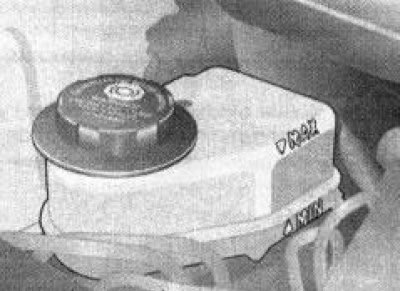
4.23 The level of the working fluid in the master cylinder reservoir is clearly visible through its translucent walls
24. If it is necessary to adjust the fluid level, carefully wipe the reservoir cap and the area around it with a clean cloth to prevent dirt from getting into the hydraulic system.
25. When pouring fluid into the reservoir, make sure that it does not splash onto the surrounding painted surfaces of body parts. Add only fresh fluid of the grade specified by regulatory requirements (see Specifications at the beginning of this Chapter), - mixing two liquids of different types is in no way permissible and may lead to failure of the corresponding system!
Warning! Brake fluid is extremely chemically aggressive - do not allow it to come into contact with your eyes or paint on body panels! Do not add brake fluid to the system that has been standing for more than one year or that has been stored in a loosely closed container. Remember that brake fluid is very hygroscopic, i.e. it has the ability to absorb moisture from the air, which can dangerously reduce the efficiency of the brake system!
26. During the level adjustment stage, the condition of the fluid and the inner walls of the reservoir should also be carefully checked. If dirt deposits, solid foreign particles or water droplets are detected, the system should be emptied and filled with fresh brake fluid (see Chapters 6 and 9).
27. Once the tank is filled to the required level, replace the lid tightly.
28. Remember that the brake fluid level in the reservoir gradually drops as the friction linings of the brake shoes wear down, but this drop is always very small. If the fluid has to be topped up too often, then there is a leak in the system, the source of which must be identified without delay and the cause eliminated - carefully inspect all brake lines and their nipple connections (see Section 9). A drop in the fluid level in the clutch hydraulic drive reservoir indicates the development of leaks in the tract, including the slave cylinder.
29. In case of significant losses of brake fluid, when the reservoir is completely empty, after eliminating the cause of the leak, it is necessary to bleed the hydraulic lines of the brake system and the clutch engagement drive.
Power steering fluid
30. Depending on the model, the fluid reservoir may be located in the engine compartment directly above the steering gear or in the rear niche of the right wing.
31. The liquid level is controlled using marks on the measuring probe built into the filler cap of the tank (see accompanying illustration). The level should be between the MIN (a) and MAX (b) marks. When the liquid is "cold", its level should not fall below the lower mark.
Note: Depending on the configuration, some covers are equipped with limiters - these are cross-shaped plastic plates on the dipstick, designed to prevent splashing and leaking of liquid when driving on an uneven road or with a large inclination.
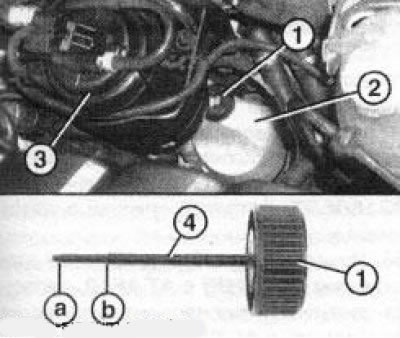
4.31 Power steering fluid reservoir (2) (installation option on diesel models): 1. Filler cap; 3. Fuel filter; 4. Measuring probe: a. Minimum level mark; b. Maximum level mark
32. Try not to allow the liquid level to go beyond the lower limit of the permissible range.
33. If necessary, make the appropriate adjustment of the level by adding the required grade of hydraulic fluid into the reservoir neck (see Specifications).
34. If the need to adjust the fluid level occurs regularly and frequently, check the steering pump, rack and pinion housing, as well as all connecting lines of the hydraulic system and their fittings for signs of leaks.
Manual transmission oil
Note: Checking and adjusting the level should only be done if oil leaks from the manual transmission are detected. In other cases, there is no need to do this.
35. First of all, it is necessary to carry out a thorough visual inspection of the box for possible oil leaks. To do this, clean the box body from dust, dirt and traces of oil, sprinkle possible leaks with talc. The most likely leaks are:
- Mating surfaces of the engine and manual transmission;
- Primary shaft seals for manual transmission;
- Filler cap;
- Drain plug. Before the control check, it is necessary to warm up the gearbox oil well during a short run (up to 30 km) trips.
36. Drive the car onto a ramp or inspection pit, or jack it up and place it on supports in a strictly horizontal position. If an oil leak is detected, first eliminate its cause, and then adjust the oil level in the manual transmission.
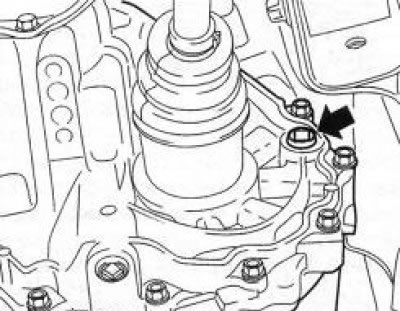
4.37 Location of the check hole of the manual transmission
37. Carefully wipe the surface of the gearbox housing around the inspection plug. If necessary, remove the protective cover of the engine compartment. The inspection hole is located on the left rear of the gearbox (behind the primary shaft) (see illustration).
38. To check, it is necessary to unscrew the plug of the inspection hole and measure the oil level in the manual transmission crankcase using a wire bent at 90° - the oil level should not fall below the edge of the inspection hole by more than 20 mm (minimum acceptable level).
Attention! On models equipped with Z20NET and Y30DT engines with a 6-speed manual transmission, transmission oil level control is not provided, since when installing a manual transmission on a car, the oil level is located above the inspection hole (approximately 1.3 l).
39. If necessary, the level is adjusted using a special syringe/oiler through the hole for installing the reverse light switch sensor (F17/F17+ manual transmission), or through the inspection hole (Manual transmission F23/F35/F40) - disconnect the electrical wiring connector (with appropriate equipment) and unscrew the sensor/plug. Oil should be poured until its level reaches the lower edge of the inspection hole.
Note: Transmission oil has a high viscosity - it takes time for it to be evenly distributed throughout the entire volume of the gearbox housing. Make adjustments in several stages, do not pour too much oil at once, check its level periodically.
If oil begins to leak out of the edge of the inspection hole, allow the excess to drain off.
40. After completing the adjustment, screw the inspection hole plug back into place with a force of approximately 4 Nm and tighten it with a wrench about another 1/8, maximum 3/8 of a turn (45°-135°). Then screw in the reverse light switch sensor, after replacing the sealing gasket, and tighten it with force 20 Nm.
41. To ventilate the crankcase, a special breather with a cover is screwed into the manual transmission housing. Every time you inspect the manual transmission, check the breather cover - it should fit loosely onto the breather. If the breather is clogged, (fixed seated lid) increased pressure is created in the manual transmission housing, which can cause malfunction of the manual transmission, as well as lead to extrusion of seals and leakage of transmission oil.
42. After completing the work, remove traces of oil from the gearbox, remove the tool from under the car and lower the latter to the ground if it was jacked up or lifted. During the first trips, check the gearbox for leaks.
ATF
43. Correct ATF level is one of the critical operating parameters of AT-equipped models. Excessive drop in ATF level can lead to slippage of the rotation converter, while excessive amount of fluid leads to foaming, leakage and may result in transmission failure.
44. The ATF level can be checked when the transmission is warmed up to normal operating temperature (15-20 km, 72-80°C).
Caution! Do not check the ATF level immediately after driving the vehicle at high speeds, in hot urban conditions, or after towing a trailer - allow the fluid to cool down for about 30 minutes first!
45. Park the car on a level, hard-surfaced surface and set the parking brake firmly. If the engine is cold, start it and let it warm up at idle speed. With the engine running, depress the foot brake pedal and move the AT selector lever through all positions in turn, finally returning it to the "P" position. On CVTronic models, leave the lever in each position for about 10 seconds.
Material was taken from a resource OPELBOOK
46. On models equipped with AT AF23 and AF33 (engines Z22SE/ Z32SE/Y22DTR), if necessary, first disconnect the gear shift cable and wiring harness from the AT housing and move them to the side. Remove the mounting bolt (see accompanying illustration) and remove the dipstick.
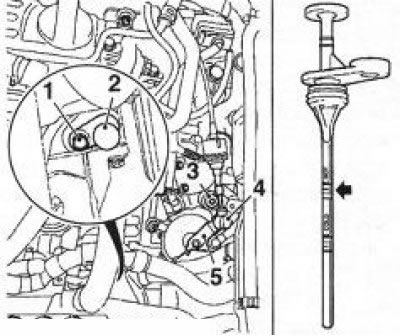
4.46 Checking and adjusting the AFT level on AT AF 23 and AF 33 - the arrow indicates the marks for checking the fluid level when the transmission is warm: 1. Bolt for fastening the scrotum; 2. Measuring probe; 3. Filler plug; 4. Drive cable tip; 5. Drive lever
Caution! Do not unscrew the sealed, hex/pentagon bolt under any circumstances - otherwise, the AT will need to be overhauled or replaced.
47. Wipe the blade thoroughly with a clean rag and insert the dipstick back into the guide tube, firmly seating it on the neck. Remove the dipstick from the neck again - the fluid level should be between the marks next to the inscription "HOT" (see illustration 4.46). If necessary, make the appropriate adjustment by adding to the transmission through the special filler hole (see ibid) liquid of the required grade.
Attention! Before filling, shake the liquid in the packaging container well and mix it thoroughly. Failure to do so may result in foam formation and transmission failure while the vehicle is moving!
Add ATF in small portions in several steps, checking the level each time.
48. When installing on a vehicle AT AF 23/AF 33 together with the Y30DT engine, to gain access to the ATF level dipstick, it is necessary to remove the front engine support, - the oil level at a temperature70-80 'C should be located between the marks next to the inscription "NOT".
Note: It takes about 0.3 liters of fluid to raise the level from the bottom mark on the dipstick to the top. To access the filler hole, remove the battery with the tray (see Chapter 5).
49. On models equipped with AT CVTronic - VT 20-E, remove the engine sump guard if necessary (diesel models) and place it under the drain hole (see accompanying illustration) a suitable container to collect the liquid and unscrew the control bolt.
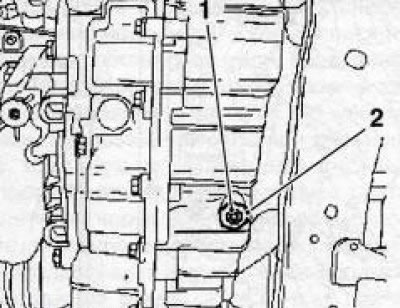
4.49 Drain hole AT CVTronic VT 20-E: 1. Control bolt; 2. Drain plug
Attention! To check the oil level, only the check bolt should be unscrewed, not the entire oil drain plug!
50. When the bolt is unscrewed, some oil will flow into a container placed underneath. Wait until the oil stops dripping - at a normal level, about 0.5 l oils.
51. Tighten the check bolt to the required torque. Remove the cover (see accompanying illustration) filler hole and add the required amount of liquid, and first mix it with the additive (see Specifications).
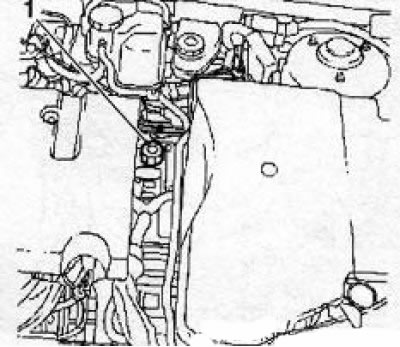
4.51 Filler cap (1)
Note: Depending on the oil temperature, different volumes of oil are poured (see Specifications). Oil temperature is measured using the Opel - TECH - 2 diagnostic tool.
52. On models equipped with Z18XE engines with AT CVTronic VT20-E, it is required to perform at each regular maintenance (see Section 1) regeneration of additives. Remove the cover (see illustration 4.51) filler hole and add 8 portions (syringes) of Opel additive 93160537. Tighten the cap to the required force.
53. On models equipped with the Z19DT(H) CATAF40 engine, the ATF level is checked in the same way as on models with AT CVTronic - VT 20-E.
54. After completing the adjustment, reinstall all removed components and tighten the threaded connections to the required torque (see Specifications).
55. The procedure for checking and replacing ATF is described in Chapter 7.
Visitor comments