


Contents: Draining sludge/water ⬇ Replacing the working element of the…⬇ Removal air from the fuel system ⬇
Note: Before performing any maintenance on the fuel filter, thoroughly wipe the area around the filter to prevent dirt from entering the fuel system. To collect any spilled fuel, place a rag under the filter or install a suitable drain container.
Caution! Do not allow diesel fuel to come into contact with the surfaces of the generator, starter, cooling system hoses, engine mounts and electrical wiring harnesses!
1. The fuel filter is installed on the rear bulkhead of the engine compartment.
Draining sludge/water
2. On engines with a working volume of 1.9 l before draining the sediment from the fuel filter (see accompanying illustration) it is necessary to disconnect the terminal clamps from the battery, observing the requirements given in Chapter 5.
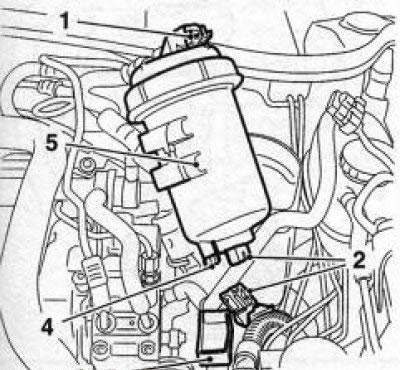
8.2 Fuel filter for engine Z19DT(H): 1. Fuel heating system plug connector; 2. Fuel temperature sensor plug connector (with appropriate equipment); 3. Container for draining sludge; 4. Filter drain plug; 5. Filter housing
3. Disconnect the plug connectors (see illustration 8.2) fuel heating system and fuel temperature sensor (with appropriate equipment). Then, without disconnecting the fuel hoses, remove the filter housing from the mounting clamp. Place a suitable container underneath it to drain the sediment/water.
Note: Try not to shake the filter so that the sediment does not mix with the top layer of fuel.
Loosen the drain plug about one turn and allow the fuel to drain into the container provided. Do not tighten the plug until clean fuel begins to flow out of the hose - usually about 100 ml.
Attention! Fuel should not be drained from the filter completely. Upon completion of the operation, secure the filter housing in its regular place and connect the plug connectors.
4. On Y20DTH/Z22DTR/Y30DT engines, to drain sediment/water from the fuel filter, it is necessary to put it on the drain valve (see accompanying illustration) at the bottom of the filter housing, a section of hose of a suitable size, - lower the other end of the hose into a clean container, preferably with transparent walls. Slightly loosen the clamping bolt on the filter cover, and then the valve. Drain the sediment/water as described above. Upon completion of the operation, close the valve and tighten the clamping bolt on the filter cover (6 Nm).
Note: Do not apply too much force to tighten, otherwise the sealing gasket may be damaged and leakage may occur. It is not necessary to bleed the fuel system to remove air after draining the sediment/water (see paragraph 17).
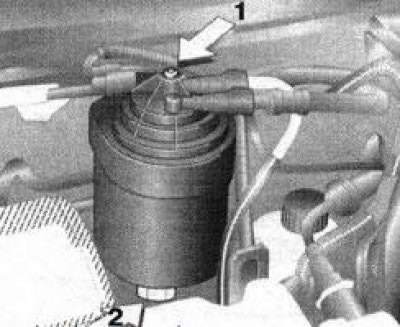
8.4 Fuel filter for Y20DTH/Z22DTR/Y30DT engines: 1. Fuel filter clamp bolt; 2. Drain valve
Attention! On 2.0 and 2.2 l diesel engines, if the filter is completely empty, air will have to be removed from the fuel system using a special device!
5. Remove the drain pan. Use a clean rag to wipe up any spilled fuel. Reconnect the battery. Finally, check all loose components for signs of developing leaks.
Replacing the working element of the fuel filter
6. Disconnect the battery and completely drain the fuel from the filter (see above).
7. Disconnect all system plug connectors (if they were not disconnected when draining the fuel).
8. Disconnect the fuel hoses from the filter housing (see accompanying illustration), - try not to damage the special connectors, use a special tool from Opel (KM-796-A or Hazet 4501-1). To prevent fuel spillage and air from entering the fuel system after disconnecting, close the free ends of the hoses with plugs.
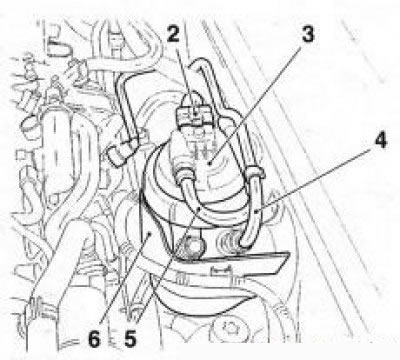
8.8 Diesel engine fuel filter (using Z19DT(H) as an example): 2. Fuel heating system plug connector; 3. Fuel filter housing; 4. Fuel outlet hose; 5. Fuel inlet hose; 6. Filter fastening
9. Remove the fuel filter housing from the mount by pushing it upwards.
10. To replace the filter element of engines with a working volume of 2.0/2.2/3.0 l, it is necessary to unscrew the tightening bolt (see accompanying illustration) and disassemble the filter. There is some fuel left in the replaceable element - after removing it, place it in a suitable container, and drain the remaining fuel from the filter housing there. Wipe the cover and filter housing with a clean rag.
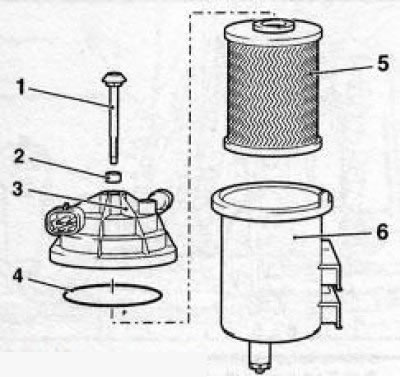
8.10 Design of fuel filter for Y20DTH/Z22DTR/Y30DT engines: 1. Tie bolt; 2. Sealing gasket; 3. Filter cover; 4. Lid sealing gasket; 5. Replaceable filter element; 6. Filter housing
11. Insert a new replacement filter element into the housing and fill the filter almost to the top edge of the housing with clean diesel fuel.
Attention! Even a small amount of sand and dirt on the inner surface of the replaceable element can lead to failure of the high-pressure fuel pump (HPFP). Replace the sealing gaskets, carefully assemble the filter and tighten the clamping bolt with a force of 6 Nm.
Note: Do not apply too much force when tightening, otherwise the filter cover sealing gasket may be damaged.
12. The design of the filter for Z19DT(H) engines is shown in the accompanying illustration 8. 12a. To replace the filter element, it is necessary to use a special device (Opel-EN-46784-020) clamp the filter housing in a vice, then, using a special key (Opel-EN-46784010) (see accompanying illustration 8.12b), release the filter cover clamping ring. If special devices are not available, secure the fuel filter housing in a vice using suitable pads or shaped jaws and release the clamping ring using a hammer and a wooden block - strike the block carefully, alternately adjusting it to the various projections of the ring
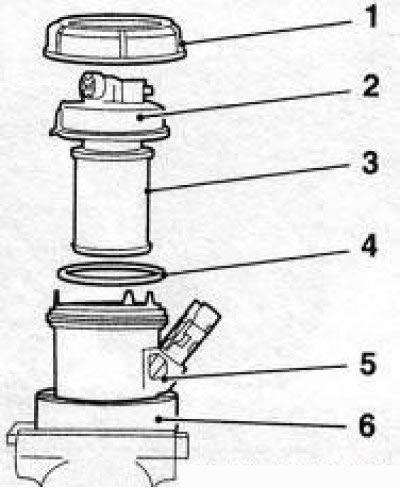
8.12a Design of the fuel filter of the Z19DT(H) engine: 1. Pressure ring; 2. Fuel filter cover; 3. Replaceable filter element; 4. Sealing gasket; 5. Filter housing; 6. Device for clamping the filter housing in a vice (Opel-EN46784-020)
Attention! When disassembling the filter without using a special tool, be especially careful - you can damage the thread or edges of the pressure ring, which in turn will lead to a loss of seal tightness!
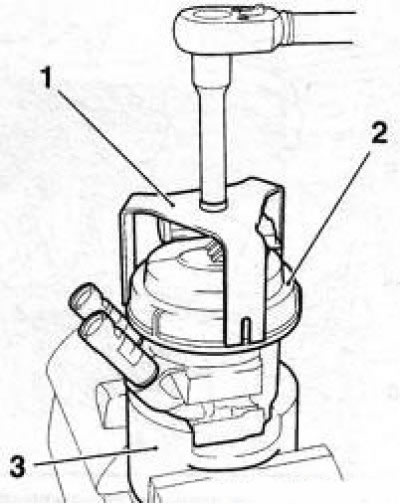
8.12b Disassembling the fuel filter of Z19DT(H) engines: 1. Special key (Opel-EN-46784OU); 2. Pressure ring; 3. Device for clamping the filter housing in a vice (Opel-EN46784-020)
13. Remove the filter cover with the replaceable element, remove the sealing ring and, turning the replaceable element 50° counterclockwise, detach it from the cover. Wipe the cover and filter housing with a clean rag.
14. After replacing the replaceable element, assemble the filter in the reverse order - do not forget to replace the sealing gasket and fill the filter with fuel.
Note: The filter cover can only be installed in the housing in one position to avoid incorrect assembly. The clamping ring is tightened with a force of 30 Nm.
15. After assembling the filter, carefully install it into the mount, remove the plugs and connect the fuel hoses, then connect the electrical wiring to the filter and connect the battery.
16. After completing all operations with the fuel filter, start the engine and let it idle. Check the fuel system for leaks. If the engine does not start, remove air from the fuel supply system (see below).
Removal air from the fuel system
17. Air will be removed from the system automatically when the ignition is turned on and the engine is started. However, if there is too little fuel in the filter, the engine may not start or the engine may stop shortly after starting.
18. In this case, on Z19DT(Hf and Y30DT engines, turn on/off the ignition three times, each time leaving it on for at least 3 seconds. When the ignition is turned on, the electric fuel pump is activated, with the help of which the fuel circulates throughout the entire fuel system circuit, air is removed and the fuel filter is filled. Repeat the engine start - hold the ignition key until the engine starts, but no more 30 seconds. If the engine does not start again, turn off the ignition and after a while repeat the air bleeding procedure.
Note: On the Y30DT engine, you can skip the pre-priming step and simply hold the ignition key until the engine starts. However, if this does not happen within about 1 minute, the ECM will deactivate the starter to prevent damage to the starter. Wait 1-2 minutes and turn the starter on again.
19. On Y20DTH and Y22DTR engines, if the engine fails to start after the fuel tank or fuel filter has been completely drained, it is necessary to remove air from the system using an external fuel pump (for example, Orel-KM-948).
Warning! Attempts to remove air by starting the starter may result in the failure of the fuel injection pump!
20. Before starting the procedure, make sure that there is a reserve of fuel in the fuel tank not less than 5 l, all elements of the fuel system have been checked for leaks and the battery is sufficiently charged.
21. Place a suitable container under the fuel tank to collect any leaking fuel. Disconnect the quick-release coupling and separate the front fuel line (see accompanying illustration) from the end connector and release the end connector from the holder.
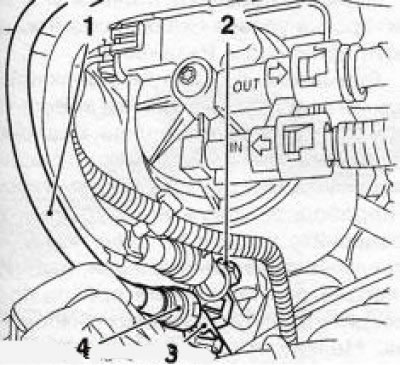
8.21 Disconnecting the front fuel line (1): 2. Fuel line holder; 3. Fuel line end connector; 4. Quick release coupling
22. Connect the vacuum pump pressure hose (see illustration 8.22a) to the end connector of the front fuel line, and the suction hose of the pump to the front fuel line (see illustration 8.22b).
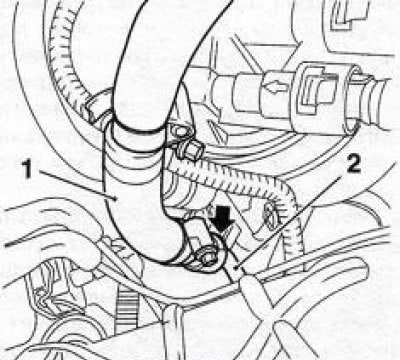
8.22a Connecting the pressure hose (1) of the vacuum pump to the end connector (2) of the front fuel line - the arrow indicates the quick-release connection
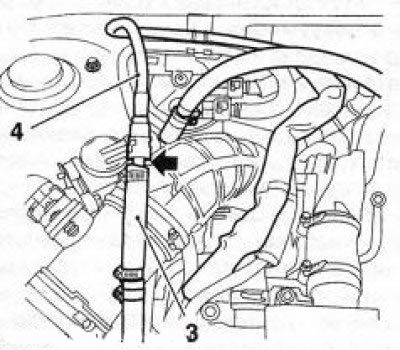
8.22b Connecting the suction hose (3) of the vacuum pump to the front fuel line (4) the arrow indicates the quick-release connection
23. Turn on the vacuum pump for about 3 minutes, then, without turning off the pump, start the engine with the starter.
Note: The engine can be cranked by the starter for no more than 40 seconds. If the engine does not start during this time, wait about 20 seconds, then repeat the starting process.
24. After starting the engine, leave the vacuum pump on for a while. Turn off the pump and stop the engine.
25. Connecting the front fuel line is done in reverse order.
26. Start the engine and check the fuel system for leaks.
Visitor comments