


General information
1. The 12-volt battery installed in the car is located under the hood in the left front part of the engine compartment and consists of six cans, in which positive and negative plates (lamellas) are placed, immersed in a solution of sulfuric acid. The main task of the battery is to generate the current necessary for starting the engine, ignition/activation of glow plugs and for lighting, as well as to provide power to other on-board or auxiliary consumers of electrical energy.
2. Modern batteries, if the minimum maintenance requirements (see below) are met and when used under normal conditions, do not require additional maintenance and are designed, on average, to last 4 years.
Warning! Carrying out battery checks and maintenance requires some special precautions. Remember that the hydrogen released by the electrolyte is a highly explosive gas. Do not smoke or approach the work site with an open flame or a lit cigarette! Do not forget that the electrolyte itself is diluted sulfuric acid, which can cause severe chemical burns if it gets into your eyes or on exposed areas of the body. The electrolyte can also easily damage clothing fabric and the paintwork of body panels!
3. When installing additional electrical and electronic equipment on the vehicle, the load on the battery may increase and a battery with a higher capacity may be required - consult an Opel service station about the possibility of using such a battery.
Attention! The battery charging system is designed for strictly defined capacity values! Installing a battery with either too much or too little capacity will result in its premature failure - strictly follow the recommendations of specialists, and if necessary, make the appropriate adjustments at a service station.
4. If you do not plan to use the car for 30 days or more, disconnect the negative cable from the battery to prevent premature discharge, and in winter, when the outside air temperatures are very low, it is recommended to remove the battery and store it in a room with a positive (but not high, up to +10°C) temperature.
Note: After connecting the battery, you must enter the security code for the infotainment system, reset the chronometer and set the date on the information display and, if equipped, synchronize the electric windows and sunroof (see Chapter "Controls and operating techniques").
5. The quality of the contact between the battery terminals and the connecting wires is of particular importance for ensuring reliable engine starting and long-term trouble-free operation of the battery. Every time you look under the hood of the car, check the reliability and completeness of their contact and fully tighten the fasteners.
6. A conscientious attitude to the implementation of routine preventive maintenance procedures for the battery is the only guarantee of a quick and trouble-free engine start. Before starting battery maintenance, make sure that you have all the necessary materials and tools at hand to ensure the safety of the work (see accompanying illustration), try to use only non-sparking tools.
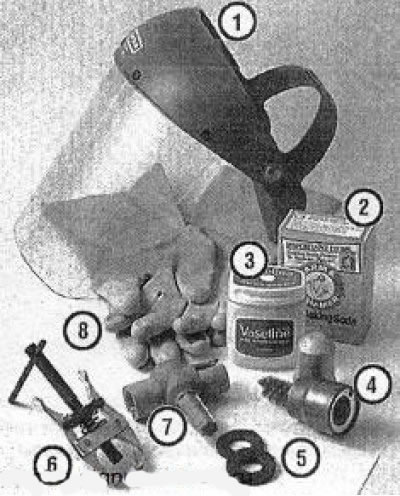
11.6 Tools and materials required for battery maintenance:
1. Face shield/safety glasses - When removing corrosion marks with a stiff brush, crystallized acid particles can easily get into the eyes.
2. Baking soda - an aqueous solution of baking soda is used to neutralize traces of corrosion.
3. Acid-free petroleum jelly - lubricating the battery terminals will help prevent corrosion in the future.
4. Battery Terminal/Wire Terminal Stripper - Specially shaped stiff wire brush attachments help effectively strip battery terminals and terminal clamps.
5. Impregnated felt washers - installing such a washer directly under the terminal clamp will prevent the development of corrosion.
6. Puller - sometimes the wire clamps are seated on the terminals very tightly and cannot be removed even if the fasteners are completely released.
7. Battery terminal/wire end stripper - although different in design from that mentioned in point 4, it is designed to perform the same tasks.
8. Rubber gloves - the importance of this protective equipment should not be underestimated - do not forget that the battery contains sulfuric acid!
7. Before starting work, be sure to turn off the engine and all electrical consumers. Disconnect the negative cable from the battery. When servicing the battery, wear protective glasses and gloves, and do not allow children to approach the work area.
Service
8. First of all, examine the external condition of the battery. If the positive battery terminal with the clamp put on it is equipped with a rubber protective cover, make sure that the latter is not damaged. The cover must completely cover the metal components of the terminal connection. Check the condition and reliability of the fastening of the terminal connections, inspect the cover and battery cover for cracks and other mechanical damage. Make sure that the clamping bolts are securely fastened. Assess the condition of the insulation of the battery wires along their entire length.
Caution: If the wire is not securely fastened to the positive battery terminal, disconnect the wire from the negative battery terminal before tightening it to avoid the possibility of a short circuit! After tightening the positive wire, reconnect the wire to the negative battery terminal (see Chapter 5).
9. If traces of corrosion in the form of a white powdery coating are found on the surface of the battery (see accompanying illustration), especially near the terminal areas, the battery must be removed from the vehicle for a thorough exterior cleaning. Refer to Chapter 5, Section 14 for battery removal and installation procedures.
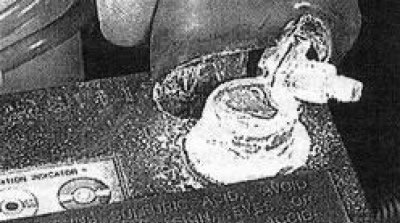
11.9 Terminal corrosion usually appears as a white powdery deposit
10. Carefully clean the contact surfaces of the terminal clamps of the wires and the battery terminals with special brushes using a 10% solution of baking soda/technical soda (see accompanying illustrations). Clean the battery terminals with the same solution and wash the surface of its cover. Make sure that the solution does not get inside the jars. Clean in a protective mask/glasses and rubber gloves to avoid getting acid particles in your eyes and on your hands. Also try to choose appropriate clothing that you won't mind throwing away later. After finishing cleaning, wipe all battery surfaces with a clean, slightly damp towel/rag soaked in the soda solution.
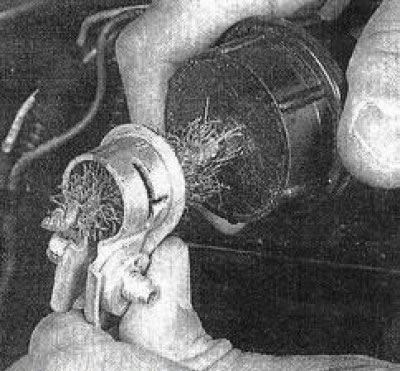
11.10a Cleaning the terminal clamp using a special brush
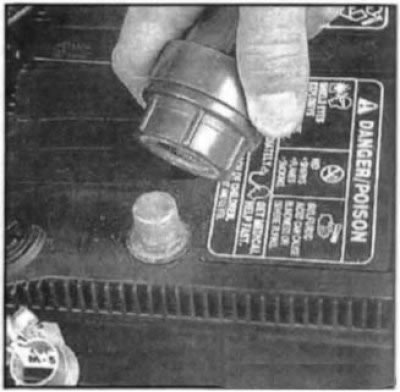
11.10b Stripping the pole terminal
11. Check the condition of the battery tray and the clamping bar mounting studs. Wash the tray with a solution of baking soda, - treat the areas damaged by corrosion with a zinc-based primer or special compounds designed to protect against corrosion and reduce the effects of acid.
12. Before installing the battery, make sure that no tools or materials are left on the tray. Tighten the battery clamp mounting bolt - a weak fastening leads to vibration and shaking of the battery while the car is moving and, as a result, to its premature failure.
13. To protect the terminal connections from corrosion, it is recommended to put specially treated felt washers on the battery terminals. After connecting the wires, cover the terminal assemblies with acid-free petroleum jelly. Remember that the negative wire is always connected last!
14. Ensure that the clamp fasteners are tightened securely.
Charger
15. The battery is constantly charged by the generator current when the engine is running. In case of a long break in the operation of the vehicle (more than 1 month), if a fault occurs in the charging system, if the engine is started frequently in unfavorable conditions, or if the battery approaches its end of service life, it may be necessary to charge it while removing it from the vehicle.
16. Almost all sealed maintenance-free batteries equipped with a charge level indicator (see accompanying illustration). Compare the color of the indicator spot in the viewing window with the indicator status map printed on a special label pasted to the battery case. Some batteries are placed in a sealed case and equipped with a built-in hydrometer, allowing you to visually determine the battery charge level by the color of the color spot, the color of which is specified in the battery operating instructions. Check the battery condition regularly, and charge it in a timely manner if necessary. If necessary, service station specialists can check the battery charge using special equipment.
Warning! During charging, highly flammable and fire hazardous hydrogen is released in the battery cells! Do not smoke or approach the charging area with an open flame. Wear protective glasses when approaching the battery installation area. Before connecting or disconnecting the battery from the charger, make sure that the device is disconnected from the power supply. Charge the battery in a well-ventilated area.
Note: The authors of this Manual recommend charging the battery outside the vehicle, as the gas released during the procedure is chemically aggressive to paintwork. Remember that performing a quick charge without disconnecting the wires from the battery may cause damage to the vehicle's electrical components.
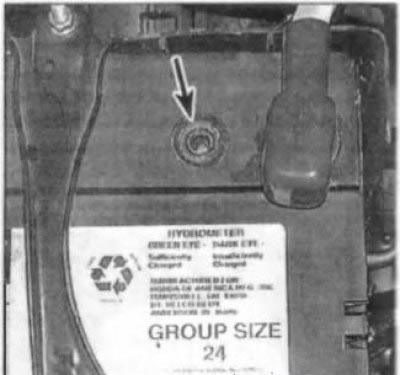
11.16 Sealed batteries are equipped with a charge level indicator - a label with a map of the indicator spot states is attached to the battery case
17. Charging a discharged battery should be done in accordance with the instructions of the charger manufacturer, in a well-ventilated room equipped with all safety measures for working with batteries. If the device is equipped with a selector switch, make sure that it is set to 12 V. If the appropriate conditions are not available, it is advisable to seek help from a service station.
18. During charging, all battery can neck caps (if any are provided) must be open. Before removing the plugs, clean the adjacent surfaces from dust and dirt, do not allow foreign particles to enter the battery jars.
Checking the electrolyte level
19. For batteries with filler holes, it is necessary to periodically, especially in hot weather, check the electrolyte level in the cans.
Warning! Do not allow the battery to operate for a long time with an insufficient electrolyte level - this may lead to overcharging of the battery, destruction of the plates and a significant reduction in its service life!
20. The electrolyte level is checked visually, through the translucent plastic battery case. The level in ALL sections of the battery should be between the MIN and MAX marks on the battery case.
21. If the electrolyte level is not visible through the housing, check it through the filler holes of the battery sections; it should reach the lower edge of the filler hole sleeve or cover the internal mesh of the battery can (depending on the battery design).
22. If it is necessary to adjust the electrolyte level, add the required amount of DISTILLED water.
Note: Do not add too much water; excess electrolyte is removed using a special hand pump (bulb).
Warning! Electrolyte is an acid solution! It should be collected in special containers and disposed of properly! If you do not have sufficient experience or the appropriate capabilities, leave the operation of adjusting the electrolyte level to service station specialists!
23. After completing the level adjustment, close the filler holes tightly and wipe the battery surfaces with a rag soaked in an alkaline solution.
Visitor comments