
OpelBook.ru
Cars AvtoVAZ Cars Mitsubishi Cars BMW Cars Mercedes Cars Nissan Cars Toyota Cars Chevrolet
English Русский
Български
Беларускі
Український
Српски
Hrvatski
Română
Polski
Slovenský
Magyar
 |  Sitemap  |  Contacts  |    


Main Astra Corsa Insignia Kadett Omega Vectra Zafira Others Articles
Kadett D (1979-1984) Kadett E (1984-1995)
  • Main
  • Kadett
  • Kadett D
  • Electrical equipment
  • Power devices
  • Checking the battery

Checking the battery (Opel Kadett D)

            0

Contents: Checking the density of the…⬇ Cleaning the battery terminals ⬇ Checking the battery under load ⬇
The electrolyte level should be 5 mm above the plates including the separators. If there is an electrolyte level mark, then you should be guided by it. Only distilled water should be used for topping up.
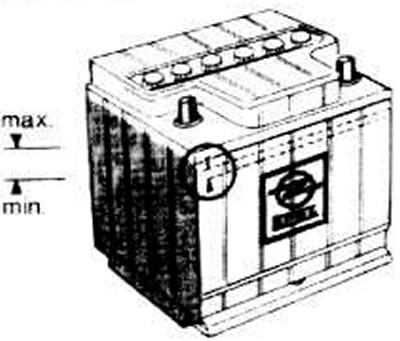
The electrolyte level should be 5 mm above the plates including the separators. If there is an…


Batteries with very high electrolyte levels when heavily charged (long trip) may boil. A very low electrolyte level will greatly reduce the life of the battery.

Checking the density of the electrolyte


The density of the electrolyte together with the voltage measurement allows us to draw a conclusion about the battery charge level. A hydrometer is used to check the density. The higher the density, the more the float rises. The scale can be used to determine the density value in g/mm³ or degrees (+°Be). The following values should be present.
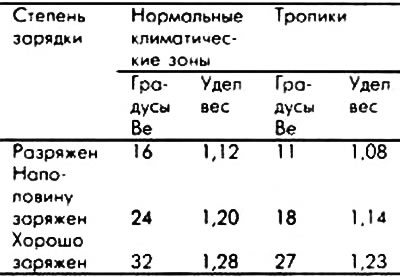
The density of the electrolyte together with the voltage measurement allows us to draw a conclusion…


Cleaning the battery terminals


During regular inspection of the car, you should also clean the terminals and connecting terminals of the battery and lubricate them with a special lubricant (acid-resistant).

[Original posted on the website: www.OPELBOOK.ru]

Caution: When not in use, the battery discharges itself.


If the battery is not checked and recharged in time, irreparable damage may appear on the plates. If the car is not moving for a long time, the battery should be discharged and charged every month.

Checking the battery under load


Connect the voltmeter to the vehicle's terminals.

Start the engine and read the voltmeter readings.

When starting the engine, the voltage with a fully charged battery should not be below 10 V (electrolyte temperature ~20°C).

If the voltage drops immediately and the electrolyte density in the cells is different, then we can conclude that the battery is faulty.

The total voltage can be measured with a battery tester.
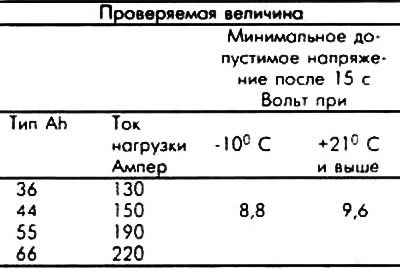
The total voltage can be measured with a battery tester.


Caution: A freshly charged, maintenance-free battery must have its surface charge removed. To do this, apply 300 A to the battery for 15 seconds. Allow the battery to rest for 15 seconds before the second test. If the voltage drops below the specified value during this measurement, the battery is either discharged or faulty.


This article is available at russian, bulgarian, belarusian, ukrainian, serbian, croatian, romanian, polish, slovak, hungarian
Checking the article: Kornev Georgy

Share information:

Previous articles
Opel Kadett D: Power devices
Next articles

Removal and installation the battery
Charging the battery
Maintenance free batteries
Battery malfunctions and how to fix them
Generator — design description
Removal and installation the generator
Checking and tensioning the V-belt


See similar ones from other Opel car manuals:
▶ Battery — Checking and Charging Opel Astra F (1991-1998, petrol)
▶ Battery — general information, checking the condition,… Opel Corsa B (1993-2000)
▶ Battery — Checking and Charging Opel Vectra A (1988-1995, petrol)
▶ Checking battery condition, care and charging Opel Frontera A (1991-1998, petrol)
▶ Checking the compression in the cylinders Opel Insignia A (2008-2017)
Link to this page in different formats

Visitor comments


No comments yet


How much will 12 + 28 =


Kadett E (1984-1995) 
  • General information
  • Vehicle description
  • Operation and maintenance
  • OHV power unit
  • Engine design
  • Check and repair
  • Engine work
  • OHC power unit
  • Engine design
  • Engine repair
  • Ignition system
  • Cooling and lubrication
  • Supply system
  • Fuel injection «LE-Jetronic»
  • Fuel injection «LE3-Jetronic»
  • Motronic ML4.1 system
  • Motronic M1.5 system
  • Motronic M2.5 system
  • Transmission
  • Clutch
  • Gearbox F10 and F13
  • Gearbox F16 and F20
  • Automatic gearbox
  • Drive shafts
  • Chassis
  • Front suspension
  • Rear suspension
  • Steering
  • Brake system
  • Electrical equipment
  • Equipment and devices
  • Electrical circuits
Kadett D (1979-1984) 
  • General information
  • Car care
  • Maintenance
  • Power unit
  • Gasoline engines
  • Lubrication system
  • Cooling system
  • Power system (gasoline)
  • Carburetor Solex 35 PDSI
  • Carburetor Varajet II
  • Carburetor 1B1
  • Fuel injection (gasoline)
  • Diesel engines
  • Fuel system (diesel)
  • Transmission
  • Clutch
  • Manual gearbox
  • Chassis
  • Front suspension
  • Rear suspension
  • Steering
  • Brake system
  • Wheels and tires
  • Body
  • Body elements
  • Doors and windows
  • Electrical equipment
  • Equipment and devices
  • Lighting system
  • Power devices
  • Ignition system
  • Electrical circuits
OpelBook.ru © 2017–2026 · Mobile version · · Sitemap: EN BG BY UA RS HR RO PL SK HU · Feedback · Site search
Astra F, petrol · Astra G, petrol · Astra G · Astra H · Astra J, petrol · Corsa B · Corsa C, petrol · Corsa C · Insignia A · Kadett D · Kadett E · Omega A · Omega B · Omega B2 · Vectra A, petrol · Vectra A · Vectra B, petrol · Vectra B · Vectra C · Zafira A, petrol · Frontera A, petrol · Frontera B · Ascona C · Vivaro A ·
We want your visit to be comfortable 🤝! We use cookies 🍪 to make that happen.