


Contents: General information ⬇ Examination ⬇ Replacement ⬇ Removal and installation ⬇ Storage and commissioning ⬇
Information on servicing and charging the battery is provided in Chapter Vehicle settings and routine maintenance.
General information
A 12-volt battery installed in a car consists of six cans containing positive and negative plates (lamellas) dipped in a sulfuric acid solution. The battery's job is to generate current for starting the car, ignition, lighting, and other consumers of electrical energy.
The battery is 100 percent efficient at 27°C. At -18°C, the efficiency drops to 40 percent, meaning starting the engine will require twice as much energy as it would at 27°C.
Starting power (starting current) shows the battery's ability to start the engine in very cold weather conditions. This characteristic is usually understood as the current in amperes that the battery is capable of delivering for 30 seconds at an air temperature of -18°C without the voltage dropping below 7.2 V (minimum level required for reliable starting). The higher this figure, the greater the starting power of the battery.
Reserve power shows the time in minutes during which the battery delivers a current of 25 A at a temperature of 27°C, i.e. the time during which the battery provides operation of all auxiliary consumers of the car's electrical energy at night and in bad weather conditions with a faulty generator.
In winter conditions, at air temperatures of -18°C and below, the efficiency of battery recharging drops sharply due to the increase in internal resistance. During short trips in winter, the energy spent on starting is not restored, as a result of which the battery begins to wear out, eventually completely wasting its charge.
During the summer months, after long trips, the engine gets very hot and often difficult to restart. These "hot starts" sometimes require as much power as in cold weather, and sometimes even more. This is especially true for high-compression, large-displacement engines and air-conditioned models.
The above lines once again emphasize the importance of choosing the right battery in accordance with the requirements of the engine installed in the vehicle.
Examination
1. Disconnect both wires from the battery.
The negative cable should always be disconnected first and reconnected last. If your car stereo has a security code, make sure you have the correct combination to activate the system before disconnecting the battery!
2. Check the electrolyte level in the battery (only applies to batteries that require maintenance and are equipped with removable covers) - the electrolyte should completely cover the lamellas, otherwise the appropriate amount of distilled water should be added to the jars. DO NOT OVERFILL - excess electrolyte will start to spill over the edges of the necks when the battery is overcharged! Using a hydrometer (ask in car accessories stores) measure the specific gravity of the electrolyte. Remove the caps from the filler necks and take a sample of electrolyte from each of the battery jars in turn with a hydrometer. Following the manufacturer's instructions, determine the specific gravity of the electrolyte by the position of the measuring float of the device. At a normal charge level, the specific gravity of the electrolyte should be 1.270 units (green zone of the measuring scale). When the density of the electrolyte is too low (red zone of the scale) the battery should be charged (see Chapter Vehicle settings and routine maintenance). Maintenance-free batteries are usually equipped with a special color indicator. When the spot in the indicator's viewing window turns black, the battery should be charged immediately. After checking the electrolyte density, the battery's output voltage should be measured using a digital voltmeter.
Before connecting the voltmeter, the surface charge should be removed from the battery - turn on the high beam for approximately 10 seconds, then turn off all on-board power consumers and wait about two minutes.
3. With the engine off and all electrical consumers disconnected, connect the black probe of the voltmeter to the negative terminal of the battery. Connect the red probe to the positive terminal. The battery output voltage should be 11.5÷12.5 V or slightly higher.
The nominal value of the electrolyte density is determined depending on the ambient temperature (and is directly proportional to it), - use the temperature map supplied by the manufacturer with the battery.
If the results of the above tests are positive, there is no need to test the battery under load.
4. A more accurate check of the battery condition can be made using a universal meter (ask in car accessories stores). The device allows you to determine the battery's ability to turn the starter and supply power to on-board consumers of electrical energy under increased engine loads. Connect the meter to the battery terminals. Follow the device manufacturers' instructions - when the load is turned on for 15 seconds, the battery voltage should not fall below 9.6 V, otherwise the battery must be replaced.
At ambient temperatures below 0°C the minimum acceptable reading is reduced to 9.1 V.
Replacement
Disconnecting the battery
The negative wire is always disconnected first and connected last!
The car has several systems that require constant power supply. Disconnecting the battery inevitably leads to erasing the information about the optimal settings stored in the engine management system memory, disabling the clock, destroying the security code entered into the radio, etc. Before disconnecting the battery, carefully read the recommendations below:
- On models equipped with a single lock, do not forget to remove the key from the ignition and put it in your pocket - when the battery is connected, all doors will automatically lock;
- Disconnecting the battery will erase all the learned settings from the ECM memory (except for basic settings). These parameters include: idle speed, maximum speed and self-diagnostic system fault codes. Before disconnecting the battery, read the diagnostic (see section Electronic ignition control system (and injection) gasoline engines). After connecting, all lost settings will be restored automatically, but the control system will need some time, during which the engine may operate unstably in various modes. To speed up the recovery process, start the engine and warm it up to normal operating temperature at idle speed, then increase the engine speed to 1200 rpm for 2 minutes, then take a short trip (about 7 kilometers), constantly changing the engine operating modes - as a result, all settings should be restored;
- If the battery was disconnected with the anti-theft alarm system turned on, the system will remain in the same mode after the battery is connected - if equipped accordingly, this also applies equally to the standard engine immobilizer;
- On models equipped with a trip computer, disconnecting the battery will also erase all user data entered during operation of the computer;
- If your car stereo is equipped with a security code, make sure you have the correct combination to activate the system before disconnecting the battery. Details on entering the code and instructions for using the system are provided in Chapter Controls and operating techniques. If you lose the combination, please contact the specialists at your Opel service station for assistance.
You can avoid unpleasant consequences of disconnecting the battery by using an external power source - detailed rules for using such devices are usually given in the operating instructions. As a rule, such power sources are connected to the cigarette lighter socket, after which the standard battery can be safely disconnected. The current generated by the source should be sufficient to power the control module memory, prevent the radio from blocking and maintain the functionality of the clock.
Some of these devices can supply the system with current sufficient for normal operation of other energy consumers. Before servicing electrical equipment components, make sure that the corresponding consumer is completely de-energized!
Purchasing a new battery
Probably the most important thing a buyer should pay attention to is the battery's performance. There are three such characteristics. The first is rated voltage, - it is the same for all batteries, and it is impossible to make a mistake. When buying, it is advisable to check the battery with a load fork. The second - capacity, measured in ampere/hours (A/h), and roughly speaking, determining the amount of electricity stored in the battery. The capacity determines how long the engine can be turned by the starter, or more precisely, how many attempts can be made to start the engine. The price of a battery is mainly determined by its capacity. And the third characteristic is the starting current (measured in Amperes), i.e. the current supplied to the starter when starting the engine. This parameter can be indicated on batteries in four different ways: in accordance with the requirements of domestic standards (GOST), according to the standards of the United Europe (EN), according to the American standard (SAE), or according to the German standard (DIN). The DIN standard is closest to the domestic GOST and is used "by default" on most European-made batteries, i.e. without specifying the system. The higher the starting current, the faster and with a higher torque the starter will turn the engine.
It is best to buy a battery with the characteristics specified in the car's operating instructions: yes, in this case it will last longer and with minimal expenses. For reasons of economy, you can buy a battery with a lower capacity than required, but it will last less and will bring much more trouble during cold starts in winter. Buying a battery with a larger capacity than the nominal one does not provide a gain in its service life, since constant undercharging will lead to sulfation of the plates. Using a battery with an excessively high starting current is fraught with burning out the starter windings - a much more effective way to combat difficult starts is an elementary replacement of engine oil.
Recently, the country's market has been overflowing with low-quality goods and fakes. Storage batteries are no exception. There are several signs by which you can distinguish the original from a fake with a fairly high degree of accuracy. First and perhaps most important: the country of manufacture and the manufacturing plant must be indicated on the battery, preferably with the address. Second: the production date must be indicated, which especially applies to sealed batteries that do not require maintenance. Each battery must be accompanied by a technical passport, but the presence of instructions is not required. This is due to the fact that in the West, batteries are almost never sold at retail - they are installed by specialists at service stations. Third: a high-quality battery is unthinkable without a high-quality case, good plugs and smooth terminals, often coated with a special grease to protect against oxidation and covered with colored plastic caps on top.
Removal and installation
Please read the above instructions carefully before disconnecting the battery.
Removal
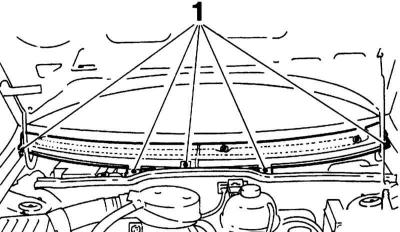
1. Remove the screws (1) securing the windshield fairing.
Fairing mounting bolts
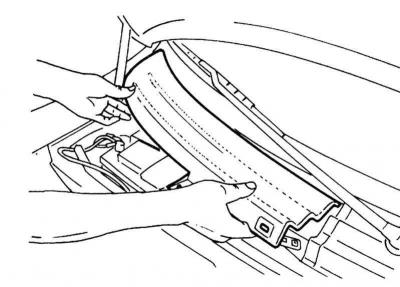
2. Lift the drainage channel in the middle and remove its right half.
Removal the right half of the drainage gutter
3. Disconnect the wires from the battery, first the negative, then the positive.
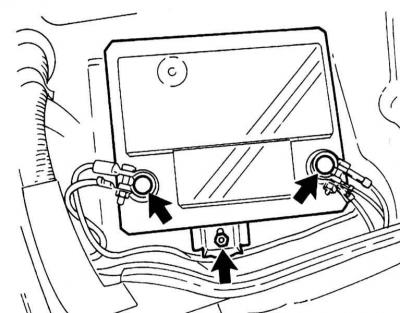
4. Unscrew the fastener and remove the mounting plate.
Removal the mounting plate
5. Remove the battery.
Installation
Due to the limited space available for the battery, its height should not exceed 175 mm. When replacing the battery, please note that it is not possible to install a battery that is higher than this.
Installation is performed in the reverse order of dismantling the components. After connecting the wires, lubricate the terminal blocks with technical petroleum jelly.
The negative wire is always disconnected first and connected last!
Storage and commissioning
If you plan to stop using the car for more than two months, the battery should be removed and stored. The optimal battery storage temperature is from 0 to 27°C. At these temperatures, self-discharge of the battery is minimal. To avoid irreversible destruction of the lamellas, charge the battery in storage at least once a month.
In addition to discharging, an unused battery is subject to sulfation. If such a battery is charged with a fast charger, it will not accept the charging current, or as a result of sulfation, it will be overcharged and cannot be used further.
Before discarding a failed battery, perform the following checks:
- Measure the density of the electrolyte (see Chapter Vehicle settings and routine maintenance), - if the difference between the densities in individual jars does not exceed 0.04 g/ml, then it is necessary to charge the battery with a normal charger;
- After charging, check the battery under load - if the battery characteristics are below the nominal (see Specifications in Chapter Engine electrical systems), the battery needs to be replaced;
- If the density of the electrolyte in one or two adjacent cans differs significantly (for example, in five sections it is 1.16 g/ml, and in the sixth - 1.08 g/ml), there is a short circuit in the battery and its further use is not advisable.
Visitor comments