


Attention: It is necessary to replace all brake pads of one axle of the vehicle at the same time, even if only one of them has reached the wear limit! Use only pads approved for use by the manufacturer!
Corsa models produced up to August 2003
1. The procedures for replacing and checking the condition of the rear brake pads are fundamentally the same as those for the front brakes. All instructions given in Section 5.
2. Support the front wheels with wheel chocks, remove the rear wheels and place the rear of the car on stands.
3. Loosen the lower guide pin bolt and rotate the caliper upward on the upper guide pin axis.
4. The brake pads of the rear brake mechanisms are installed in the guide on the sliding plates (see accompanying illustration). Remove the pads from the guide first, and then the plates.
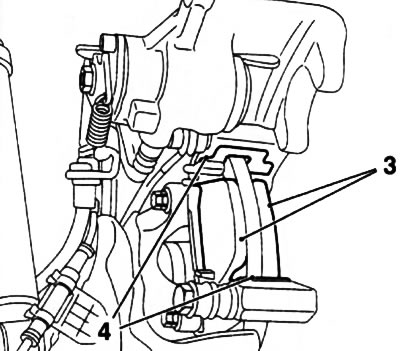
6.4. Brake pads (3) and sliding plates (4) of the rear disc brake mechanisms
Attention: If you plan to reinstall the same brake pads, you must mark their installation locations when removing them!
5. Perform all checks and recommendations given in paragraphs 4 through 7 Section 5 (see above).
6. Press the brake piston using a special tool Opel-KM-610/7 (see accompanying illustration), using the KM-6007-10 adapter, or using the Hazet-4970/6 device. Slowly rotate the device handle to the right (clockwise) - the piston will provide significant resistance. When the piston is pressed, the brake fluid will be squeezed into the reservoir, monitor the fluid level, pump out the excess if necessary.
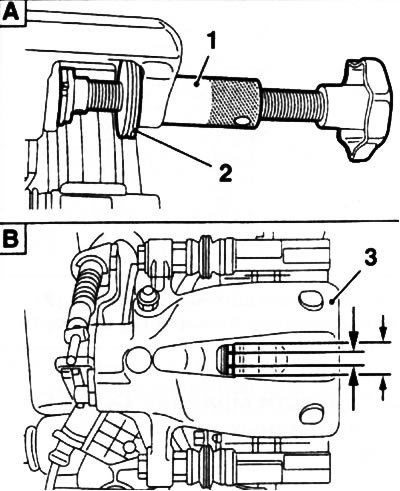
6.6. The KM-6007-10 adapter (2) of the special Opel-KM-6007 device (1) must fit tightly to the caliper (3).
Attention: The piston should be pressed only with a special tool! Using improvised means may lead to a violation of the parking brake adjustment!
7. First, push the piston back until it stops. Then turn the tool axis again so that the piston groove is in line with the caliper viewing window (see illustration 6.6, B).
8. Before installing new brake pads, clean the mating surfaces of the brake mechanism and the guides with alcohol. Lubricate the guide at the indicated points (see accompanying illustration) a thin layer of heat-resistant grease. Install new sliding plates.
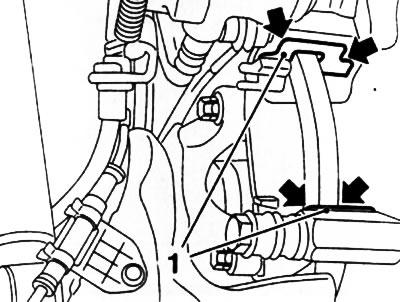
6.8. Lubrication points (indicated by arrows) brake shoe guide: 1. Sliding plates
9. Insert new brake pads between the plates. Install a pad with an acoustic wear indicator (with appropriate equipment) from the brake piston side.
10. After installing the pad, remove the protective film from its back side - it contains an adhesive substance for connecting to the caliper.
11. Place the caliper on the guide and pads, making sure that the sliding plates do not bend and that the brake pads do not stick to the caliper too early.
12. Install the new lower caliper guide pin bolt and tighten to the specified torque, holding the bolt from turning with a second wrench.
13. Further installation is carried out in the reverse order of removal. Follow the instructions given in Section 5.
Corsa models from September 2003 and Meriva models
Note: On these models, the removal/installation of the rear brake pads is performed almost identically to those described above. Below is a description of only the differences.
14. Remove the caliper (see section 8).
15. Using a special device Opel-KM-6007 (see illustration 6.6A), using the KM-6007-30 adapter, press the brake mechanism piston.
Source is on this resource: opelbook
16. Remove the brake pads with sliding plates from the pad guide.
Caution: Be careful when removing the inner pad - do not damage its rear surface! When reinstalling the same brake pads, replace the adhesive film on the rear surface of the inner pad!
Visitor comments