


2. Every time you perform maintenance, check all elements of the brake system for cracks, signs of damage to the protective shell, traces of fluid leaks, swelling and other damage. Hoses are a critical and most vulnerable component of the brake system, so they must be inspected with the utmost care. If any, even minor, damage or signs thereof are detected, the suspected hose must be replaced.
Attention: Do not allow brake hoses to come into contact with oil or gasoline, do not paint them, or expose them to special compounds for anti-corrosion protection of the underbody.
3. Over time, during vehicle operation, old brake hoses may swell, reducing their flow area - this complicates the return of brake fluid to the master cylinder and the complete removal of the brake pads from the disk. As a result, the brake mechanisms heat up, which can lead to failure of both the mechanisms themselves and the wheel bearings.
4. Replacement steel and flexible brake lines can always be purchased at branded service stations, as well as in branded automotive accessory stores.
Attention: Do not under any circumstances use any replacement tubes other than branded ones, specially designed for installation in the brake circuit of your vehicle.
5. If it is necessary to replace metal brake lines, it is necessary to contact an Opel service station, since their installation requires a certain skill and qualification - careless handling can lead to bending of the tubes and affect the size of the channel cross-section. Brake lines must be located at a distance of at least 20 mm from moving or vibrating components of the body, suspension or steering gear. When installing, it is necessary to use all standard clamps and line holders.
6. Before replacing the hose, check the brake fluid level in the reservoir and add the required amount if necessary. Remove the corresponding wheel. Have plugs to plug the brake lines after disconnecting them and a rag to remove any spilled brake fluid. If necessary, pump out the fluid from the reservoir.
Replacing the front brake hose
7. To loosen the union nut connections of the flexible hoses with the steel tubes of the hydraulic lines, use special open-end wrenches with a slotted head. After loosening the union nut, remove the locking bracket and release the brake hose from the support bracket (see accompanying illustration) in the wheel arch, - the locking bracket must be installed in place after disconnecting the hose. Immediately close the brake pipe with the prepared plug.
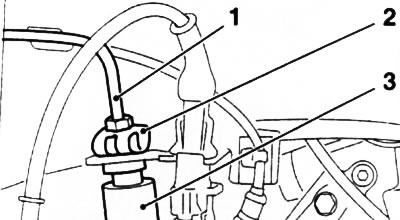
4.7. Connecting the front wheel brake hose (3) to the metal brake line (1): 2. Locking bracket
8. Unscrew the hollow bolt (see accompanying illustration) and disconnect the brake hose from the caliper nipple and remove the hose. Remove the old sealing washers - during assembly, the washers must be replaced without fail.
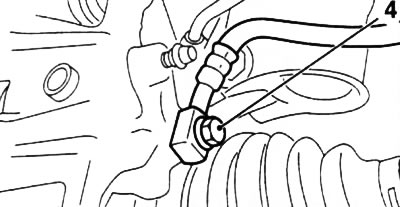
4.8. Hollow bolt (4) for fastening the brake hose to the front wheel caliper
9. Make sure that the new brake hoses exactly match the dimensions and characteristics of those removed from the vehicle.
10. Fasten the brake hose with new sealing rings to the caliper, tighten the hollow bolt to the required force. Then remove the plug and connect the hose to the metal brake line, tighten the union nut. After that, fasten the hose in the intermediate holder on the shock absorber strut - make sure that the hose does not twist during installation.
11. With the front wheels raised, turn the steering wheel to the right and left - the hose should not interfere with the moving parts of the steering mechanism and should not come into contact with other structural elements.
12. After replacing the hose, be sure to remove air from the brake system using a special device (see section 3). Check the fluid level in the master cylinder reservoir and make the appropriate adjustments if necessary.
13. Before operating the vehicle, make sure that the brakes are functioning properly.
Replacing the rear brake hose
15. On Corsa-Eco models, remove the crankcase guard (see Chapter 2).
16. Disconnect the ABS sensor wiring harness from the brake hose.
17. Disconnect the brake hose from the metal brake supply line (see paragraph 7). Similarly, on models equipped with rear drum brakes, the other end of the brake hose is disconnected.
18. On models equipped with rear disc brakes, the hose tip (nipple) is screwed directly into the caliper (see accompanying illustration). Unscrew the nipple and remove the hose, being careful not to twist or damage the hose.
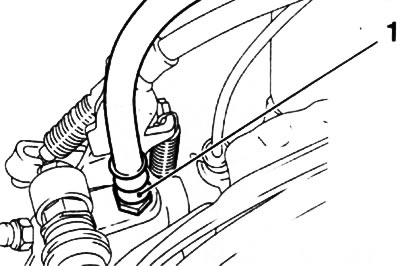
4.18. The nipple (1) of the brake hose is screwed directly into the caliper of the rear disc brake mechanism
19. Installation is carried out in the reverse order of removal. Bleed the brake system (see Section 3), adjust the brake fluid level in the reservoir. Before operating the vehicle, make sure the brakes are functioning properly.
Visitor comments