


Note: The calipers cannot be repaired in a regular workshop - contact an Opel service station or replace them as a whole.
Removal
Caution: After removing the brake pads, do not press the brake pedal, otherwise the piston may be pushed out of the housing. In this case, you will have to go to a service station to install the piston back.
1. Remove the brake pads (see Section 5).
2. Remove the upper guide pin mounting bolt (see accompanying illustration) and remove the caliper from the guide.
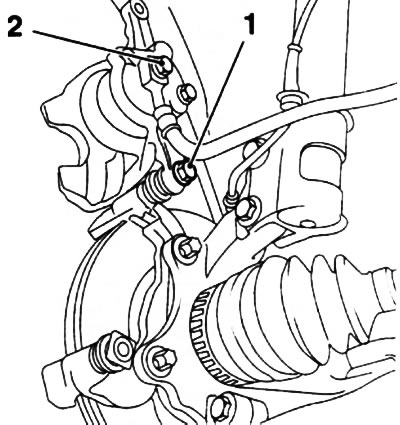
7.2. Bolt (1) for fastening the upper guide pin: 2. Hollow bolt
3. Thoroughly clean the brake hose connection on the caliper. Unscrew the hollow bolt securing the hose (see illustration 7.2) and remove the copper sealing washers - the washers must be replaced without fail. Immediately plug the open end of the hose and the fitting to prevent dirt from getting into the system or attach it to a new caliper.
Note: If the caliper is removed only to remove the brake pads or brake disc, do not disconnect the hose. In this case, tie the caliper to the body with wire so that the hose is not twisted or stretched.
4. Unscrew the 2 mounting bolts (Togh) and remove the shoe guide from the steering knuckle (see accompanying illustrations).
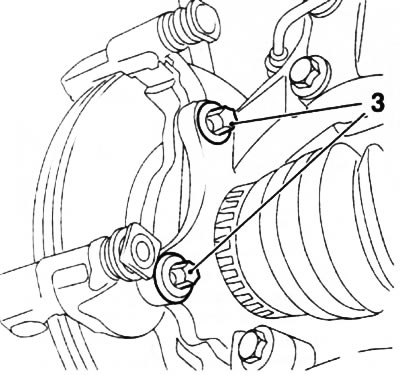
7.4. Bolts Torg (3) for fastening the front brake mechanism guide
Caution: A lot of force is required to loosen/tighten the guide mounting bolts! It is recommended to install the wheels and lower the car to the ground before performing this operation.
Installation
6. Before installation, clean the threads of all bolts from any remaining compound and lubricate them with fresh compound (for example, Loctite Tour 243).
[Text copied from this portal: www.OpelBook.ru]
7. Installation is performed in the reverse order of removal. A lot of force is required to tighten the guide mounting bolts (100 Nm!) - check the reliability of the vehicle mounting in the suspended position. It is recommended to install the wheels in place and lower the vehicle.
8. If the brake hose was disconnected, do not forget to replace the sealing washers and bleed air from the brake system (see section 3), the hose should not be twisted or kinked.
Note: It is sufficient to bleed only the circuit whose caliper was removed. Check that the hoses on the front wheels do not touch them at the maximum steering angle. Check the fluid level in the master cylinder reservoir, if necessary, make the appropriate adjustment (see Chapter 1).
9. Before operating the vehicle, check that the brake system is functioning properly.
Features of Corsa C models equipped with Z17DTH engine and Meriva models
10. On these models, the removal/installation of the calipers and guides of the front brake mechanisms is performed in a completely similar way to those described above. The difference lies in the appearance and a slightly different design of some parts.
Visitor comments