
OpelBook.ru
Cars AvtoVAZ Cars Mitsubishi Cars BMW Cars Mercedes Cars Nissan Cars Toyota Cars Chevrolet
English Русский
Български
Беларускі
Український
Српски
Hrvatski
Română
Polski
Slovenský
Magyar
 |  Sitemap  |  Contacts  |    


Main Astra Corsa Insignia Kadett Omega Vectra Zafira Others Articles
Corsa B (1993-2000) Corsa C (2000-2006, petrol) Corsa C (2000-2006)
  • Main
  • Corsa
  • Corsa C
  • General information
  • Maintenance
  • Brake system and clutch drive fluid

Brake system and clutch drive fluid (Opel Corsa C)

            0

23. The reservoir for hydraulic (brake) fluid is located in the underhood space between the engine compartment bulkhead and the front wall of the passenger compartment (see accompanying illustration) and covered with a protective cover. It is used to store a reserve supply of fluid in the hydraulic circuits of the brake and clutch drive (models with manual transmission) (cm. Chapters 6 and 9).

Note: On models with the Easytronic robotic gearbox, the clutch drive is equipped with a separate reservoir for brake fluid (see Chapter 6, Section 4).
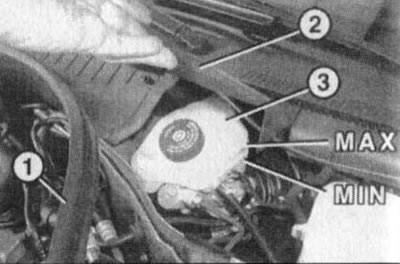

4.23. The brake fluid level in the reservoir (3) must be between the MAX and MIN marks (using the…

4.23. The brake fluid level in the reservoir (3) must be between the MAX and MIN marks (using the Corsa-C model as an example) - protective cover removed: 1. Upper seal of engine compartment bulkhead; 2. Protective cover


24. The liquid level inside the tank is clearly visible through the translucent walls of the latter and should be maintained between the MIN and MAX marks, slightly short of the top.

25. If it is necessary to adjust the fluid level, carefully wipe the reservoir cap and the area around it with a clean cloth to prevent dirt from getting into the hydraulic system.


26. When pouring fluid into the reservoir, make sure that it does not splash onto the surrounding painted surfaces of body parts. Add only fresh fluid of the grade specified by regulatory requirements (withm. Specifications at the beginning of this Chapter), - mixing two liquids of different types is under no circumstances allowed and may lead to failure of the corresponding system!

Warning: Brake fluid is extremely chemically aggressive - do not allow it to come into contact with your eyes or paint on body panels! Do not add hydraulic fluid to the system that has been standing for more than one year or that has been stored in a loosely closed container. Remember that brake fluid is very hygroscopic, i.e. it has the ability to absorb moisture from the air, which can dangerously reduce the efficiency of the brake system!


27. During the level adjustment stage, the condition of the fluid and the inner walls of the tank should also be carefully checked. If any mud deposits, solid foreign particles or water droplets are detected, the system should be emptied and filled with fresh hydraulic fluid (see Chapters 6 and 9).

28. Once the tank is filled to the required level, place the lid on it tightly.

29. Remember that the brake fluid level in the reservoir gradually decreases as the friction linings of the brake shoes wear down, but this decrease is always very slight.

30. If the fluid has to be topped up too often, then there is a leak in the system, the source of which must be identified without delay and the cause eliminated. Carefully inspect all brake lines and their nipple connections (see Section 9), and on models with manual transmission, also the entire hydraulic clutch drive path, including the slave cylinder (see Chapter 6).

31. In case of significant losses of brake fluid, when the reservoir is completely empty, after eliminating the cause of the leak, it is necessary to bleed the hydraulic lines of the brake system and the clutch engagement drive (see Chapter 6 and 9).


This article is available at russian, bulgarian, belarusian, ukrainian, serbian, croatian, romanian, polish, slovak, hungarian
Checking the article: Kornev Georgy

Share information:

Previous articles
Opel Corsa C: Maintenance
Next articles

Windshield and rear window/headlight washer fluid
Engine Coolant — Check
Engine oil — check
Checking Fluid Levels — General Information
General information about settings and adjustments
General information about maintenance
Manual transmission oil — check
Automatic transmission fluid (ATF) — check
Wheels and tires — general information and designation
Wheels and tires — checking condition and pressure
Wheel rotation
Changing engine oil and oil filter


See similar ones from other Opel car manuals:
▶ Hydraulic fluid for brake and clutch systems Opel Astra H (2004-2009)
▶ Hydraulic clutch release drive system Opel Omega B (1993-1999)
▶ Service brake system drive — check Opel Zafira A (1999-2005, petrol)
▶ Check the brake system and replace the brake fluid with… Opel Frontera A (1991-1998, petrol)
▶ Brake and clutch fluids Opel Insignia A (2008-2017)
Link to this page in different formats

Visitor comments


No comments yet


How much will 11 + 45 =


Corsa C (2000-2006) 
  • General information
  • Introduction to guide
  • Troubleshooting
  • Vehicle device
  • User manual
  • Maintenance
  • Power unit
  • Engine repair
  • Cooling system
  • Power and exhaust system
  • Control system
  • Engine electrical equipment
  • Transmission
  • Clutch
  • Mechanical gearbox
  • Automatic gearbox
  • Drive shafts
  • Chassis
  • Brake system
  • Wheel suspension
  • Steering
  • Body
  • Exterior
  • Interior
  • Doors and windows
  • Heating and air conditioning
  • Electrical equipment
  • Equipment and devices
  • Lamps and lighting
  • Electrical circuits
Corsa C (2000-2006, petrol) 
  • User manual
  • Car access
  • Governing bodies
  • Seat control
  • Heating and air conditioning
  • Driving and maintenance
  • Engines 1.0 and 1.2 l
  • Engine repair
  • Cooling and lubrication system
  • Injection system
  • Engines 1.4, 1.6 and 1.8 l
  • Engine repair
  • Cooling and lubrication system
  • Injection system
  • Transmission
  • Clutch
  • Mechanical gearbox
  • Automatic gearbox
  • Drive shafts
  • Chassis
  • Wheels and tires
  • Wheel suspension
  • Steering
  • Brake system
  • Body
  • Exterior
  • Doors and windows
  • Electrical equipment
  • Equipment and devices
  • Lighting system
  • Electrical circuits
Corsa B (1993-2000) 
  • General information
  • Introduction to guide
  • User manual
  • Maintenance
  • Power unit
  • SOHC gasoline engines
  • DOHC gasoline engines
  • Diesel engines
  • Engine repair
  • Cooling system
  • Supply system
  • Injection system (gasoline)
  • Injection system (diesel)
  • Exhaust systems
  • Control system (gasoline)
  • Preheat system (diesel)
  • Charge and launch system
  • Transmission
  • Mechanical gearbox
  • Automatic gearbox
  • Clutch and drive shafts
  • Chassis
  • Brake system
  • Front suspension
  • Rear suspension
  • Steering
  • Body
  • Ventilation and heating
  • Exterior
  • Interior
  • Doors and windows
  • Electrical equipment
  • Equipment and devices
  • Lamps and lighting
  • Electrical circuits
OpelBook.ru © 2017–2026 · Mobile version · · Sitemap: EN BG BY UA RS HR RO PL SK HU · Feedback · Site search
Astra F, petrol · Astra G, petrol · Astra G · Astra H · Astra J, petrol · Corsa B · Corsa C, petrol · Corsa C · Insignia A · Kadett D · Kadett E · Omega A · Omega B · Omega B2 · Vectra A, petrol · Vectra A · Vectra B, petrol · Vectra B · Vectra C · Zafira A, petrol · Frontera A, petrol · Frontera B · Ascona C · Vivaro A ·
We want your visit to be comfortable 🤝! We use cookies 🍪 to make that happen.