OpelBook.ru
Cars AvtoVAZ Cars Mitsubishi Cars BMW Cars Mercedes Cars Nissan Cars Toyota Cars Chevrolet
English Русский
Български
Беларускі
Український
Српски
Hrvatski
Română
Polski
Slovenský
Magyar
 |  Sitemap  |  Contacts  |    


Main Astra Corsa Insignia Kadett Omega Vectra Zafira Others Articles
Corsa B (1993-2000) Corsa C (2000-2006, petrol) Corsa C (2000-2006)
  • Main
  • Corsa
  • Corsa C
  • General information
  • Maintenance
  • Wheels and tires — checking condition and pressure

Wheels and tires — checking condition and pressure (Opel Corsa C)

            0

9. A conscientious attitude to regularly checking the condition of the tires will allow the driver to avoid annoying delays associated with the failure of a wheel while driving. In addition, the nature of the wear of the treads can be used to identify in advance any developing defects in the components of the suspension and steering drive (see Chapter "Introduction", Section "Troubleshooting"). Curbs should be driven over at low speed and, if possible, at a right angle. Driving over sharp curbs can cause hidden damage to tires and wheels that only becomes apparent later: When parking the tire, do not press the wheels against the curb.

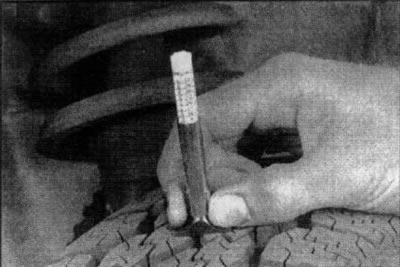
10. The wheels included in the standard equipment of the vehicles discussed in this Manual are equipped with special tire wear indicators (TWI) (see accompanying illustration 5.10a) located in the recesses of the tread pattern along the entire perimeter of the wheel at equal intervals - their position is marked on the side surface of the tire. The minimum permissible tread depth is 1.6 mm, at which pointers protrude from the recesses. You can assess the intermediate degree of tread wear using a special inexpensive device (see accompanying illustration 5.10b), - ask in car accessory stores or at a service station. If the wear of the front tires exceeds the wear of the rear tires, rotate them (see below). To ensure guaranteed driving safety, do not wait for the tread to wear to the limit; it is recommended to replace the tires when the remaining tread depth is 2-3 mm (winter tires - 4 mm).
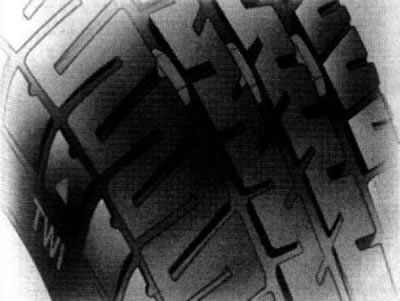


5.10a. Tread Wear Indicators (TWI)

5.10a. Tread Wear Indicators (TWI)
5.10b. Special inexpensive profile pattern depth gauges are available to assess the degree of tread…

5.10b. Special inexpensive profile pattern depth gauges are available to assess the degree of tread wear

Caution: The risk of aquaplaning increases especially when the tread pattern is low!


11. Look out for any signs of uneven tread wear (see accompanying illustration). Such local defects as cup-shaped wear, flattening, etc., usually owe their occurrence to violations of the angles of installation of the front wheels, or the balancing of the latter. To identify and eliminate faults, the car should be driven to a specialized auto service workshop or service station.
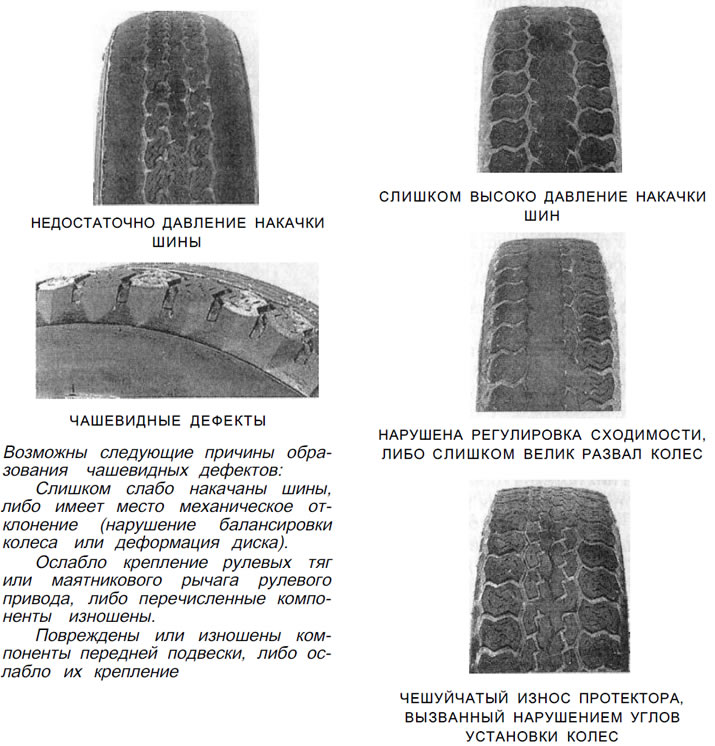
5.11. The most typical examples of tread wear

5.11. The most typical examples of tread wear


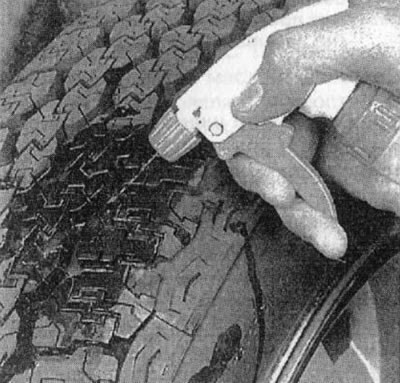
12. Carefully inspect the tires of all wheels for cuts, punctures and foreign objects stuck in the grooves of the tread pattern. Sometimes a punctured wheel continues to hold air inside itself for some time due to the fact that the object that punctured the tire continues to remain stuck in it. The reason for the slow deflating of the tire may be a defective valve nipple of the tire inflation valve - check the condition of the nipple (see accompanying illustration 5.12a). Carefully inspect the tread for foreign objects stuck in it and signs of a leak in the seal of the repair "plugs" used to repair small punctures in the tire. It is quite easy to verify the presence of a puncture - just wet the suspected area of the tire surface with a solution of soapy water (see accompanying illustration 5.12b) - if there is a puncture, the solution will start to bubble. Small punctures are usually easily repaired in tire shops.
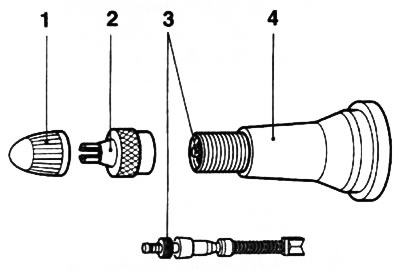
5.12a. If the wheel is constantly «deflating», you should check the condition of the inflation…

5.12a. If the wheel is constantly "deflating", you should check the condition of the inflation valve nipple
5.12b. If the valve is OK, then there is a minor defect in the tire, which can be detected by…

5.12b. If the valve is OK, then there is a minor defect in the tire, which can be detected by wetting the tread with a solution of soapy water


13. Carefully inspect the inner walls of the tires of all four wheels for any signs of brake fluid leakage. If any are found, immediately check the condition of the corresponding brake mechanisms and the hydraulic lines connected to them.

14. Maintaining the required tire inflation pressure will significantly extend the service life of the wheels, and will also ensure maximum comfort when driving and will not reduce the car's controllability. Excessively low pressure can lead to strong heating of the tires, internal damage and, due to this, at high speeds - to peeling of the running surface of the tires and even to rupture. Hidden tire damage cannot be eliminated by subsequent adjustment of the air pressure. Remember that it is almost impossible to correctly determine the tire pressure by eye, especially when it comes to radial tires. It is necessary to always have a suitable pressure gauge at hand - the readings of the compressor inflation gauges at gas stations and service stations should not be trusted.

15. Check the tire inflation pressure when the wheels are cold - this means that the car has driven no more than one mile in the last three hours. Remember that an increase in pressure by 0.3-0.6 kgf/cm² as a result of the wheel warming up is a completely natural phenomenon - it is impossible to adjust the pressure when the tires are hot. Checking should be done at least once every 14 days.

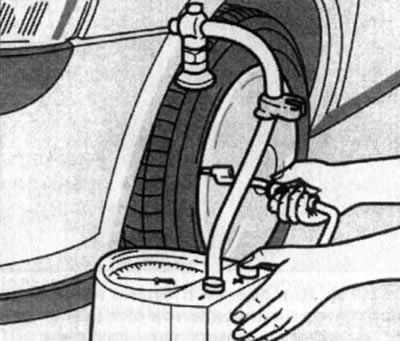
16. Remove the protective cap from the tire inflation valve. To make it easier to remove the caps, use the special key stored on the inside of the fuel filler cap (see accompanying illustration 5.16a). Press the pressure gauge nozzle firmly against the valve outlet, squeezing the nipple stem (see accompanying illustration 5.16b). Read the reading and compare it with the standard data, adjust the pressure if necessary.
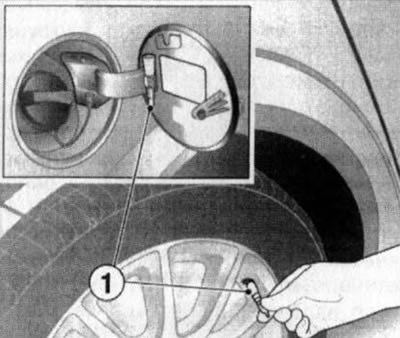


5.16a. Wheel valve cap remover

5.16a. Wheel valve cap remover
5.16b. Timely performance of tire inflation pressure checks will extend the service life of the…

5.16b. Timely performance of tire inflation pressure checks will extend the service life of the wheels (don't forget about the spare tire)

17. Don't forget to screw the valve cap back on to prevent moisture and dirt from getting into the valve. Check the pressure in all wheels, including the spare.

18. Tires, like any rubber products, age, even if the car is used or operated with low intensity - do not install new or continue to use old wheels if more than 6 years have passed since their manufacture. If the spare wheel has not been used for 6 months, its use is permissible only in extreme cases and only at low speeds. Never use used tires whose origin is unknown to you.

19. Installation of protective/decorative caps may change the cooling conditions of the brake mechanisms - use only caps approved by Opel for this model, preferably original ones.


This article is available at russian, bulgarian, belarusian, ukrainian, serbian, croatian, romanian, polish, slovak, hungarian
Checking the article: Kornev Georgy

Share information:

Previous articles
Opel Corsa C: Maintenance
Next articles

Wheels and tires — general information and designation
Automatic transmission fluid (ATF) — check
Manual transmission oil — check
Brake system and clutch drive fluid
Windshield and rear window/headlight washer fluid
Engine Coolant — Check
Wheel rotation
Changing engine oil and oil filter
Checking the condition and replacing the multi-rib drive belt of the units
Draining sediment, removing air from the filter (diesel models)
Checking and replacing hoses located in the engine compartment
Checking the condition of the cooling system components


See similar ones from other Opel car manuals:
▶ Checking the condition of the tires and their inflation… Opel Astra G (1998-2004)
▶ Checking the condition of tires, inflation pressure, wheel… Opel Vectra C (2002-2008)
▶ Checking the condition of the tires and their pressure Opel Frontera A (1991-1998, petrol)
▶ Wheels, tires and hubs — technical condition check Opel Zafira A (1999-2005, petrol)
▶ Cleaning and checking the technical condition of the… Opel Insignia A (2008-2017)
Link to this page in different formats

Visitor comments


No comments yet


How much will 40 + 23 =


Corsa C (2000-2006) 
  • General information
  • Introduction to guide
  • Troubleshooting
  • Vehicle device
  • User manual
  • Maintenance
  • Power unit
  • Engine repair
  • Cooling system
  • Power and exhaust system
  • Control system
  • Engine electrical equipment
  • Transmission
  • Clutch
  • Mechanical gearbox
  • Automatic gearbox
  • Drive shafts
  • Chassis
  • Brake system
  • Wheel suspension
  • Steering
  • Body
  • Exterior
  • Interior
  • Doors and windows
  • Heating and air conditioning
  • Electrical equipment
  • Equipment and devices
  • Lamps and lighting
  • Electrical circuits
Corsa C (2000-2006, petrol) 
  • User manual
  • Car access
  • Governing bodies
  • Seat control
  • Heating and air conditioning
  • Driving and maintenance
  • Engines 1.0 and 1.2 l
  • Engine repair
  • Cooling and lubrication system
  • Injection system
  • Engines 1.4, 1.6 and 1.8 l
  • Engine repair
  • Cooling and lubrication system
  • Injection system
  • Transmission
  • Clutch
  • Mechanical gearbox
  • Automatic gearbox
  • Drive shafts
  • Chassis
  • Wheels and tires
  • Wheel suspension
  • Steering
  • Brake system
  • Body
  • Exterior
  • Doors and windows
  • Electrical equipment
  • Equipment and devices
  • Lighting system
  • Electrical circuits
Corsa B (1993-2000) 
  • General information
  • Introduction to guide
  • User manual
  • Maintenance
  • Power unit
  • SOHC gasoline engines
  • DOHC gasoline engines
  • Diesel engines
  • Engine repair
  • Cooling system
  • Supply system
  • Injection system (gasoline)
  • Injection system (diesel)
  • Exhaust systems
  • Control system (gasoline)
  • Preheat system (diesel)
  • Charge and launch system
  • Transmission
  • Mechanical gearbox
  • Automatic gearbox
  • Clutch and drive shafts
  • Chassis
  • Brake system
  • Front suspension
  • Rear suspension
  • Steering
  • Body
  • Ventilation and heating
  • Exterior
  • Interior
  • Doors and windows
  • Electrical equipment
  • Equipment and devices
  • Lamps and lighting
  • Electrical circuits
OpelBook.ru © 2017–2026 · Mobile version · · Sitemap: EN BG BY UA RS HR RO PL SK HU · Feedback · Site search
Astra F, petrol · Astra G, petrol · Astra G · Astra H · Astra J, petrol · Corsa B · Corsa C, petrol · Corsa C · Insignia A · Kadett D · Kadett E · Omega A · Omega B · Omega B2 · Vectra A, petrol · Vectra A · Vectra B, petrol · Vectra B · Vectra C · Zafira A, petrol · Frontera A, petrol · Frontera B · Ascona C · Vivaro A ·
We want your visit to be comfortable 🤝! We use cookies 🍪 to make that happen.