


Attention: When working with AT, the issue of maintaining cleanliness is of great importance! The ingress of the smallest particles of dirt or abrasive into the ATF can lead to the failure of the AT! Before starting work, carefully wipe the surfaces adjacent to the control (filler) hole, use only absolutely clean, lint-free cloth/rag to wipe the measuring probe!
40. Correct ATF level is one of the critical operating parameters of AT-equipped models. Excessive drop in ATF level can lead to slippage of the rotation converter, while excessive amount of fluid leads to foaming, leakage and may result in transmission failure.
41. When performing work in a service station or if portable diagnostic equipment is available, first check the presence of the on-board self-diagnostic system in the processor memory (see Chapter 5) information about AT failures.
42. Checking the ATF level can be done with the transmission warmed up to normal operating temperature (15-20 km, 72-80°C), or with a "cold" transmission (after approximately 1 minute of engine idling after a long period of standing).
Caution: Do not check the ATF level immediately after driving the vehicle at high speeds, in hot urban conditions, or after towing a trailer - allow the fluid to cool down for approximately 30 minutes first!
43. Park the car on a level, horizontal surface with a hard surface, firmly apply the parking brake. If the engine is cold, start it and warm it up at idle speed. With the engine running, depress the foot brake pedal and move the AT selector lever through all positions in turn, finally returning it back to the "P" position.
44. Without stopping the engine, remove the dipstick (see accompanying illustration). Use your fingers to remove any traces of ATF from the dipstick blade and assess its condition by touch.
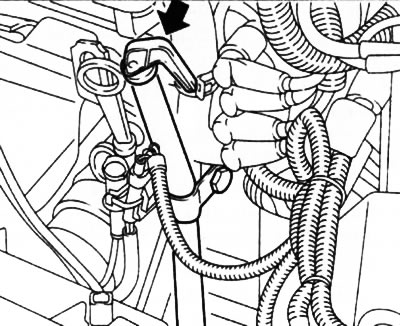
4.44. ATF dipstick
Warning: If checking is done after the ride, be careful not to burn your fingers!
Note: A more detailed description of the procedure for checking the condition and replacing the AT working fluid is given in Chapter 7.
45. Wipe the blade thoroughly with a clean cloth and insert the probe back into the guide tube, firmly fitting the cap onto the neck.
46. Remove the dipstick from the filler neck again and use the length of the wetted section of the blade to determine the ATF level in the transmission housing (see accompanying illustration). If necessary, make the appropriate adjustment by adding the required grade of fluid to the transmission through a funnel with a fine mesh screen. Add ATF in small portions in several steps, checking the level each time - if necessary, remove excess oil with a syringe or special device.
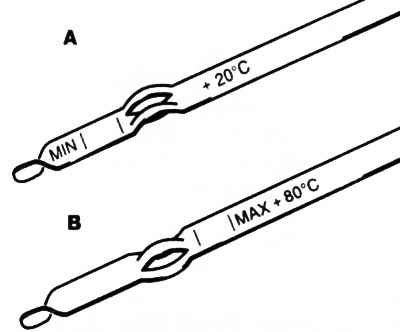
4.46. The ATF level must be within the range indicated on the dipstick blade by the MIN and MAX marks; try not to overfill the transmission with fluid:
A - Marking for checking the ATF level when the transmission is cold
B - Marking for checking the ATF level at operating temperature
Attention: Before filling, read the ATF application instructions, which are usually provided on the packaging - some types of fluid may have important features and require a number of additional operations when filling ATF. Failure to comply with these requirements may result in transmission failure while the vehicle is moving!
47. Once the level adjustment is complete, reinstall the dipstick, depress the brake pedal and move the AT selector lever through all positions, then check the oil level again. Stop the engine.
Visitor comments