
OpelBook.ru
Cars AvtoVAZ Cars Mitsubishi Cars BMW Cars Mercedes Cars Nissan Cars Toyota Cars Chevrolet
English Русский
Български
Беларускі
Український
Српски
Hrvatski
Română
Polski
Slovenský
Magyar
 |  Sitemap  |  Contacts  |    


Main Astra Corsa Insignia Kadett Omega Vectra Zafira Others Articles
Corsa B (1993-2000) Corsa C (2000-2006, petrol) Corsa C (2000-2006)
  • Main
  • Corsa
  • Corsa C
  • General information
  • Maintenance
  • Engine Coolant — Check

Engine Coolant — Check (Opel Corsa C)

            0

See also Chapter 3.

Warning: Do not allow antifreeze to come into contact with exposed areas of the body or painted surfaces of the vehicle. Wash away accidental splashes immediately with plenty of water. Remember that antifreeze is a highly toxic liquid and its ingestion, even in small quantities, can have the most serious consequences, including death. Never leave antifreeze stored in a loosely closed container; immediately collect any coolant spilled on the floor. Remember that the sweet smell of antifreeze can attract the attention of children and animals. Never pour old coolant down the drain or onto the ground!


15. All models of cars described in this Manual are equipped with a compensating cooling system operating under excess pressure. The expansion tank of the cooling system, made of translucent plastic, is located on the left (in the direction of travel) rear of the engine compartment and is connected by an overflow hose to the radiator of the cooling system. As the engine warms up during its operation, the excess expanding coolant is forced into the tank. When cooling, the coolant automatically flows back into the cooling system, which ensures that its level is maintained at a constant value. A valve built into the expansion tank cap protects the system from excessive pressure build-up.

16. The coolant level in the expansion tank should be checked regularly and with a cold engine (approximately +20°C). It should not fall below the KALT/COLD mark on the tank wall (see accompanying illustration). If necessary, make the appropriate adjustment by adding the required amount of fresh mixture to the tank. Note: When adding a significant amount of coolant, this operation must be performed after the engine has cooled down.
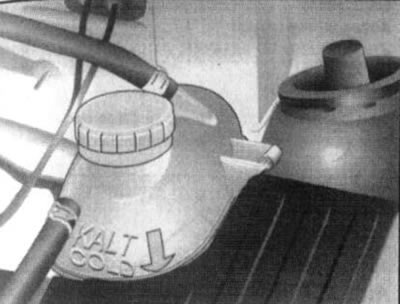


4.16. The coolant level is checked visually through the translucent walls of the expansion tank and…

4.16. The coolant level is checked visually through the translucent walls of the expansion tank and should not fall below the KALT/COLD mark


(Text copied from a web portal: Opelbook.ru)

Attention: To adjust the level, use only the required fluid composition - carefully study the Specifications for this Chapter! Please note that the color of the fluid should be light orange (with prolonged use it may change slightly and become yellow). Using antifreeze of various brands as a coolant (the liquid has a characteristic blue-green color - "sea wave") is unacceptable! Remember that frequent topping up of the cooling system with drinking/distilled water leads to gradual dilution of the antifreeze and loss of frost resistance and anticorrosive properties by the mixture.


17. With a closed cooling system, there is virtually no loss of fluid. A constant drop in the coolant level usually indicates the development of leaks in the system. Check the radiator, connecting hoses, drain plugs and water pump housing for signs of leaks. A low coolant level may be due to improper installation of the expansion tank cap. Significant loss of coolant and/or the presence of oil in it, as well as white smoke in the exhaust gases on a warm engine indicate damage to the cylinder head seal. If the leaks cannot be detected visually, it is recommended to conduct an inspection using special equipment at a service station.


18. If you need to remove the expansion tank cap, wait until the engine has completely cooled down, then wrap the neck with a thick layer of rags and slowly unscrew the cap to the first stop. If steam is released, let the engine cool down a little more, and only then completely remove the cap. Caution: Never remove the expansion tank cap when the engine is hot!

19. In addition to the level regularly, in accordance with the maintenance schedule (see Section 1), also check the condition of the coolant and its concentration (see Specifications for this Chapter). Even if the liquid does not undergo any changes externally, the corrosion inhibitors included in its composition are subject to development over time. The concentration of the liquid is checked using a hydrometer with a special scale (see accompanying illustration) - it can be purchased over the counter or checked at a service station. Before checking the density, warm up the engine during a short trip to the thermostat opening temperature (see Chapter 3), - the upper radiator hose of the engine cooling system should be heated. Compare the measurement results with the data Specifications, make appropriate adjustments if necessary.
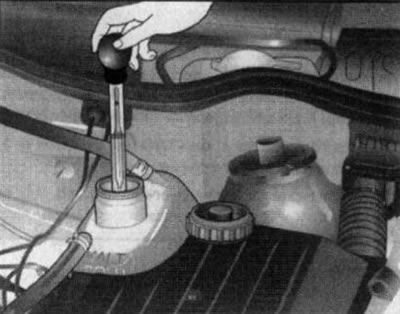
4.19. Checking the density of the coolant using a hydrometer

4.19. Checking the density of the coolant using a hydrometer


This article is available at russian, bulgarian, belarusian, ukrainian, serbian, croatian, romanian, polish, slovak, hungarian
Checking the article: Kornev Georgy

Share information:

Previous articles
Opel Corsa C: Maintenance
Next articles

Engine oil — check
Checking Fluid Levels — General Information
General information about settings and adjustments
General information about maintenance
Schedule of scheduled maintenance (TO)
Specifications for maintenance
Windshield and rear window/headlight washer fluid
Brake system and clutch drive fluid
Manual transmission oil — check
Automatic transmission fluid (ATF) — check
Wheels and tires — general information and designation
Wheels and tires — checking condition and pressure


See similar ones from other Opel car manuals:
▶ Engine starting system — check Opel Astra G (1998-2004, petrol)
▶ Engine coolant temperature indicator Opel Insignia A (2008-2017)
▶ Check coolant level — every 400 km Opel Omega A (1986-1993)
▶ Check Engine Light Opel Vectra B (1995-2002, petrol)
▶ Engine — technical condition check Opel Zafira A (1999-2005, petrol)
Link to this page in different formats

Visitor comments


No comments yet


How much will 34 + 39 =


Corsa C (2000-2006) 
  • General information
  • Introduction to guide
  • Troubleshooting
  • Vehicle device
  • User manual
  • Maintenance
  • Power unit
  • Engine repair
  • Cooling system
  • Power and exhaust system
  • Control system
  • Engine electrical equipment
  • Transmission
  • Clutch
  • Mechanical gearbox
  • Automatic gearbox
  • Drive shafts
  • Chassis
  • Brake system
  • Wheel suspension
  • Steering
  • Body
  • Exterior
  • Interior
  • Doors and windows
  • Heating and air conditioning
  • Electrical equipment
  • Equipment and devices
  • Lamps and lighting
  • Electrical circuits
Corsa C (2000-2006, petrol) 
  • User manual
  • Car access
  • Governing bodies
  • Seat control
  • Heating and air conditioning
  • Driving and maintenance
  • Engines 1.0 and 1.2 l
  • Engine repair
  • Cooling and lubrication system
  • Injection system
  • Engines 1.4, 1.6 and 1.8 l
  • Engine repair
  • Cooling and lubrication system
  • Injection system
  • Transmission
  • Clutch
  • Mechanical gearbox
  • Automatic gearbox
  • Drive shafts
  • Chassis
  • Wheels and tires
  • Wheel suspension
  • Steering
  • Brake system
  • Body
  • Exterior
  • Doors and windows
  • Electrical equipment
  • Equipment and devices
  • Lighting system
  • Electrical circuits
Corsa B (1993-2000) 
  • General information
  • Introduction to guide
  • User manual
  • Maintenance
  • Power unit
  • SOHC gasoline engines
  • DOHC gasoline engines
  • Diesel engines
  • Engine repair
  • Cooling system
  • Supply system
  • Injection system (gasoline)
  • Injection system (diesel)
  • Exhaust systems
  • Control system (gasoline)
  • Preheat system (diesel)
  • Charge and launch system
  • Transmission
  • Mechanical gearbox
  • Automatic gearbox
  • Clutch and drive shafts
  • Chassis
  • Brake system
  • Front suspension
  • Rear suspension
  • Steering
  • Body
  • Ventilation and heating
  • Exterior
  • Interior
  • Doors and windows
  • Electrical equipment
  • Equipment and devices
  • Lamps and lighting
  • Electrical circuits
OpelBook.ru © 2017–2026 · Mobile version · · Sitemap: EN BG BY UA RS HR RO PL SK HU · Feedback · Site search
Astra F, petrol · Astra G, petrol · Astra G · Astra H · Astra J, petrol · Corsa B · Corsa C, petrol · Corsa C · Insignia A · Kadett D · Kadett E · Omega A · Omega B · Omega B2 · Vectra A, petrol · Vectra A · Vectra B, petrol · Vectra B · Vectra C · Zafira A, petrol · Frontera A, petrol · Frontera B · Ascona C · Vivaro A ·
We want your visit to be comfortable 🤝! We use cookies 🍪 to make that happen.